Preparing for the AP* Calculus AB and BC Exams (Part 2 - Integral Calculus) (Coursera)

Preparing for the AP* Calculus AB and BC Exams (Part 2 - Integral Calculus) (Coursera)

This is a 6 week course covering the second part of AP Calculus curriculum which includes integration rules, techniques and applications. AP Calculus is a registered trademark of the College Board, which was not involved in the production of, and does not endorse, this product.

Class Deals by MOOC List - Click here and see Coursera's Active Discounts, Deals, and Promo Codes.

This course reviews the topics for the AP Calculus AB Exam.
The course is divided into two parts. Part 1 is Differential Calculus and incorporates mostly AB topics but does have some BC topics. Part 2 is Integral Calculus, and again is mostly AB material. The BC material that is not covered in either of these parts will be reviewed in an extension.
Each week of the six week review will include review videos for an important block of material, complete with videos of worked example problems and exam tips. There will also be extensive online quizzes given each week, with multiple problem versions that students can use to practice, along with practice tests to help students prepare for the AP Calculus AB Exam.
Note: This course is currently not available.

Related Courses

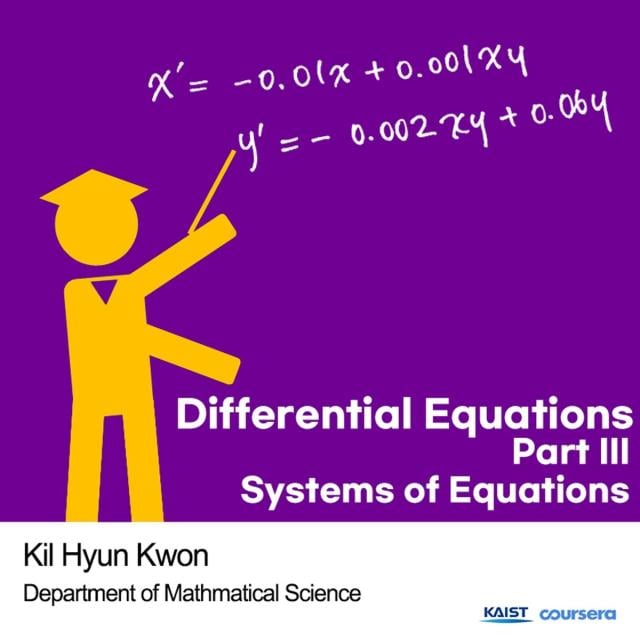
Differential Equations Part III Systems of Equations (Coursera) Coursera
Korea Advanced Institute of Science and Technology - KAIST

Differential Equations Part III Systems of Equations (Coursera)

This introductory courses on (Ordinary) Differential Equations are mainly for the people, who need differential equations mostly for the practical use in their own fields. So we try to provide basic terminologies, concepts, and methods of solving various types of differential equations as well as a rudimentary but indispensable knowledge of the underlying theory and some related applications.

Nov 2nd 2026
5-12 Weeks
Interest Rate Models (Coursera) Coursera
École Polytechnique Fédérale de Lausanne

Interest Rate Models (Coursera)

This course gives you an easy introduction to interest rates and related contracts. These include the LIBOR, bonds, forward rate agreements, swaps, interest rate futures, caps, floors, and swaptions. We will learn how to apply the basic tools duration and convexity for managing the interest rate risk of a bond portfolio. We will gain practice in estimating the term structure from market data. We will learn the basic facts from stochastic calculus that will enable you to engineer a large variety of stochastic interest rate models. In this context, we will also review the arbitrage pricing theorem that provides the foundation for pricing financial derivatives.

Oct 19th 2026
5-12 Weeks
Introduction to Mathematical Thinking (Coursera) Coursera
Stanford University

Introduction to Mathematical Thinking (Coursera)

Learn how to think the way mathematicians do - a powerful cognitive process developed over thousands of years. Mathematical thinking is not the same as doing mathematics – at least not as mathematics is typically presented in our school system. School math typically focuses on learning procedures to solve highly stereotyped problems. Professional mathematicians think a certain way to solve real problems, problems that can arise from the everyday world, or from science, or from within mathematics itself.

Nov 2nd 2026
5-12 Weeks
Fundamentals of Engineering Exam Review (Coursera) Coursera
Georgia Institute of Technology

Fundamentals of Engineering Exam Review (Coursera)

The purpose of this course is to review the material covered in the Fundamentals of Engineering (FE) exam to enable the student to pass it. It will be presented in modules corresponding to the FE topics, particularly those in Civil and Mechanical Engineering. Each module will review main concepts, illustrate them with examples, and provide extensive practice problems.

Nov 2nd 2026
5-12 Weeks
Introduction to Calculus (Coursera) Coursera
The University of Sydney

Introduction to Calculus (Coursera)

The focus and themes of the Introduction to Calculus course address the most important foundations for applications of mathematics in science, engineering and commerce. The course emphasises the key ideas and historical motivation for calculus, while at the same time striking a balance between theory and application, leading to a mastery of key threshold concepts in foundational mathematics.

Nov 2nd 2026
5-12 Weeks
English for Science, Technology, Engineering, and Mathematics (Coursera) Coursera
University of Pennsylvania

English for Science, Technology, Engineering, and Mathematics (Coursera)

Welcome to English for Science, Technology, Engineering, and Mathematics, a course created by the University of Pennsylvania, and funded by the U.S. Department of State Bureau of Educational and Cultural Affairs, Office of English Language Programs. This course is designed for non-native English speakers who are interested in improving their English skills in the sciences. In this course, you will explore some of the most innovative areas of scientific study, while expanding your vocabulary and the language skills needed to share scientific information within your community.

Oct 19th 2026
5-12 Weeks
Differential Equations Part II Series Solutions (Coursera) Coursera
Korea Advanced Institute of Science and Technology - KAIST

Differential Equations Part II Series Solutions (Coursera)

This introductory courses on (Ordinary) Differential Equations are mainly for the people, who need differential equations mostly for the practical use in their own fields. So we try to provide basic terminologies, concepts, and methods of solving various types of differential equations as well as a rudimentary but indispensable knowledge of the underlying theory and some related applications.

Oct 26th 2026
5-12 Weeks
Introduction à la théorie de Galois (Coursera) Coursera
École normale supérieure

Introduction à la théorie de Galois (Coursera)

Le cours expose la théorie de Galois, du classique critère de non-résolubilité des équations polynomiales aux méthodes plus avancées de calcul de groupes de Galois par réduction modulo un nombre premier. Le thème général de cette théorie est l'étude des racines d'un polynôme et concerne en particulier la possibilité de les exprimer à partir des coefficients de ce polynôme. Evariste Galois considère les symétries de ces racines et associe ainsi à ce polynôme un groupe de permutations de ses racines, que l'on appelle maintenant son groupe de Galois.

Oct 26th 2026
5-12 Weeks
Initiation à la théorie des distributions (Coursera) Coursera
École Polytechnique

Initiation à la théorie des distributions (Coursera)

Une fonction discontinue peut-elle être solution d'une équation différentielle? Comment définir rigoureusement la masse de Dirac (une "fonction" d'intégrale un, nulle partout sauf en un point) et ses dérivées? Peut-on définir une notion de "dérivée d'ordre fractionnaire"? Cette initiation aux distributions répond à ces questions - et à bien d'autres.

Nov 2nd 2026
5-12 Weeks
Image and video processing: From Mars to Hollywood with a stop at the hospital (Coursera) Coursera
Duke University

Image and video processing: From Mars to Hollywood with a stop at the hospital (Coursera)

In this course, you will learn the science behind how digital images and video are made, altered, stored, and used. We will look at the vast world of digital imaging, from how computers and digital cameras form images to how digital special effects are used in Hollywood movies to how the Mars Rover was able to send photographs across millions of miles of space.

Nov 2nd 2026
5-12 Weeks
Calculus: Single Variable Part 3 - Integration (Coursera) Coursera
University of Pennsylvania

Calculus: Single Variable Part 3 - Integration (Coursera)

Calculus is one of the grandest achievements of human thought, explaining everything from planetary orbits to the optimal size of a city to the periodicity of a heartbeat. This brisk course covers the core ideas of single-variable Calculus with emphases on conceptual understanding and applications. The course is ideal for students beginning in the engineering, physical, and social sciences.

Oct 26th 2026
4 Weeks