Differential Equations Part II Series Solutions (Coursera)

Differential Equations Part II Series Solutions (Coursera)

This introductory courses on (Ordinary) Differential Equations are mainly for the people, who need differential equations mostly for the practical use in their own fields. So we try to provide basic terminologies, concepts, and methods of solving various types of differential equations as well as a rudimentary but indispensable knowledge of the underlying theory and some related applications.

Class Deals by MOOC List - Click here and see Coursera's Active Discounts, Deals, and Promo Codes.

The prerequisites of the courses is one- or two- semester calculus course and some exposure to the elementary theory of matrices like determinants, Cramer’s Rule for solving linear systems of equations, eigenvalues and eigenvectors.

Syllabus

WEEK 1: Euler Equations
WEEK 2: Power Series
WEEK 3: Solutions about ordinary points
WEEK 4: Frobenius Theorem
WEEK 5: Finding a Second Solution
WEEK 6: Bessel Functions
WEEK 7: Legendre Polynomials


Go to Class
MOOC List is learner-supported. When you buy through links on our site, we may earn an affiliate commission.

Related Courses

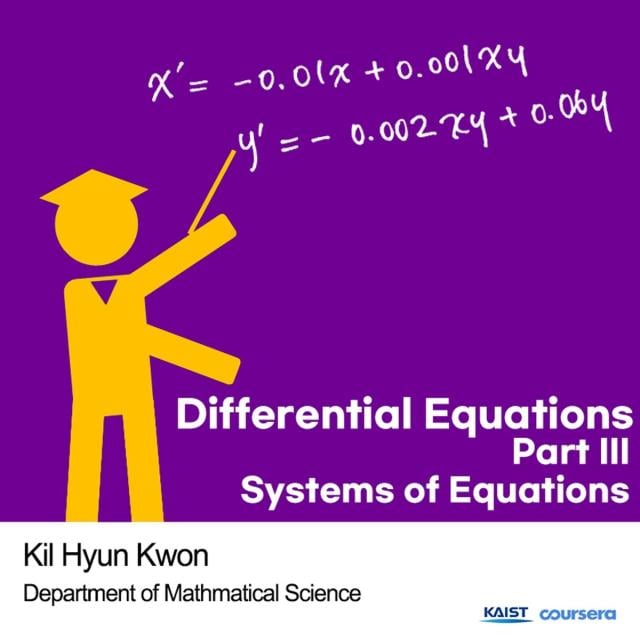
Differential Equations Part III Systems of Equations (Coursera) Coursera
Korea Advanced Institute of Science and Technology - KAIST

Differential Equations Part III Systems of Equations (Coursera)

This introductory courses on (Ordinary) Differential Equations are mainly for the people, who need differential equations mostly for the practical use in their own fields. So we try to provide basic terminologies, concepts, and methods of solving various types of differential equations as well as a rudimentary but indispensable knowledge of the underlying theory and some related applications.

Oct 5th 2026
5-12 Weeks
Jugar y Aprender Matemática en aulas heterogéneas (Coursera) Coursera
Universidad Austral

Jugar y Aprender Matemática en aulas heterogéneas (Coursera)

Cuando se asume la enseñanza de la matemática con el compromiso de la participación de todos los alumnos en una comunidad de producción, en la que se resuelven problemas con distintos procedimientos, se comparan producciones, se analiza la validez de las afirmaciones que se hacen, la tarea resulta todo un desafío. En el caso del plurigrado, el desafío parece aún mayor. ¿Cómo presentar problemas que involucren en este trabajo reflexivo a niños y niñas de distintas edades y con distintos conocimientos?

Sep 28th 2026
4 Weeks
Introduction à la théorie de Galois (Coursera) Coursera
École normale supérieure

Introduction à la théorie de Galois (Coursera)

Le cours expose la théorie de Galois, du classique critère de non-résolubilité des équations polynomiales aux méthodes plus avancées de calcul de groupes de Galois par réduction modulo un nombre premier. Le thème général de cette théorie est l'étude des racines d'un polynôme et concerne en particulier la possibilité de les exprimer à partir des coefficients de ce polynôme. Evariste Galois considère les symétries de ces racines et associe ainsi à ce polynôme un groupe de permutations de ses racines, que l'on appelle maintenant son groupe de Galois.

Sep 28th 2026
5-12 Weeks
Initiation à la théorie des distributions (Coursera) Coursera
École Polytechnique

Initiation à la théorie des distributions (Coursera)

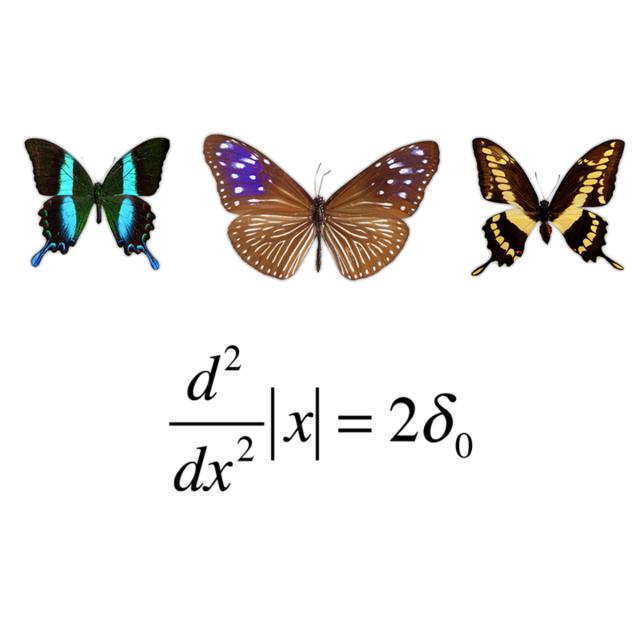
Une fonction discontinue peut-elle être solution d'une équation différentielle? Comment définir rigoureusement la masse de Dirac (une "fonction" d'intégrale un, nulle partout sauf en un point) et ses dérivées? Peut-on définir une notion de "dérivée d'ordre fractionnaire"? Cette initiation aux distributions répond à ces questions - et à bien d'autres.

Oct 5th 2026
5-12 Weeks
English for Science, Technology, Engineering, and Mathematics (Coursera) Coursera
University of Pennsylvania

English for Science, Technology, Engineering, and Mathematics (Coursera)

Welcome to English for Science, Technology, Engineering, and Mathematics, a course created by the University of Pennsylvania, and funded by the U.S. Department of State Bureau of Educational and Cultural Affairs, Office of English Language Programs. This course is designed for non-native English speakers who are interested in improving their English skills in the sciences. In this course, you will explore some of the most innovative areas of scientific study, while expanding your vocabulary and the language skills needed to share scientific information within your community.

Sep 21st 2026
5-12 Weeks
Fibonacci Numbers and the Golden Ratio (Coursera) Coursera
The Hong Kong University of Science and Technology - HKUST

Fibonacci Numbers and the Golden Ratio (Coursera)

Learn the mathematics behind the Fibonacci numbers, the golden ratio, and how they are related. These topics are not usually taught in a typical math curriculum, yet contain many fascinating results that are still accessible to an advanced high school student. The course culminates in an explanation of why the Fibonacci numbers appear unexpectedly in nature, such as the number of spirals in the head of a sunflower.

Sep 28th 2026
3 Weeks
Mathematics for Machine Learning: Linear Algebra (Coursera) Coursera
Imperial College London

Mathematics for Machine Learning: Linear Algebra (Coursera)

In this course on Linear Algebra we look at what linear algebra is and how it relates to vectors and matrices. Then we look through what vectors and matrices are and how to work with them, including the knotty problem of eigenvalues and eigenvectors, and how to use these to solve problems. Finally we look at how to use these to do fun things with datasets - like how to rotate images of faces and how to extract eigenvectors to look at how the Pagerank algorithm works.

Sep 21st 2026
5-12 Weeks
Calculus: Single Variable Part 3 - Integration (Coursera) Coursera
University of Pennsylvania

Calculus: Single Variable Part 3 - Integration (Coursera)

Calculus is one of the grandest achievements of human thought, explaining everything from planetary orbits to the optimal size of a city to the periodicity of a heartbeat. This brisk course covers the core ideas of single-variable Calculus with emphases on conceptual understanding and applications. The course is ideal for students beginning in the engineering, physical, and social sciences.

Sep 28th 2026
4 Weeks