KI und Datenqualität - Perspektiven aus Data Science, Ethik, Normung und Recht (openHPI)

KI und Datenqualität - Perspektiven aus Data Science, Ethik, Normung und Recht (openHPI)

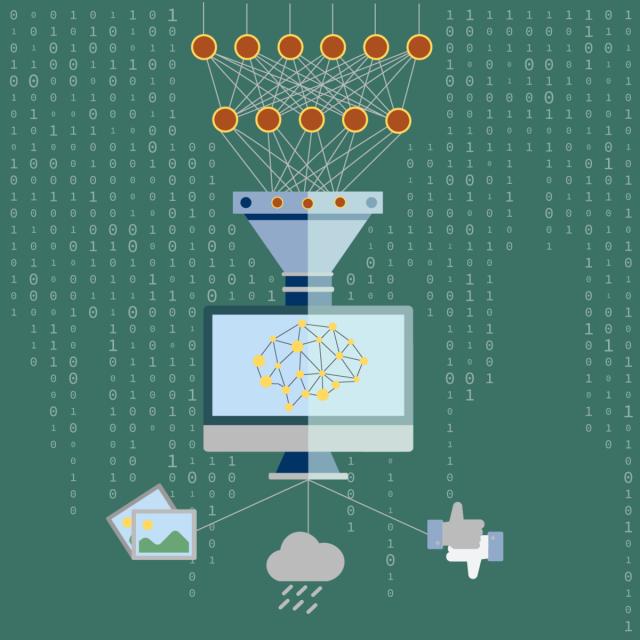
Ohne Daten gibt es keine Künstliche Intelligenz. Maschinelles Lernen benutzt große Datenmengen, um KI-Modelle zu trainieren. Eine der größten Herausforderungen beim Einsatz von gesellschaftlich verträglicher KI ist die Bereitstellung ausreichender, besonders aber qualitativ hochwertiger Trainingsdaten. In dem Kurs “KI und Datenqualität” berichten Expertinnen und Experten aus den Bereichen Informatik, Recht, Ethik und Normung über diese vielfältigen Aspekte der Daten für die Künstliche Intelligenz.

Künstliche Intelligenz beruht auf Verfahren des maschinellen Lernens, die mit großen Datenmengen trainiert werden. Viele der KI-Methoden, die seit Ende der 1950er Jahre erforscht werden, basieren vor allem auf manuell entwickelten Modellen und Regeln. Neuronale Netze jedoch, die seit 2006/07 technisch und seit 2011/12 auch in der breiten Anwendung zum jüngsten Durchbruch von KI und maschinellem Lernen geführt haben, sind auf große Mengen passender Trainingsdaten zwingend angewiesen. Auch die Bundesregierung betont in ihrer nationalen Strategie für Künstliche Intelligenz die große Bedeutung von Trainingsdaten.
Wie kommt man an gute, also qualitativ hochwertige Trainingsdaten? Das ist die große Frage, die wir uns stellen müssen, wenn wir gesellschaftlich verträgliche KI entwickeln wollen.
Dabei ist “Qualität” in einem weiten Sinn zu verstehen und umfasst sowohl informatische als auch juristische, ethische, normungstechnische und regulatorische Aspekte. Ziele wie “Diskriminierungsfreiheit”, „Diversität“ oder “Arbeitnehmerdatenschutz”, die für KI-Anwendungen angestrebt werden, wirken auch auf die Daten und Prozesse zurück, mit denen KI-Systeme zuvor trainiert wurden. Umgekehrt führen unvollständige, fehlerbehaftete, unpassende oder asymmetrische Trainingsdaten zu unsicheren Modellen und können so letztlich zu Fehlentscheidungen führen. Auch die rechtlichen Vorgaben für KI-Test-, Validierungs- und Trainingsdaten sowie deren Umsetzung in Normen und Standards sind noch weitgehend ungeklärt und damit Gegenstand von Wissenschaft und Forschung. In unserem Kurs “KI und Datenqualität” berichten Expertinnen und Experten aus den Bereichen Informatik, Recht, Ethik und Normung über diese vielfältigen Aspekte der Daten für die Künstliche Intelligenz. Die Dozenten dieses Kurses forschen gemeinsam im Rahmen des KITQAR Projekts an dem Thema KI und Datenqualität.
Der Kurs richtet sich an die interessierte Öffentlichkeit, sowie an Praktiker und Praktikerinnen, die bei der Entwicklung und beim Einsatz von KI-Systemen nicht nur hohe Ergebnisqualität erzielen wollen, sondern auch Wert auf ethische und rechtliche Aspekte legen. Zur Teilnahme bestehen keine besonderen technischen Voraussetzungen – die relevanten KI-Grundlagen werden einführend erläutert.
Kursdauer: 2 Wochen + Prüfung
Zeitaufwand: 3 - 5 Stunden pro Kurswoche


Go to Class
MOOC List is learner-supported. When you buy through links on our site, we may earn an affiliate commission.

Related Courses

Data Science Bootcamp (openHPI) OpenHPI
Hasso-Plattner-Institut

Data Science Bootcamp (openHPI)

The ultimate goal of the bootcamp is to cultivate strong data science skills with an emphasis on machine learning techniques to satisfactorily meet and exceed the requests of the Data science world. In the process, we will develop good habits for operating independently as data scientists and for operating as members of productive data science teams.

Jun 7th 2023
4 Weeks
An Introduction to Probabilistic Machine Learning (openHPI) OpenHPI
Hasso-Plattner-Institut

An Introduction to Probabilistic Machine Learning (openHPI)

Probabilistic machine learning has gained a lot of practical relevance over the past 15 years as it is highly data-efficient, allows practitioners to easily incorporate domain expertise and, due to the recent advances in efficient approximate inference, is highly scalable. Moreover, it has close relations to causal inference which is one of the key methods for measuring cause-effect relationship of machine learning models and explainable artificial intelligence. This openHPI course will introduce all recent developments in probabilistic modeling and inference. It will cover both the theoretical as well as practical and computational aspects of probabilistic machine learning.

Jun 14th 2023
2 Weeks
Advanced Linear Models for Data Science 1: Least Squares (Coursera) Coursera
Johns Hopkins University

Advanced Linear Models for Data Science 1: Least Squares (Coursera)

Welcome to the Advanced Linear Models for Data Science Class 1: Least Squares. This class is an introduction to least squares from a linear algebraic and mathematical perspective. Before beginning the class make sure that you have the following: a basic understanding of linear algebra and multivariate calculus; a basic understanding of statistics and regression models; at least a little familiarity with proof based mathematics; basic knowledge of the R programming language.

Oct 19th 2026
5-12 Weeks
Developing AI Applications on Azure (Coursera) Coursera
LearnQuest

Developing AI Applications on Azure (Coursera)

This course introduces the concepts of Artificial Intelligence and Machine learning. We'll discuss machine learning types and tasks, and machine learning algorithms. You'll explore Python as a popular programming language for machine learning solutions, including using some scientific ecosystem packages which will help you implement machine learning.

Oct 19th 2026
5-12 Weeks
Exam Prep AI-102: Microsoft Azure AI Engineer Associate (Coursera) Coursera
Whizlabs

Exam Prep AI-102: Microsoft Azure AI Engineer Associate (Coursera)

The AI-102: Designing and Implementing a Microsoft Azure AI Solution certification exam tests the candidate’s experience and knowledge of the AI solutions that make the most of Azure Cognitive Services and Azure services. In addition, the exam also tests the candidate's ability to implement this knowledge by participating in all phases of AI solutions development—from defining requirements, and design to development, deployment, integration, maintenance, performance tuning, and monitoring.

Oct 19th 2026
5-12 Weeks
Introduction to Machine Learning (Coursera) Coursera
Duke University

Introduction to Machine Learning (Coursera)

This course will provide you a foundational understanding of machine learning models (logistic regression, multilayer perceptrons, convolutional neural networks, natural language processing, etc.) as well as demonstrate how these models can solve complex problems in a variety of industries, from medical diagnostics to image recognition to text prediction.

Oct 19th 2026
5-12 Weeks
Preparing for the Google Cloud Professional Data Engineer Exam (Coursera) Coursera
Google Cloud

Preparing for the Google Cloud Professional Data Engineer Exam (Coursera)

From the course: "The best way to prepare for the exam is to be competent in the skills required of the job." This course uses a top-down approach to recognize knowledge and skills already known, and to surface information and skill areas for additional preparation. You can use this course to help create your own custom preparation plan. It helps you distinguish what you know from what you don't know. And it helps you develop and practice skills required of practitioners who perform this job.

Oct 19th 2026
5-12 Weeks
A Step-by-Step Introduction to Process Mining (openHPI) OpenHPI
Hasso-Plattner-Institut

A Step-by-Step Introduction to Process Mining (openHPI)

Process mining is widely used in organizations to improve the understanding of business processes, based on data. Therefore, process mining is also called “data science for business processes”. While process mining has gone mainstream, there are many underlying concepts and techniques, and these are complex. The goal of this online course is to provide a general understanding of the concepts and techniques behind process mining. The course will be most valuable for domain experts, whose business processes are investigated, and for professionals in IT and in business consulting. We aim at providing a common understanding and a common language that facilitates communication between all stakeholders involved in process mining projects.

May 5th 2021
2 Weeks
Deep Learning for Business (Coursera) Coursera
Yonsei University

Deep Learning for Business (Coursera)

Your smartphone, smartwatch, and automobile (if it is a newer model) have AI (Artificial Intelligence) inside serving you every day. In the near future, more advanced “self-learning” capable DL (Deep Learning) and ML (Machine Learning) technology will be used in almost every aspect of your business and industry. So now is the right time to learn what DL and ML is and how to use it in advantage of your company. This course has three parts, where the first part focuses on DL and ML technology based future business strategy including details on new state-of-the-art products/services and open source DL software, which are the future enablers.

Oct 19th 2026
5-12 Weeks
Introduction to Digital Transformation (Coursera) Coursera
Siemens

Introduction to Digital Transformation (Coursera)

This course is primarily for professionals, college students, and advanced high school students who are interested in driving the digital transformation by integrating automation, software, and cutting-edge technologies. This course represents a foundational introduction to Digital Transformation, appropriate for learners with a basic familiarity with common business terms and concepts and an interest in digital technology.

Oct 19th 2026
5-12 Weeks
Data Science Ethics (Coursera) Coursera
University of Michigan

Data Science Ethics (Coursera)

What are the ethical considerations regarding the privacy and control of consumer information and big data, especially in the aftermath of recent large-scale data breaches? This course provides a framework to analyze these concerns as you examine the ethical and privacy implications of collecting and managing big data. Explore the broader impact of the data science field on modern society and the principles of fairness, accountability and transparency as you gain a deeper understanding of the importance of a shared set of ethical values.

Oct 19th 2026
4 Weeks