Introduction to Number Theory (Coursera)

Introduction to Number Theory (Coursera)

Introduction to Number Theory is an introductory course designed for a wide audience that gives a general idea of some basic concepts and statements in the field. These include divisibility, primes, Euclidean algorithm, and linear representation of the greatest common divisor. These concepts will help you to dive more deeply into the further subject.

Class Deals by MOOC List - Click here and see Coursera's Active Discounts, Deals, and Promo Codes.

Syllabus

WEEK 1
Euclidean Algorithm, Linear Representation of GCD
In this lecture, you will be introduced to the basic concepts and statements required to study number theory. These include divisibility, primes, Euclidean algorithm, linear representation of the greatest common divisor. We advise you to pay attention to all new concepts, because they will meet frequently in the future.

WEEK 2
Unique Factorization in Euclidean Rings
In this lecture, you will learn the most important property of Euclidean rings — uniqueness of prime factorization — and also learn how to apply it in practice to solve problems related to divisibility. As a beautiful application, the Fermat's Two Squares Theorem will be proved.

WEEK 3
Euler's Function and it's Properties
In this lecture, you will be introduced to the very useful Euler's function, as well as some other arithmetic functions. We believe that you will find the Mobius Inversion Formula quite interesting. However pay special attention to the properties of the Euler's function including the "amusing property" as they will be used in one of the later lectures.

WEEK 4
Modular Arithmetic Theorems
In this lecture, we will study tools for exploring situations in which there is no divisibility. You will learn what modular congruence is, as well as the basic theorems of modular arithmetic: Fermat's Little Theorem, Euler's Theorem, Wilson's Theorem.

WEEK 5
Primitive Roots and Quadratic Remainders
In the first half of this lecture, you will be introduced to a powerful tool for solving problems modulo prime numbers: the primitive root. In the second half of the lecture, we will consider the theory of quadratic remainders which are needed to solve quadratic modular equations.

WEEK 6
Continuants and Continued Fractions
This lecture is the first of two dedicated to continued fractions. You will get acquainted with continued fractions and learn how to decompose real numbers into continued fractions, as well as find the values of continued fractions. In addition, with the help of special polynomials in several variables (so called "continuants"), some of the properties of continued fractions will be proved, and these properties will be needed for rational approximations in the next lecture.

WEEK 7
Convergence of Continued Fractions, Diophantine Approximations
This lecture is the second of two dedicated to continued fractions. You will find out why each continued fraction corresponds to a specific real number. In addition, you will learn how to find the best rational approximation of an irrational number based on the properties of continued fractions which will explain Archimedes' approximation for PI and the size of A4 paper.

WEEK 8
Blichfeldt's Lemma, Minkowski's Lemma
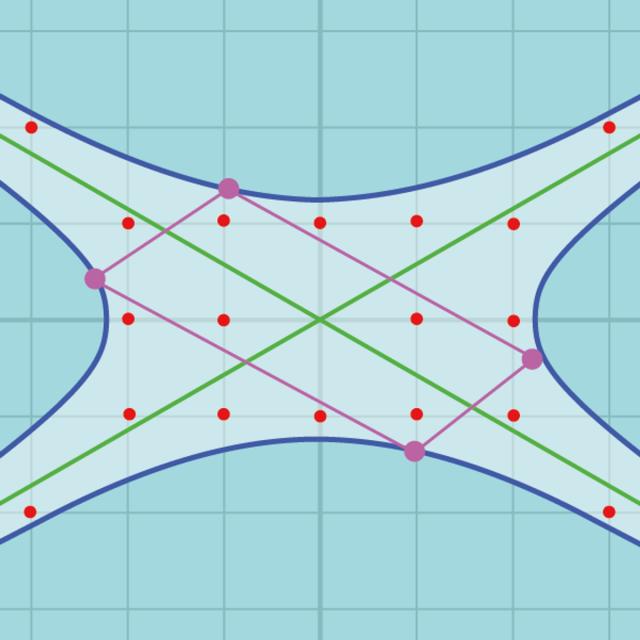
This lecture has a combinatorial flavor just like the next one. You will learn useful theorems concerning figures on an integer lattice (i.e., a coordinate plane with an integer grid), and also learn how to apply these theorems and ideas in practice. We believe that you will love the artful proof of Fermat's Two Squares Theorem based on Minkowski's Lemma. Nevertheless, pay special attention to Minkowski's theorem: we will use it once again in the last lecture.

WEEK 9
Kronecker's Theorem, Weyl's Theorem
This lecture has a combinatorial flavor just like the previous one. You will study the properties of the fractional parts of numbers of the form nα‎, where n is an arbitrary positive integer and α‎ is a fixed irrational number. Using the Kronecker's and Weyl's theorems, you will learn to find answers to unusual questions, for example, how often does the power of a positive integer begin with a given combination of digits, or what are the bounds of sets of values of trigonometric functions of integers.

WEEK 10
Linear Diophantine Equations, Chinese Remainders Theorem
This lecture initiates a set of three lectures dedicated to Diophantine equations (this means equations that need to be solved in integers). In the first part of the lecture, you will learn how to solve linear equations in integers, as well as separately in non-negative integers (Sylvester's theorem). In the second part of the lecture, you will get acquainted with an important tool for simultaneous exploration of remainders modulo several different integers — the Chinese Remainder Theorem.

WEEK 11
Nonlinear Diophantine Equations
In this lecture, you will learn various techniques that are useful for solving arbitrary equations in integers: the remainder method, the decomposition method, and the descent method. In addition, you will get acquainted with Pythagorean triples (the lengths of the sides of integer right-angled triangles), the notion of perfect numbers, Fermat's primes and Catalan's conjecture.

WEEK 12
Quadratic Irrationalities and Pell's Equations
In this lecture, you will study the tools for working with quadratic irrationalities and consequently learn how to find all solutions of one of the brightest Diophantine equations — the Pell's equation. In the end of the lecture you will find an artful proof of existence of non-trivial solutions.
Go to Class
MOOC List is learner-supported. When you buy through links on our site, we may earn an affiliate commission.

Related Courses

Differential Equations Part II Series Solutions (Coursera) Coursera
Korea Advanced Institute of Science and Technology - KAIST

Differential Equations Part II Series Solutions (Coursera)

This introductory courses on (Ordinary) Differential Equations are mainly for the people, who need differential equations mostly for the practical use in their own fields. So we try to provide basic terminologies, concepts, and methods of solving various types of differential equations as well as a rudimentary but indispensable knowledge of the underlying theory and some related applications.

Jun 8th 2026
5-12 Weeks
Calculus through Data & Modelling: Integration Applications (Coursera) Coursera
Johns Hopkins University

Calculus through Data & Modelling: Integration Applications (Coursera)

This course continues your study of calculus by focusing on the applications of integration. The applications in this section have many common features. First, each is an example of a quantity that is computed by evaluating a definite integral. Second, the formula for that application is derived from Riemann sums. Rather than measure rates of change as we did with differential calculus, the definite integral allows us to measure the accumulation of a quantity over some interval of input values.

Jun 8th 2026
4 Weeks
Essential Linear Algebra for Data Science (Coursera) Coursera
University of Colorado Boulder

Essential Linear Algebra for Data Science (Coursera)

Are you interested in Data Science but lack the math background for it? Has math always been a tough subject that you tend to avoid? This course will teach you the most fundamental Linear Algebra that you will need for a career in Data Science without a ton of unnecessary proofs and concepts that you may never use. Consider this an expressway to Data Science with approachable methods and friendly concepts that will guide you to truly understanding the most important ideas in Linear Algebra.

Jun 8th 2026
5-12 Weeks
Data Science as a Field (Coursera) Coursera
University of Colorado Boulder

Data Science as a Field (Coursera)

This course provides a general introduction to the field of Data Science. It has been designed for aspiring data scientists, content experts who work with data scientists, or anyone interested in learning about what Data Science is and what it’s used for. Weekly topics include an overview of the skills needed to be a data scientist; the process and pitfalls involved in data science; and the practice of data science in the professional and academic world. This course is part of CU Boulder’s Master’s of Science in Data Science and was collaboratively designed by both academics and industry professionals to provide learners with an insider’s perspective on this exciting, evolving, and increasingly vital discipline.

Jun 8th 2026
4 Weeks
Calculus: Single Variable Part 2 - Differentiation (Coursera) Coursera
University of Pennsylvania

Calculus: Single Variable Part 2 - Differentiation (Coursera)

Calculus is one of the grandest achievements of human thought, explaining everything from planetary orbits to the optimal size of a city to the periodicity of a heartbeat. This brisk course covers the core ideas of single-variable Calculus with emphases on conceptual understanding and applications. The course is ideal for students beginning in the engineering, physical, and social sciences.

Jun 8th 2026
3 Weeks
Introduction to Linear Algebra (Coursera) Coursera
The University of Sydney

Introduction to Linear Algebra (Coursera)

Linear algebra and calculus are the two most important foundational pillars on which modern mathematics is built. They are studied by almost all mathematics students at university, though typically labelled as different subjects and taught in parallel. Over time, students discover that linear algebra and calculus are inseparable (but not identical) twins that interlock to form the backbone of almost all applications of mathematics to physical and biological sciences, engineering and computer science. It is recommended that participants in the MOOC Introduction to Linear Algebra have already taken, or take in parallel, the MOOC Introduction to Calculus.

Jun 8th 2026
4 Weeks
Differential Equations for Engineers (Coursera) Coursera
The Hong Kong University of Science and Technology - HKUST

Differential Equations for Engineers (Coursera)

This course is about differential equations and covers material that all engineers should know. Both basic theory and applications are taught. In the first five weeks we will learn about ordinary differential equations, and in the final week, partial differential equations. The course is composed of 56 short lecture videos, with a few simple problems to solve following each lecture. And after each substantial topic, there is a short practice quiz. Solutions to the problems and practice quizzes can be found in instructor-provided lecture notes. There are a total of six weeks in the course, and at the end of each week there is an assessed quiz.

Jun 8th 2026
5-12 Weeks
Number Theory and Cryptography (Coursera) Coursera
University of California, San Diego,Higher School of Economics - HSE University

Number Theory and Cryptography (Coursera)

We all learn numbers from the childhood. Some of us like to count, others hate it, but any person uses numbers everyday to buy things, pay for services, estimated time and necessary resources. People have been wondering about numbers’ properties for thousands of years. And for thousands of years it was more or less just a game that was only interesting for pure mathematicians. Famous 20th century mathematician G.H. Hardy once said “The Theory of Numbers has always been regarded as one of the most obviously useless branches of Pure Mathematics”. Just 30 years after his death, an algorithm for encryption of secret messages was developed using achievements of number theory. It was called RSA after the names of its authors, and its implementation is probably the most frequently used computer program in the word nowadays.

Jun 8th 2026
4 Weeks
Calculus: Single Variable Part 4 - Applications (Coursera) Coursera
University of Pennsylvania

Calculus: Single Variable Part 4 - Applications (Coursera)

Calculus is one of the grandest achievements of human thought, explaining everything from planetary orbits to the optimal size of a city to the periodicity of a heartbeat. This brisk course covers the core ideas of single-variable Calculus with emphases on conceptual understanding and applications. The course is ideal for students beginning in the engineering, physical, and social sciences.

Jun 8th 2026
5-12 Weeks
Linear Regression and Modeling (Coursera) Coursera
Duke University

Linear Regression and Modeling (Coursera)

This course introduces simple and multiple linear regression models. These models allow you to assess the relationship between variables in a data set and a continuous response variable. Is there a relationship between the physical attractiveness of a professor and their student evaluation scores? Can we predict the test score for a child based on certain characteristics of his or her mother? In this course, you will learn the fundamental theory behind linear regression and, through data examples, learn to fit, examine, and utilize regression models to examine relationships between multiple variables, using the free statistical software R and RStudio.

Jun 8th 2026
4 Weeks