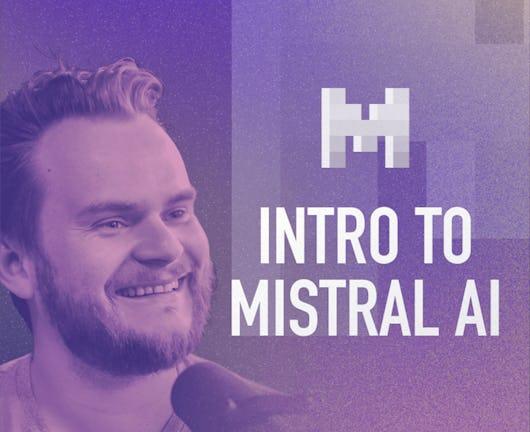
Intro to Mistral AI (Coursera)

Offered by Scrimba,
Intro to Mistral AI (Coursera)

This course teaches you how to interact with Mistral's AI models with JavaScript. This enables you to build intelligent apps, all the way from simple chat completions to advanced use-cases like RAG and function calling.

Class Deals by MOOC List - Click here and see Coursera's Active Discounts, Deals, and Promo Codes.

The code is written using Mistral's JavaScript SDK, but the concepts covered are language-agnostic, making this course just as relevant for Python developers as it is JavaScript developers.
Created in collaboration between Mistral AI and Scrimba.

What you'll learn

  • How to create AI Agents with function calling
  • Learn to use Mistral's "Le Plateforme" to build AI apps
  • How to implement Retrieval-Augmented Generation (RAG)

Syllabus

Intro to Mistral AI
Learn how to use the Mistral AI to build intelligent apps, all the way from simple chat completions to advanced use-cases like RAG and function calling.

Go to Class
MOOC List is learner-supported. When you buy through links on our site, we may earn an affiliate commission.
Related Courses

Algorithmic Toolbox (Coursera) Coursera
University of California, San Diego,Higher School of Economics - HSE University

Algorithmic Toolbox (Coursera)

The course covers basic algorithmic techniques and ideas for computational problems arising frequently in practical applications: sorting and searching, divide and conquer, greedy algorithms, dynamic programming. We will learn a lot of theory: how to sort data and how it helps for searching; how to break a large problem into pieces and solve them recursively; when it makes sense to proceed greedily; how dynamic programming is used in genomic studies. You will practice solving computational problems, designing new algorithms, and implementing solutions efficiently (so that they run in less than a second).

Jun 1st 2026
5-12 Weeks
LangChain: Chat with Your Data (DeepLearning.AI) Other Providers
DeepLearning.AI

LangChain: Chat with Your Data (DeepLearning.AI)

Create a chatbot to interface with your private data and documents using LangChain. Join our new short course, LangChain: Chat With Your Data! The course delves into two main topics: (1) Retrieval Augmented Generation (RAG), a common LLM application that retrieves contextual documents from an external dataset, and (2) a guide to building a chatbot that responds to queries based on the content of your documents, rather than the information it has learned in training.

Self Paced
Self-Paced
Preprocessing Unstructured Data for LLM Applications (Coursera) Coursera
DeepLearning.AI

Preprocessing Unstructured Data for LLM Applications (Coursera)

Enhancing a RAG system’s performance depends on efficiently processing diverse unstructured data sources. In this course, you’ll learn techniques for representing all sorts of unstructured data, like text, images, and tables, from many different sources and implement them to extend your LLM RAG pipeline to include Excel, Word, PowerPoint, PDF, and EPUB files.

May 25th 2026
1 Week
A Beginner's Guide to Open Source Software Development (Linux Foundation) The Linux Foundation
Linux Foundation

A Beginner's Guide to Open Source Software Development (Linux Foundation)

Learn the key concepts in developing open source software. This course introduces developers to the key concepts in developing open source software. It covers the who (successful projects and communities), what (definition), why (benefits), where (Git) and how (licensing, compliance, collaboration tips, managing diversity and continuous development & integration).

Self Paced
Self-Paced
Cloud Computing Concepts: Part 2 (Coursera) Coursera
University of Illinois at Urbana-Champaign

Cloud Computing Concepts: Part 2 (Coursera)

Cloud computing systems today, whether open-source or used inside companies, are built using a common set of core techniques, algorithms, and design philosophies—all centered around distributed systems. Learn about such fundamental distributed computing "concepts" for cloud computing. Some of these concepts include: Clouds, MapReduce, key-value stores, Classical precursors, Widely-used algorithms, Classical algorithms, Scalability, Trending areas, And more!

Jun 1st 2026
5-12 Weeks
Open Source Programming - Master's (Coursera) Coursera
Illinois Tech

Open Source Programming - Master's (Coursera)

Contemporary open-source programming languages and frameworks are presented in this course. Students will consider design and development topics in system, graphical user interface, network, and web programming. Dynamic scripting languages are covered using object-oriented, concurrent, and functional programming paradigms. Concepts gained throughout the course are reinforced with numerous exercises which will culminate in an open-source programming project.

May 11th 2026
5-12 Weeks
Object Oriented Programming in Java (Coursera) Coursera
University of California, San Diego

Object Oriented Programming in Java (Coursera)

Welcome to our course on Object Oriented Programming in Java using data visualization. People come to this course with many different goals -- and we are really excited to work with all of you! Some of you want to be professional software developers, others want to improve your programming skills to implement that cool personal project that you’ve been thinking about, while others of you might not yet know why you’re here and are trying to figure out what this course is all about.

Jun 1st 2026
5-12 Weeks
Introduction to Open Source Application Development (Coursera) Coursera
Illinois Tech

Introduction to Open Source Application Development (Coursera)

This course introduces basic concepts of systems programming using a modern open source language. You will learn to apply basic programming concepts toward solving problems, writing pseudocode, working with and effectively using basic data types, abstract data types, control structures, code modularization and arrays. You will learn to detect errors, work with variables and loops, and discover how functions, methods, and operators work with different data types. You will also be introduced to the object paradigm including classes, inheritance, and polymorphism.

May 25th 2026
5-12 Weeks