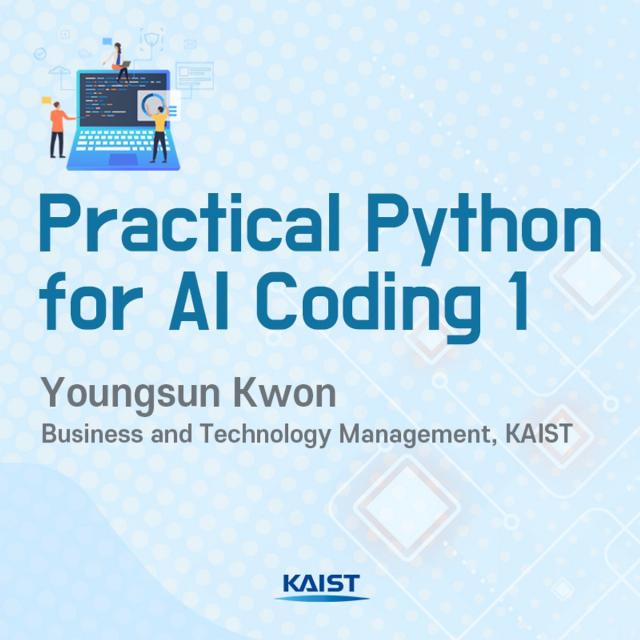
Practical Python for AI Coding 1 (Coursera)

Practical Python for AI Coding 1 (Coursera)

This course is for a complete novice of Python coding, so no prior knowledge or experience in software coding is required. This course selects, introduces and explains Python syntaxes, functions and libraries that were frequently used in AI coding. In addition, this course introduces vital syntaxes, and functions often used in AI coding and explains the complementary relationship among NumPy, Pandas and TensorFlow, so this course is helpful for even seasoned python users.

Class Deals by MOOC List - Click here and see Coursera's Active Discounts, Deals, and Promo Codes.

This course starts with building an AI coding environment without failures on learners’ desktop or notebook computers to enable them to start AI modeling and coding with Scikit-learn, TensorFlow and Keras upon completing this course. Because learners have an AI coding environment on their computers after taking this course, they can start AI coding and do not need to join or use the cloud-based services.

Syllabus

WEEK 1: Preparation for coding : Setting up AI coding environment
WEEK 2: Basic concepts and rules of Python coding
WEEK 3: Primitive data types
WEEK 4: Control statements and iteration
WEEK 5: Creating functions
WEEK 6: Non-primitive data types: Lists and tuples
WEEK 7: Non-primitive data types: Dictionaries and sets


Go to Class
MOOC List is learner-supported. When you buy through links on our site, we may earn an affiliate commission.

Related Courses

Getting Started with Machine Learning at the Edge on Arm (Coursera) Coursera
Arm

Getting Started with Machine Learning at the Edge on Arm (Coursera)

The age of machine learning has arrived! Arm technology is powering a new generation of connected devices with sophisticated sensors that can collect a vast range of environmental, spatial and audio/visual data. Typically this data is processed in the cloud using advanced machine learning tools that are enabling new applications reshaping the way we work, travel, live and play.

Sep 28th 2026
5-12 Weeks
Machine Learning for Accounting with Python (Coursera) Coursera
University of Illinois at Urbana-Champaign

Machine Learning for Accounting with Python (Coursera)

This course, Machine Learning for Accounting with Python, introduces machine learning algorithms (models) and their applications in accounting problems. It covers classification, regression, clustering, text analysis, time series analysis. It also discusses model evaluation and model optimization. This course provides an entry point for students to be able to apply proper machine learning models on business related datasets with Python to solve various problems.

Sep 21st 2026
5-12 Weeks
Getting Started with CyberGIS (Coursera) Coursera
University of Illinois at Urbana-Champaign

Getting Started with CyberGIS (Coursera)

This course is intended to introduce students to CyberGIS—Geospatial Information Science and Systems (GIS)—based on advanced cyberinfrastructure as well as the state of the art in high-performance computing, big data, and cloud computing in the context of geospatial data science. Emphasis is placed on learning the cutting-edge advances of cyberGIS and its underlying geospatial data science principles.

Sep 28th 2026
4 Weeks
Problem Solving, Python Programming, and Video Games (Coursera) Coursera
University of Alberta

Problem Solving, Python Programming, and Video Games (Coursera)

This course is an introduction to computer science and programming in Python. Important computer science concepts such as problem solving (computational thinking), problem decomposition, algorithms, abstraction, and software quality are emphasized throughout. The Python programming language and video games are used to demonstrate computer science concepts in a concrete and fun manner. However, a learner can take the knowledge and skills from this course and apply them to non-game problems, other programming languages, and other computer science courses.

Sep 21st 2026
5-12 Weeks
Programação para todos (Conceitos básicos de Python) (Coursera) Coursera
University of Michigan

Programação para todos (Conceitos básicos de Python) (Coursera)

Este curso tem como objetivo ensinar a todos os conceitos básicos de programação de computadores usando Python. Abordamos o básico de como criar um programa a partir de uma série de instruções simples em Python. O curso não tem pré-requisitos e evita tudo, exceto a matemática mais simples. Qualquer pessoa com experiência moderada em computadores deve ser capaz de dominar os materiais deste curso. Este curso abordará os capítulos 1 ao 5 do livro “Python para Todos”.

Sep 21st 2026
5-12 Weeks
Programación en Python (Coursera) Coursera
Universidad de los Andes

Programación en Python (Coursera)

¡Te damos la bienvenida al curso de Programación en Python de la Universidad de los Andes! El propósito de este curso es ofrecerte un ambiente interactivo para que desarrolles tus habilidades de pensamiento computacional, aprendas a programar en el lenguaje Python y te entrenes en la resolución de problemas utilizando un computador. La estrategia pedagógica empleada es el aprendizaje activo basado en casos.

Sep 28th 2026
4 Weeks
Machine Learning: Concepts and Applications (Coursera) Coursera
University of Chicago

Machine Learning: Concepts and Applications (Coursera)

This course gives you a comprehensive introduction to both the theory and practice of machine learning. You will learn to use Python along with industry-standard libraries and tools, including Pandas, Scikit-learn, and Tensorflow, to ingest, explore, and prepare data for modeling and then train and evaluate models using a wide variety of techniques. Those techniques include linear regression with ordinary least squares, logistic regression, support vector machines, decision trees and ensembles, clustering, principal component analysis, hidden Markov models, and deep learning.

Sep 21st 2026
5-12 Weeks
Applied Social Network Analysis in Python (Coursera) Coursera
University of Michigan

Applied Social Network Analysis in Python (Coursera)

This course will introduce the learner to network analysis through the NetworkX library. The course begins with an understanding of what network analysis is and motivations for why we might model phenomena as networks. The second week introduces the concept of connectivity and network robustness.. The third week will explore ways of measuring the importance or centrality of a node in a network. The final week will explore the evolution of networks over time and cover models of network generation and the link prediction problem.

Sep 28th 2026
4 Weeks
The Raspberry Pi Platform and Python Programming for the Raspberry Pi (Coursera) Coursera
University of California, Irvine

The Raspberry Pi Platform and Python Programming for the Raspberry Pi (Coursera)

The Raspberry Pi is a small, affordable single-board computer that you will use to design and develop fun and practical IoT devices while learning programming and computer hardware. In addition, you will learn how to set up up the Raspberry Pi environment, get a Linux operating system running, and write and execute some basic Python code on the Raspberry Pi. You will also learn how to use Python-based IDE (integrated development environments) for the Raspberry Pi and how to trace and debug Python code on the device.

Sep 14th 2026
4 Weeks
Functions, Tools and Agents with LangChain (Coursera) Coursera
DeepLearning.AI

Functions, Tools and Agents with LangChain (Coursera)

The landscape of LLMs and the libraries that support them has evolved rapidly in recent months. This course is designed to keep you ahead of these changes. You’ll explore new advancements like ChatGPT’s function calling capability, and build a conversational agent using a new syntax called LangChain Expression Language (LCEL) for tasks like tagging, extraction, tool selection, and routing.

Sep 21st 2026
1 Week