Getting Started with Data Visualization in R (Coursera)

Getting Started with Data Visualization in R (Coursera)

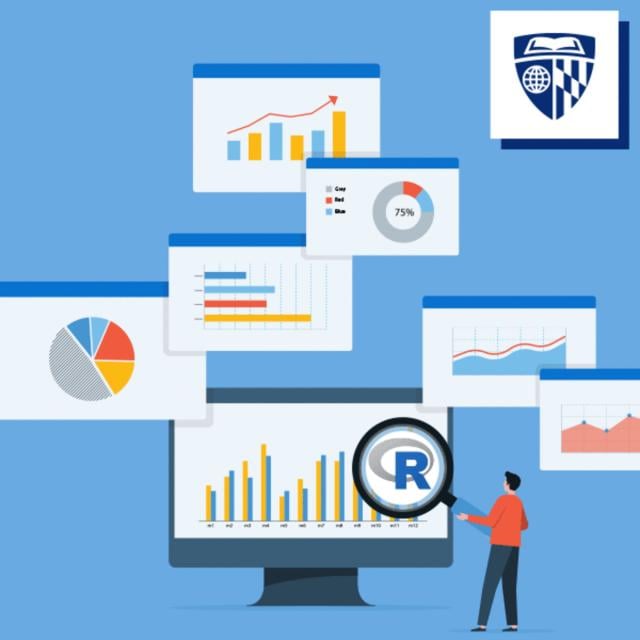
Data visualization is a critical skill for anyone that routinely using quantitative data in his or her work - which is to say that data visualization is a tool that almost every worker needs today. One of the critical tools for data visualization today is the R statistical programming language. Especially in conjunction with the tidyverse software packages, R has become an extremely powerful and flexible platform for making figures, tables, and reproducible reports. However, R can be intimidating for first time users, and there are so many resources online that it can be difficult to sort through without guidance.

Class Deals by MOOC List - Click here and see Coursera's Active Discounts, Deals, and Promo Codes.

To fill that need, this course is intended for learners who have little or no experience with R but who are looking for an introduction to this tool. By the end of this course, students will be able to import data into R, manipulate that data using tools from the popular tidyverse package, and make simple reports using R Markdown. The course is designed for students with good basic computing skills, but limited if any experience with programming.

Course 1 of 5 in the Data Visualization & Dashboarding with R Specialization

Syllabus

WEEK 1
Getting Started with Data Management and Visualization with R
In this module, we will get set up with R to process data for visualizations. You should begin by watching the introductory videos in each lesson. Then, carefully review the readings and reference materials provided. Once you have done that, I recommend watching the videos again to check your understanding. You will take a few quizzes as you progress through the material to make sure you are keeping up.

WEEK 2
Using the Tidyverse packages
In this module, we will use functions from the tidyverse to manipulate data. You should begin by watching the introductory videos in each lesson. Then, carefully review the readings and reference materials provided. Once you have done that, I recommend watching the videos again to check your understanding. You will take a few quizzes as you progress through the material to make sure you are keeping up.

WEEK 3
Using R Markdown to Make Reports
In this module, we learn to make reproducible reports using R Markdown. You should begin by watching the introductory videos in each lesson. Then, carefully review the readings and reference materials provided. Once you have done that, I recommend watching the videos again to check your understanding. You will take a few quizzes as you progress through the material to make sure you are keeping up. Then, at the end of the module, you will submit an assignment for peer review that covers all of the material in this course.
Go to Class
MOOC List is learner-supported. When you buy through links on our site, we may earn an affiliate commission.

Related Courses

3D Printing Software (Coursera) Coursera
University of Illinois at Urbana-Champaign

3D Printing Software (Coursera)

This course will demonstrate how to use 3D printing software to create digital designs that can be turned into physical objects. It will also demonstrate how 3D scanners work to turn physical objects into digital designs. This course is hands-on in nature and will provide step-by-step instructions to guide you through two popular 3D modeling programs, Tinkercad and Fusion 360.

Jun 1st 2026
5-12 Weeks
Programming Languages, Part C (Coursera) Coursera
University of Washington

Programming Languages, Part C (Coursera)

This course is an introduction to the basic concepts of programming languages, with a strong emphasis on functional programming. The course uses the languages ML, Racket, and Ruby as vehicles for teaching the concepts, but the real intent is to teach enough about how any language “fits together” to make you more effective programming in any language -- and in learning new ones.

Jun 1st 2026
3 Weeks
Operations Analytics (Coursera) Coursera
University of Pennsylvania

Operations Analytics (Coursera)

This course is designed to impact the way you think about transforming data into better decisions. Recent extraordinary improvements in data-collecting technologies have changed the way firms make informed and effective business decisions. The course on operations analytics, taught by three of Wharton’s leading experts, focuses on how the data can be used to profitably match supply with demand in various business settings. In this course, you will learn how to model future demand uncertainties, how to predict the outcomes of competing policy choices and how to choose the best course of action in the face of risk.

Jun 1st 2026
4 Weeks
The Data Scientist's Toolbox (Coursera) Coursera
Johns Hopkins University

The Data Scientist's Toolbox (Coursera)

In this course you will get an introduction to the main tools and ideas in the data scientist's toolbox. The course gives an overview of the data, questions, and tools that data analysts and data scientists work with. There are two components to this course. The first is a conceptual introduction to the ideas behind turning data into actionable knowledge. The second is a practical introduction to the tools that will be used in the program like version control, markdown, git, GitHub, R, and RStudio.

Jun 1st 2026
4 Weeks
Android App Components - Intents, Activities, and Broadcast Receivers (Coursera) Coursera
Vanderbilt University

Android App Components - Intents, Activities, and Broadcast Receivers (Coursera)

This MOOC builds upon the overview of Java and Android covered in Course 1 by delving deeper into core Android components, such as Activities, Broadcast Receivers, Intents, and Intent Filters. You will learn by example how to program these core Android components together with basic Java file I/O classes (such as File, InputStream, OutputWriter, etc.) and Android storage mechanisms (such as Shared Preferences).

Jun 1st 2026
4 Weeks
Building Data Visualization Tools (Coursera) Coursera
Johns Hopkins University

Building Data Visualization Tools (Coursera)

The data science revolution has produced reams of new data from a wide variety of new sources. These new datasets are being used to answer new questions in way never before conceived. Visualization remains one of the most powerful ways draw conclusions from data, but the influx of new data types requires the development of new visualization techniques and building blocks. This course provides you with the skills for creating those new visualization building blocks.

Jun 1st 2026
4 Weeks
Learn to Teach Java: Sequences, Primitive Types and Using Objects (Coursera) Coursera
University of California, San Diego

Learn to Teach Java: Sequences, Primitive Types and Using Objects (Coursera)

Get started with the basics of Java, and prepare to teach others using the free, online interactive CS Awesome textbook. In this course for teachers we'll guide you both in learning Java concepts and skills but also in how to effectively teach those to your students. This course will support you in teaching the Advanced Placement Computer Science A course or a similar introductory university-level programming course.

Jun 3rd 2026
4 Weeks
Introduction To Swift Programming (Coursera) Coursera
University of Toronto

Introduction To Swift Programming (Coursera)

Introduction to Swift Programming is the first course in a four part specialization series that will provide you with the tools and skills necessary to develop an iOS App from scratch. By the end of this first course you will be able to demonstrate intermediate application of programming in Swift, the powerful new programming language for iOS. Guided by best practices you will become proficient with syntax, object oriented principles, memory management, functional concepts and more in programming with Swift.

Jun 1st 2026
5-12 Weeks
Architecting Smart IoT Devices (Coursera) Coursera
EIT Digital

Architecting Smart IoT Devices (Coursera)

This course will teach you how to develop an embedded systems device. In order to reduce the time to market, many pre-made hardware and software components are available today. You'll discover all the available hardware and software components, such as processor families, operating systems, boards and networks. You'll also learn how to actually use and integrate these components.

Jun 1st 2026
5-12 Weeks