EdX

Diseña, fabrica y programa tu propio robot (edX)

Diseña, fabrica y programa tu propio robot (edX)

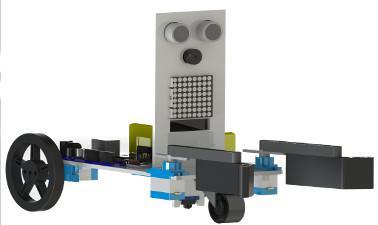
Aprenderás a diseñar, fabricar y programar tu propio robot (DYOR: Do Your Own Robot) con Arduino y te iniciarás en el mundo Maker. Es una metodología que llevamos años implementando en asignaturas de robótica de la Universitat Politènica de València. Está principalmente enfocado a educadores en áreas de Tecnología e Informática, pero también para personas que quieren iniciarse en el mundo Maker.

Class Deals by MOOC List - Click here and see EdX's Active Discounts, Deals, and Promo Codes.

El objetivo final del curso es disfrutéis aprendiendo en todo el proceso de diseño, fabricación y montaje del robot con actividades diversas, variadas y multidisciplinares. Por ello hemos preparado todos los contenidos necesarios que os permitirán fabricar un robot divertido, personalizable y de bajo coste partiendo desde cero y que vosotros podréis adaptar a vuestras necesidades. De forma orientativa, el coste de los materiales para fabricar el robot está en torno a los 65€, que correrán a cargo del alumno y que podrás comprar libremente donde más te interese.

El curso es idóneo para personas que quieran iniciarse en el mundo de la electrónica, fabricación digital y la robótica. Aprenderás a utilizar herramientas CAD (TinkerCAD), diseño electrónico (Fritzing) y programación por bloques de Arduino (Facilino) y apps Android (App Inventor2).
En el curso os explicamos divertidas actividades que podréis realizar con vuestros robots como generar emociones, reproducir melodías, controlar movimientos básicos, abrir/cerrar pinzas, seguir líneas, evitar obstáculos o controlar el robot remotamente desde un dispositivo móvil.

What you'll learn

  • Aprenderás a realizar sencillos diseños 3D con TinkerCAD.
  • Conocerás dos tecnologías de fabricación digital: impresión 3D y corte por láser.
  • Aprenderás los fundamentos básicos de la electrónica de Arduino.
  • Serás capaz de realizar sencillos diseños electrónicos con Fritzing.
  • Aprenderás a programar Arduino por bloques con Facilino.
  • Diseño de apps en Android con App Inventor 2.

Syllabus

Unidad 1: Introducción
Unidad 2: Diseño CAD
Unidad 3: Fabricación digital
Unidad 4: Electrónica y montaje
Unidad 5: Programación y robótica

Go to Class
MOOC List is learner-supported. When you buy through links on our site, we may earn an affiliate commission.

Related Courses

Arduino y algunas aplicaciones (Coursera) Coursera
Universidad Nacional Autónoma de México

Arduino y algunas aplicaciones (Coursera)

Arduino es una iniciativa empleada para simplificar el uso de los microcontroladores, que surgió en 2005 como resultado de un proyecto de estudiantes en el Instituto IVREA. Nació con el objetivo de disminuir el costo de los microcontroladores, que entonces los estudiantes empleaban para sus proyectos y que resultaban demasiado costosos.

May 25th 2026
3 Weeks
Introducción al Internet de las Cosas (IoT) (edX) EdX
Universitat Politècnica de València,UPValenciaX

Introducción al Internet de las Cosas (IoT) (edX)

Este es un curso en línea preliminar en el que tratamos los conceptos básicos de electronica y programación utilizando placas Arduino y ESP. El internet de las cosas (Internet of things o IoT) es el presente y el futuro de la tecnología. Tanto si tienes algo de experiencia con la electrónica y deseas desarrollar proyectos como si no tienes ninguna, este curso online te dara los conocimientos iniciales necesarios para comenzar a crear dispositivos increibles capaces de medir y controlar señales físicas.

Self Paced
Self-Paced
Using Rapid Prototyping in the Engineering Design Process (Coursera) Coursera
Arizona State University

Using Rapid Prototyping in the Engineering Design Process (Coursera)

Hello, everyone! Welcome to this course on Using Rapid Prototyping in the Engineering Design Process. This is part of the Rapid Prototyping and Tooling specialization. In this course, I’ll cover the engineering design process and how it can be used to solve open-ended problems. I’ll discuss the different stages of prototyping and why it is advantageous to produce prototypes rapidly. I’ll then discuss engineering drawings and how to communicate information about 3-dimensional objects on 2-dimensional mediums such as paper or a computer screen.

Jun 8th 2026
4 Weeks
Aplicaciones musicales con Arduino (Coursera) Coursera
Universidad Nacional Autónoma de México

Aplicaciones musicales con Arduino (Coursera)

En este curso nos adentraremos en el terreno del hardware. Concretamente, aprenderemos a utilizar la placa de desarrollo de hardware de código abierto, llamada Arduino, enfocándonos en las aplicaciones que esta ofrece para la experimentación musical. De manera más específica, aprenderemos en este curso a construir nuestros propios generadores de sonido, y a partir de ello haremos instalaciones sonoras que nos permitirán expandir nuestra creatividad hacia el terreno de las cosas materiales, y ya no solo de los datos informáticos.

Jun 8th 2026
4 Weeks
Introduction to the Internet of Things and Embedded Systems (Coursera) Coursera
University of California, Irvine

Introduction to the Internet of Things and Embedded Systems (Coursera)

The explosive growth of the “Internet of Things” is changing our world and the rapid drop in price for typical IoT components is allowing people to innovate new designs and products at home. In this first class in the specialization you will learn the importance of IoT in society, the current components of typical IoT devices and trends for the future. IoT design considerations, constraints and interfacing between the physical world and your device will also be covered. You will also learn how to make design trade-offs between hardware and software. We'll also cover key components of networking to ensure that students understand how to connect their device to the Internet.

Jun 8th 2026
4 Weeks
VLSI CAD Part II: Layout (Coursera) Coursera
University of Illinois at Urbana-Champaign

VLSI CAD Part II: Layout (Coursera)

A modern VLSI chip is a remarkably complex beast: billions of transistors, millions of logic gates deployed for computation and control, big blocks of memory, embedded blocks of pre-designed functions designed by third parties (called “intellectual property” or IP blocks). How do people manage to design these complicated chips? Answer: a sequence of computer aided design (CAD) tools takes an abstract description of the chip, and refines it step-wise to a final design.

Jun 1st 2026
5-12 Weeks
Introduction to Engineering Design (Coursera) Coursera
Starweaver

Introduction to Engineering Design (Coursera)

In today's fast-paced technological environment, understanding the fundamentals of engineering design is crucial for aspiring engineers and professionals alike. This comprehensive course serves as a primer, introducing participants to key concepts and methodologies essential for designing innovative solutions to complex problems. It provides an overview of the engineering design process, emphasizing the integration of creativity and functionality in problem-solving.

May 25th 2026
4 Weeks
Introduction to Solid Edge (Coursera) Coursera
Siemens

Introduction to Solid Edge (Coursera)

The Introduction to Siemens Solid Edge software will enable you to learn basic design concepts in both 2D and 3D environments using Computer-Aided Design (CAD) software. The concepts include 2D sketches, basic shapes, 3D models, and simple assemblies. You’ll gain experience using commands such as extrude, revolve, rounds, blend, and thinwall to more efficiently design solid models. Additionally, you’ll learn about drafting concepts such as detailing, drawing view, section cuts, and design intent.

Jun 8th 2026
5-12 Weeks
Designing Hardware for Raspberry Pi Projects (Coursera) Coursera
Johns Hopkins University

Designing Hardware for Raspberry Pi Projects (Coursera)

This is course 4 of this specialization (although it can be taken out of order) and focuses on applying experience and knowledge gained in the first three courses to build physical electronics hardware. Specifically, this course focuses on four areas: circuit simulation, schematic entry, PCB layout, and 3D CAD modeling. There are many excellent commercial applications available in these areas, however to give everyone access we'll be using all free and open-source software.

Jun 8th 2026
4 Weeks
Generative Design for Additive Manufacturing (Coursera) Coursera
Autodesk

Generative Design for Additive Manufacturing (Coursera)

This course introduces you to one of the more common applications of generative design: Additive Manufacturing or 3D printing as it’s also known. In this course, we explore the basics of geometry creation and the mindset shift needed to build a generative design—a deeper understanding of generative design, its parameters, and how to work with the results specifically aimed at making a 3D printed metal part.

Jan 6th 2025
4 Weeks