EdX

Deploying TinyML (edX)

Deploying TinyML (edX)

Learn to program in TensorFlow Lite for microcontrollers so that you can write the code, and deploy your model to your very own tiny microcontroller. Before you know it, you’ll be implementing an entire TinyML application. Have you wanted to build a TinyML device? In Deploying TinyML, you will learn the software, write the code, and deploy the model to your own tiny microcontroller-based device. Before you know it, you’ll be implementing an entire TinyML application.

Class Deals by MOOC List - Click here and see EdX's Active Discounts, Deals, and Promo Codes.

A one-of-a-kind course, Deploying TinyML is a mix of computer science and electrical engineering. Gain hands-on experience with embedded systems, machine learning training, and machine learning deployment using TensorFlow Lite for Microcontrollers, to make your own microcontroller operational for implementing applications such as voice recognition, sound detection, and gesture detection.
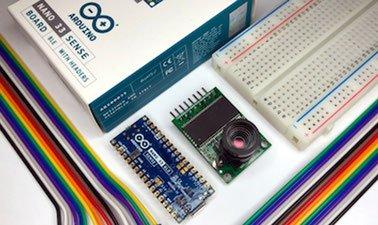
The course features projects based on a TinyML Program Kit that includes an Arduino board with onboard sensors and an ARM Cortex-M4 microcontroller. The kit has everything you need to build applications around image recognition, audio processing, and gesture detection. Before you know it, you’ll be implementing an entire tiny machine learning application.
Tiny Machine Learning (TinyML) is one of the fastest-growing areas of deep learning and is rapidly becoming more accessible. The third course in the TinyML Professional Certificate program, Deploying TinyML provides hands-on experience with deploying TinyML to a physical device.

What you'll learn

  • An understanding of the hardware of a microcontroller-based device
  • A review of the software behind a microcontroller-based device
  • How to program your own TinyML device
  • How to write your code for a microcontroller-based device
  • How to deploy your code to a microcontroller-based device
  • How to train a microcontroller-based device
  • Responsible AI Deployment

Syllabus

  • Introduction to the TinyML Kit
  • Deploying TinyML Applications on Embedded Devices
  • Collecting a Custom TinyML Dataset
  • Pre and Post Processing for Keyword Spotting, Visual Wake Words, and Gesturing a Magic Wand
  • Profiling and Optimization of TinyML Applications

Go to Class
MOOC List is learner-supported. When you buy through links on our site, we may earn an affiliate commission.

Related Courses

Computing in Python IV: Objects & Algorithms (edX) EdX
Georgia Institute of Technology,GTx

Computing in Python IV: Objects & Algorithms (edX)

Learn about recursion, search and sort algorithms, and object-oriented programming in Python. Complete your introductory knowledge of computer science with this final course on objects and algorithms. Now that you've learned about complex control structures and data structures, learn to develop programs that more intuitively leverage your natural understanding of problems through object-oriented programming. Then, learn to analyze the complexity and efficiency of these programs through algorithms. In addition, certify your broader knowledge of Introduction to Computing with a comprehensive exam.

Self Paced
Self-Paced
CSS Basics (edX) EdX
World Wide Web Consortium - W3C,W3Cx

CSS Basics (edX)

Learn, from Microsoft and W3C experts, how to take your Web pages from bland to bold with the power of CSS styling. Have you just begun your journey into Web development? This course will introduce you to the basics of Web design and teach you how to style your Web site for a professional look and feel.

Self Paced
Self-Paced
Computing in Python I: Fundamentals and Procedural Programming (edX) EdX
Georgia Institute of Technology,GTx

Computing in Python I: Fundamentals and Procedural Programming (edX)

Learn the fundamentals of computing in Python, including variables, operators, and writing and debugging your own programs. This course starts from the beginning, covering the basics of how a computer interprets lines of code; how to write programs, evaluate their output, and revise the code itself; how to work with variables and their changing values; and how to use mathematical, boolean, and relational operators.

Self Paced
Self-Paced
Python Data Structures (edX) EdX
University of Michigan,MichiganX

Python Data Structures (edX)

The second course in Python for Everybody explores variables that contain collections of data like string, lists, dictionaries, and tuples. Learning how to store and represent and manipulate data collections while a program is running is an important part of learning how to program.

Self Paced
Self-Paced
Using Python for Research (edX) EdX
HarvardX,Harvard University

Using Python for Research (edX)

Take your introductory knowledge of Python programming to the next level and learn how to use Python 3 for your research. This course bridges the gap between introductory and advanced courses in Python. While there are many excellent introductory Python courses available, most typically do not go deep enough for you to apply your Python skills to research projects.

Self Paced
Self-Paced
How to Code: Complex Data (edX) EdX
The University of British Columbia,UBCx

How to Code: Complex Data (edX)

Learn how to design more complex programs, using new data structures, abstraction, and generative recursion. As your program requirements get more complex, you will find that simple additions to the design method make it easy to write well-structured and well-tested code that is easy to maintain. By learning how to capture common data and control structures using abstraction, your programs will get shorter and better tested.

Self Paced
Self-Paced
AI Chatbots without Programming (edX) EdX
IBM

AI Chatbots without Programming (edX)

Chatbots are increasingly in demand among global businesses. This course will teach you how to build, analyze, deploy and monetize chatbots - with the help of IBM Watson and the power of AI. Please Note: Learners who successfully complete this IBM course can earn a skill badge — a detailed, verifiable and digital credential that profiles the knowledge and skills you’ve acquired in this course. Enroll to learn more, complete the course and claim your badge!

Self Paced
Self-Paced
JavaScript Introduction (edX) EdX
World Wide Web Consortium - W3C,W3Cx

JavaScript Introduction (edX)

Learn JavaScript, a Web development programming language, to add interactivity to your Web pages, and become an expert Web developer. This computer science course is an initiation to JavaScript programming and has been designed to help Web developers have an understanding of the basic concepts of the language. This course was developed in partnership between W3C and University Côte d'Azur.

Self Paced
Self-Paced
Programación para todos (empezando con Python) (edX) EdX
University of Michigan,MichiganX

Programación para todos (empezando con Python) (edX)

Este curso en línea es una introducción "sin prerrequisitos" a la programación en Python. Aprenderás sobre las variables, la ejecución condicional, la ejecución repetida y cómo usamos las funciones. Este curso de Python tiene el objetivo de enseñar a todos lo básico de la programación de computadoras usando Python. Conocerás cómo construir un programa de una serie de instrucciones simples en Python.

Self Paced
Self-Paced
Laboratorio di Programmazione (edX) EdX
University of Naples Federico II,FedericaX

Laboratorio di Programmazione (edX)

Impara a risolvere problemi complessi attraverso l'uso del computer e avvicinati alla magia degli algoritmi. Il linguaggio di programmazione è uno degli strumenti che abbiamo per interpretare e risolvere i problemi di tutti i giorni. Un linguaggio che è alla base di problemi comuni, come le previsioni del tempo o l'analisi della deformazione di una struttura di un'auto in un incidente stradale.

Self Paced
Self-Paced