Debugging: Hunting and Squashing Bugs (Coursera)

Debugging: Hunting and Squashing Bugs (Coursera)

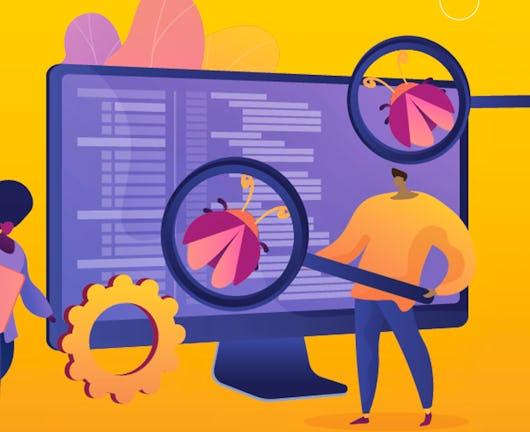
Learning how to debug is the most valuable skill to develop as you learn to program. This four-week course from the University of Michigan will help you improve your programming ability by providing you with the skills you need to understand and debug code.

Class Deals by MOOC List - Click here and see Coursera's Active Discounts, Deals, and Promo Codes.

What’s more, you’ll learn the crucial techniques to help minimize mistakes and problems in your code.
Most modern development environments contain a debugger, which you can use to find bugs and understand what is happening in your code. However, many people still rely on print statements when they debug.
This course will help you gain confidence in using debuggers, so you can spend less time seeking out and fixing bugs and focus on building exciting new programming projects. The majority of coding errors occur when the programmer doesn’t understand the code or makes mistakes with the language, resulting in bugs. In this course, you’ll gain the knowledge and skills needed to spot and solve semantic and syntax errors more easily. You’ll also streamline your coding process by learning to write and run unit tests to examine and check your code.
This course is designed for those interested in developing their Python skills or communicating with other programmers in a professional setting.
This course is part of the Creative Coding: Hands-On Python Specialization.

Syllabus

Week 1 | Working with Files and Unit Tests
Week 2 | Parsing CSV Data and Using a Debugger
Week 3 | CSV Reader/Writer and Debugging
Week 4 | Regex


Go to Class
MOOC List is learner-supported. When you buy through links on our site, we may earn an affiliate commission.

Related Courses

An Introduction to Interactive Programming in Python (Part 1) (Coursera) Coursera
Rice University

An Introduction to Interactive Programming in Python (Part 1) (Coursera)

This two-part course is designed to help students with very little or no computing background learn the basics of building simple interactive applications. Our language of choice, Python, is an easy-to learn, high-level computer language that is used in many of the computational courses offered on Coursera. To make learning Python easy, we have developed a new browser-based programming environment that makes developing interactive applications in Python simple.

Oct 5th 2026
5-12 Weeks
IBM z/OS Rexx Programming (Coursera) Coursera
IBM

IBM z/OS Rexx Programming (Coursera)

This course is designed to teach you the basic skills required to write programs using the REXX language in z/OS. The course covers the TSO extensions to REXX and interaction with other environments such as the MVS console, running REXX in batch jobs, and compiling REXX. A total of 11 hands-on labs on an IBM Z server (via remote Skytap access) are part of this course.

Oct 5th 2026
5-12 Weeks
Creative Programming for Digital Media & Mobile Apps (Coursera) Coursera
University of London,Goldsmiths, University of London

Creative Programming for Digital Media & Mobile Apps (Coursera)

This course is for anyone who would like to apply their technical skills to creative work ranging from video games to art installations to interactive music, and also for artists who would like to use programming in their artistic practice. This course will teach you how to develop and apply programming skills to creative work. This is an important skill within the development of creative mobile applications, digital music and video games. It will teach the technical skills needed to write software that make use of images, audio and graphics, and will concentrate on the application of these skills to creative projects. Additional resources will be provided for students with no programming background.

Oct 12th 2026
5-12 Weeks
Parallel programming (Scala 2 version) (Coursera) Coursera
École Polytechnique Fédérale de Lausanne

Parallel programming (Scala 2 version) (Coursera)

With every smartphone and computer now boasting multiple processors, the use of functional ideas to facilitate parallel programming is becoming increasingly widespread. In this course, you'll learn the fundamentals of parallel programming, from task parallelism to data parallelism. In particular, you'll see how many familiar ideas from functional programming map perfectly to to the data parallel paradigm. We'll start the nuts and bolts how to effectively parallelize familiar collections operations, and we'll build up to parallel collections, a production-ready data parallel collections library available in the Scala standard library.

Oct 5th 2026
4 Weeks
Learn HTML and CSS (Coursera) Coursera
Scrimba

Learn HTML and CSS (Coursera)

This course is perfect if you want to learn how to code websites from scratch. You will learn the basics of HTML and CSS through interactive challenges. Along the way, you will build multiple projects, like a Google.com clone, a Space Exploration page, and a fun birthday site filled with GIFs. While most of the challenges are done in Scrimba's interactive editor, you will also learn how to use professional tools like VS Code for code editing, GitHub for hosting your code, and Netlify for deploying your projects to the world wide web.

Oct 12th 2026
5-12 Weeks
Computer Science: Algorithms, Theory, and Machines (Coursera) Coursera
Princeton University

Computer Science: Algorithms, Theory, and Machines (Coursera)

This course introduces the broader discipline of computer science to people having basic familiarity with Java programming. It covers the second half of our book Computer Science: An Interdisciplinary Approach (the first half is covered in our Coursera course Computer Science: Programming with a Purpose, to be released in the fall of 2018). Our intent is to demystify computation and to build awareness about the substantial intellectual underpinnings and rich history of the field of computer science.

Oct 5th 2026
5-12 Weeks