Creative Coding for Designers Using Python (Coursera)

Creative Coding for Designers Using Python (Coursera)

Creative Coding for Designers Using Python,marks the final installment in the comprehensive three-course specialization, aimed at significantly enhancing the programming capabilities of designers, artists, and visual thinkers through Python. As the advanced course in the series, Creative Coding for Designers Using Python adopts a project-based learning strategy to consolidate and apply the skills acquired from the first two courses. In this course, you’ll focus on dynamic simulations and procedural content generation, offering a deeper dive into Python's application in visual design and digital art.

Class Deals by MOOC List - Click here and see Coursera's Active Discounts, Deals, and Promo Codes.

Designed for individuals who have grasped the basics of Python, including its syntax, data structures, and object-oriented programming principles, this course delves into sophisticated topics. Leveraging the Processing platform with Python, you’ll engage in interactive projects that transform theoretical knowledge into tangible outputs, bridging the gap between technical proficiency and artistic creativity.
Creative Coding for Designers Using Python is structured as an educational journey that combines technology and art, equipping participants with the skills to explore advanced digital design techniques. This course offers the tools and conceptual understanding necessary for the innovative application of Python in creating digital art and design projects.
This is the third and final course in a three-part series, Programming for Designers, aimed at equipping designers with essential computational design skills.
This course is part of the Programming for Designers Specialization.

What you'll learn

  • Create particle systems in Python to form dynamic visual patterns
  • Create vector fields in Processing using indexes and Perlin Noise remapping to create flowing patterns
  • Apply algorithms to perform procedural generation to craft intricate tile-based patterns with customizable textures

Syllabus

Project 1: Particle Systems
Our first project introduces particle systems, a fundamental concept in simulation and visual effects that can create complex and dynamic patterns from simple rules. Through a series of videos, we'll cover the creation of particles, their behaviors, and how to control and animate them to produce complex visual effects. This week sets the foundation for understanding how individual elements can work together to create intricate designs.

Project 2: Vector Fields
Building on our knowledge of particle systems, week two explores vector fields and their application in guiding the movement of particles. You'll learn how to create vector fields and use them to influence the navigation and behavior of particles within a system. This week enhances our ability to simulate natural phenomena and create dynamic, flowing patterns in our designs.

Project 3: Ecosystem Simulations
In our third project, we dive into ecosystem simulations, a complex and fascinating application of creative coding that models interactions within ecosystems. You'll learn how to simulate different entities within an ecosystem and their interactions, such as predation and reproduction. This week challenges us to think about systems, their rules, and how to represent them visually in engaging ways.

Project 4: Pathfinding
Pathfinding is crucial in many design and gaming applications, allowing objects to navigate through environments in an intelligent manner. This week, we focus on the A-Star (A) algorithm, a popular pathfinding algorithm known for its efficiency and accuracy. You'll learn how to implement A to enable characters or objects to find the shortest path between two points, overcoming obstacles and optimizing movement within your projects.

Project 5: Wave Function Collapse
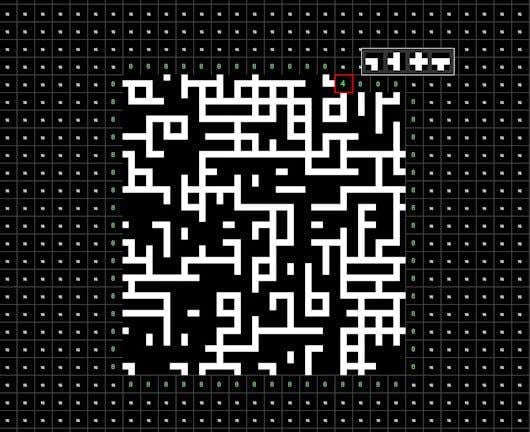
Our final project explores the wave function collapse algorithm, an advanced technique for procedural generation that's particularly useful in tile-based generative design. You'll learn how to implement this algorithm to create complex patterns and landscapes, offering a powerful tool for architectural design, game development, and digital art. This week culminates our exploration, showcasing how algorithms can inspire creativity and innovation in design.

Go to Class
MOOC List is learner-supported. When you buy through links on our site, we may earn an affiliate commission.

Related Courses

Introduction à la programmation orientée objet (en Java) (Coursera) Coursera
École Polytechnique Fédérale de Lausanne

Introduction à la programmation orientée objet (en Java) (Coursera)

Ce cours introduit la programmation orientée objet (encapsulation, abstration, héritage, polymorphisme) en l'illustrant en langage Java. Il présuppose connues les bases de la programmation (variables, types, boucles, fonctions, ...). Il est conçu comme la suite du cours « Initiation à la programmation (en Java) ».

Oct 11th 2026
5-12 Weeks
Accounting Data Analytics with Python (Coursera) Coursera
University of Illinois at Urbana-Champaign

Accounting Data Analytics with Python (Coursera)

This course focuses on developing Python skills for assembling business data. It will cover some of the same material from Introduction to Accounting Data Analytics and Visualization, but in a more general purpose programming environment (Jupyter Notebook for Python), rather than in Excel and the Visual Basic Editor. These concepts are taught within the context of one or more accounting data domains (e.g., financial statement data from EDGAR, stock data, loan data, point-of-sale data).

Oct 12th 2026
5-12 Weeks
Principles of Computing (Part 2) (Coursera) Coursera
Rice University

Principles of Computing (Part 2) (Coursera)

This two-part course introduces the basic mathematical and programming principles that underlie much of Computer Science. Understanding these principles is crucial to the process of creating efficient and well-structured solutions for computational problems. To get hands-on experience working with these concepts, we will use the Python programming language. The main focus of the class will be weekly mini-projects that build upon the mathematical and programming principles that are taught in the class.

Oct 5th 2026
4 Weeks
Understanding and Applying Text Embeddings (Coursera) Coursera
DeepLearning.AI

Understanding and Applying Text Embeddings (Coursera)

The Vertex AI Text-Embeddings API enhances the process of generating text embeddings. These text embeddings, which are numerical representations of text, play a pivotal role in many tasks involving the identification of similar items, like Google searches, online shopping recommendations, and personalized music suggestions.

Oct 12th 2026
1 Week
GitHub Copilot: The AI Pair Programmer for Coding (Coursera) Coursera
Edureka

GitHub Copilot: The AI Pair Programmer for Coding (Coursera)

Welcome to the 'GitHub Copilot: The AI Pair Programmer for Coding' course, where you will embark on an insightful journey to develop a profound understanding of the AI principles that power GitHub Copilot's coding assistance. This course is designed to transform your coding practices, leveraging the advanced capabilities of GitHub Copilot.

Oct 12th 2026
1 Week
Open Design (Coursera) Coursera
Duke University

Open Design (Coursera)

What is design? How is it a deeply human endeavor? How can we design better products, services, and experiences in our communities? If you’re interested in helping create a more equitable and accessible world, this Center for Computational Thinking module on Open Design is for you.

Oct 12th 2026
1 Week
Gen AI for Code Generation for Python (Coursera) Coursera
Edureka

Gen AI for Code Generation for Python (Coursera)

Welcome to the 'Gen AI for Code Generation for Python' course, where you'll embark on a journey to explore and develop your skills in the art of code generation with Generative AI. Throughout this short course, you will delve into various techniques for generating Python code effortlessly, ranging from simple scripts to complete end-to-end projects.

Oct 12th 2026
1 Week
Laboratório de Programação Orientada a Objetos - Parte 2 (Coursera) Coursera
Universidade de São Paulo, Brasil

Laboratório de Programação Orientada a Objetos - Parte 2 (Coursera)

Esta é a segunda parte do curso avançado de Programação Orientada a Objetos oferecido pelo Departamento de Ciência da Computação do IME-USP. O curso é voltado para profissionais ou estudantes interessados em Desenvolvimento de Software Avançado e que já dominam uma linguagem de programação e já conhecem os fundamentos básicos da orientação a objetos.

Oct 12th 2026
5-12 Weeks
Data Processing Using Python (Coursera) Coursera
Nanjing University

Data Processing Using Python (Coursera)

This course is mainly for non-computer majors. It starts with the basic syntax of Python, to how to acquire data in Python locally and from network, to how to present data, then to how to conduct basic and advanced statistic analysis and visualization of data, and finally to how to design a simple GUI to present and process data, advancing level by level.

Oct 19th 2026
5-12 Weeks
Applied Text Mining in Python (Coursera) Coursera
University of Michigan

Applied Text Mining in Python (Coursera)

This course will introduce the learner to text mining and text manipulation basics. The course begins with an understanding of how text is handled by python, the structure of text both to the machine and to humans, and an overview of the nltk framework for manipulating text. The second week focuses on common manipulation needs, including regular expressions (searching for text), cleaning text, and preparing text for use by machine learning processes. The third week will apply basic natural language processing methods to text, and demonstrate how text classification is accomplished. The final week will explore more advanced methods for detecting the topics in documents and grouping them by similarity (topic modelling).

Oct 12th 2026
4 Weeks
Uso de bases de datos con Python (Coursera) Coursera
University of Michigan

Uso de bases de datos con Python (Coursera)

Este curso presentará a los estudiantes los conceptos básicos del lenguaje de consulta estructurado (Structured Query Language, SQL), así como el diseño básico de bases de datos para almacenar datos como parte de una iniciativa de varios pasos para recopilar, analizar y procesar datos. El curso utilizará SQLite3 como base de datos. También crearemos rastreadores web y procesos de visualización y recopilación de datos de varios pasos. Utilizaremos la biblioteca D3.js para realizar la visualización básica de datos.

Oct 12th 2026
5-12 Weeks