Approximation Algorithms (Coursera)

Offered by EIT Digital,
Approximation Algorithms (Coursera)

Many real-world algorithmic problems cannot be solved efficiently using traditional algorithmic tools, for example because the problems are NP-hard. The goal of this course is to become familiar with important algorithmic concepts and techniques needed to effectively deal with such problems. These techniques apply when we don't require the optimal solution to certain problems, but an approximation that is close to the optimal solution. We will see how to efficiently find such approximations.

Class Deals by MOOC List - Click here and see Coursera's Active Discounts, Deals, and Promo Codes.

Prerequisites:
In order to successfully take this course, you should already have a basic knowledge of algorithms and mathematics. Here's a short list of what you are supposed to know:

  • O-notation, Ω-notation, Θ-notation; how to analyze algorithms
  • Basic calculus: manipulating summations, solving recurrences, working with logarithms, etc.
  • Basic probability theory: events, probability distributions, random variables, expected values etc.
  • Basic data structures: linked lists, stacks, queues, heaps
  • (Balanced) binary search trees
  • Basic sorting algorithms, for example MergeSort, InsertionSort, QuickSort
  • Graph terminology, representations of graphs (adjacency lists and adjacency matrix), basic graph algorithms (BFS, DFS, topological sort, shortest paths)

The material for this course is based on the course notes that can be found under the resources tab. We will not cover everything from the course notes. The course notes are there both for students who did not fully understand the lectures as well as for students who would like to dive deeper into the topics.
The video lectures contain a few very minor mistakes. A list of these mistakes can be found under resources (in the document called "Errata"). If you think you found an error, report a problem by clicking the square flag at the bottom of the lecture or quiz where you found the error.

Syllabus

WEEK 1
Introduction to Approximation algorithms
In the module the motivation for studying approximation algorithms will be given. We will discuss what optimization problems are, and what the difference between heuristics and approximation algorithms is. Finally, we will introduce the concept of approximation ratio, which plays a central role in the analysis of the quality of approximation algorithms.

WEEK 2
The Load Balancing problem
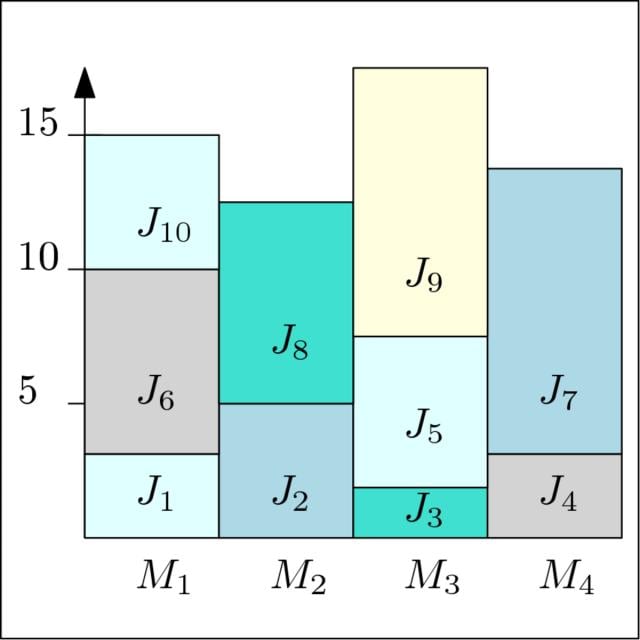
In this module we will study various approximation algorithms for the load balancing problem. This problems asks to distribute a given set of jobs, each with a certain processing time, over a number of machine. The goal is to do this such that all jobs are finished as soon as possible. We will analyze the quality of the computed solutions computed using the concept of rho-approximation, which we saw in the previous lecture. In this analysis we will see that lower bounds on the optimal solution play a crucial role in the analysis (or, for maximization problems: upper bounds).

WEEK 3
LP Relaxation
In this module we will introduce the technique of LP relaxation to design approximation algorithms, and explain how to analyze the approximation ratio of an algorithm based in LP relaxation. We will do this using the (weighted) Vertex Cover problem as an example. Before we explain the technique of LP relaxation, however, we first give a simple 2-approximation algorithm for the unweighted Vertex Cover problem.

WEEK 4
Polynomial-time approximation schemes
In this module we will introduce the concept of Polynomial-Time Approximation Scheme (PTAS), which are algorithms that can get arbitrarily close to an optimal solution. We describe a general technique to design PTASs, and apply it to the famous Knapsack problem. Finally we will see how to analyze PTASs that are designed with the general technique.

Go to Class
MOOC List is learner-supported. When you buy through links on our site, we may earn an affiliate commission.

Related Courses

Ethical Issues in Data Science (Coursera) Coursera
University of Colorado Boulder

Ethical Issues in Data Science (Coursera)

Computing applications involving large amounts of data – the domain of data science – impact the lives of most people in the U.S. and the world. These impacts include recommendations made to us by internet-based systems, information that is available about us online, techniques that are used for security and surveillance, data that is used in health care, and many more. In many cases, they are affected by techniques in artificial intelligence and machine learning.

Aug 3rd 2026
5-12 Weeks
Operations Research (2): Optimization Algorithms (Coursera) Coursera
National Taiwan University

Operations Research (2): Optimization Algorithms (Coursera)

Operations Research (OR) is a field in which people use mathematical and engineering methods to study optimization problems in Business and Management, Economics, Computer Science, Civil Engineering, Electrical Engineering, etc. The series of courses consists of three parts, we focus on deterministic optimization techniques, which is a major part of the field of OR. As the second part of the series, we study some efficient algorithms for solving linear programs, integer programs, and nonlinear programs.

Aug 3rd 2026
5-12 Weeks
Automated Reasoning: satisfiability (Coursera) Coursera
EIT Digital

Automated Reasoning: satisfiability (Coursera)

In this course you will learn how to apply satisfiability (SAT/SMT) tools to solve a wide range of problems. Several basic examples are given to get the flavor of the applications: fitting rectangles to be applied for printing posters, scheduling problems, solving puzzles, and program correctness. Also underlying theory is presented: resolution as a basic approach for propositional satisfiability, the CDCL framework to scale up for big formulas, and the simplex method to deal with linear inequallities.

Jul 20th 2026
4 Weeks
Algorithms, Part II (Coursera) Coursera
Princeton University

Algorithms, Part II (Coursera)

This course covers the essential information that every serious programmer needs to know about algorithms and data structures, with emphasis on applications and scientific performance analysis of Java implementations. Part I covers elementary data structures, sorting, and searching algorithms. Part II focuses on graph- and string-processing algorithms.

Jul 20th 2026
5-12 Weeks
Approximation Algorithms Part I (Coursera) Coursera
École normale supérieure

Approximation Algorithms Part I (Coursera)

How efficiently can you pack objects into a minimum number of boxes? How well can you cluster nodes so as to cheaply separate a network into components around a few centers? These are examples of NP-hard combinatorial optimization problems. It is most likely impossible to solve such problems efficiently, so our aim is to give an approximate solution that can be computed in polynomial time and that at the same time has provable guarantees on its cost relative to the optimum.

Aug 3rd 2026
5-12 Weeks
Algorithms, Part I (Coursera) Coursera
Princeton University

Algorithms, Part I (Coursera)

This course covers the essential information that every serious programmer needs to know about algorithms and data structures, with emphasis on applications and scientific performance analysis of Java implementations. Part I covers elementary data structures, sorting, and searching algorithms. Part II focuses on graph- and string-processing algorithms.

Jul 27th 2026
5-12 Weeks
Cloud Computing Concepts, Part 1 (Coursera) Coursera
University of Illinois at Urbana-Champaign

Cloud Computing Concepts, Part 1 (Coursera)

Cloud computing systems today, whether open-source or used inside companies, are built using a common set of core techniques, algorithms, and design philosophies—all centered around distributed systems. Learn about such fundamental distributed computing "concepts" for cloud computing. Some of these concepts include: clouds, MapReduce, key-value/NoSQL stores, classical distributed algorithms, widely-used distributed algorithms, scalability, trending areas, and much, much more!

Jul 20th 2026
5-12 Weeks
Development of Real-Time Systems (Coursera) Coursera
EIT Digital

Development of Real-Time Systems (Coursera)

This course is intended for the Master's student and computer engineer who likes practical programming and problem solving! After completing this course, you will have the knowledge to plan and set-up a real-time system both on paper and in practice. The course centers around the problem of achieving timing correctness in embedded systems, which means to guarantee that the system reacts within the real-time requirements.

Jul 27th 2026
5-12 Weeks
Probabilistic Graphical Models 3: Learning (Coursera) Coursera
Stanford University

Probabilistic Graphical Models 3: Learning (Coursera)

Probabilistic graphical models (PGMs) are a rich framework for encoding probability distributions over complex domains: joint (multivariate) distributions over large numbers of random variables that interact with each other. These representations sit at the intersection of statistics and computer science, relying on concepts from probability theory, graph algorithms, machine learning, and more. They are the basis for the state-of-the-art methods in a wide variety of applications, such as medical diagnosis, image understanding, speech recognition, natural language processing, and many, many more. They are also a foundational tool in formulating many machine learning problems.

Aug 3rd 2026
5-12 Weeks