EdX

Applied Bayesian for Analytics (edX)

Applied Bayesian for Analytics (edX)

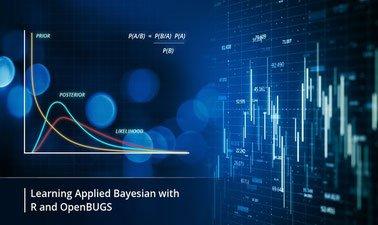
Learn how to construct, fit, estimate and compute Bayesian statistical models with the help of OpenBUGS (freely available software). Bayesian Statistics is a captivating field and is used most prominently in data sciences. In this course we will learn about the foundation of Bayesian concepts, how it differs from Classical Statistics including among others Parametrizations, Priors, Likelihood, Monte Carlo methods and computing Bayesian models with the exploration of Multilevel modelling.

Class Deals by MOOC List - Click here and see EdX's Active Discounts, Deals, and Promo Codes.

This course is divided into two parts i.e. Theoretical and Empirical part of Bayesian Analytics. First three weeks cover the Theoretical part which includes how to form a prior, how to calculate a posterior and several other aspects. Rest of the weeks will cover the empirical part which explains how to compute Bayesian modelling. Completion of this course will provide you with an understanding of the Bayesian approach, the primary difference between Bayesian and Frequentist approaches and experience in data analyses.

What you'll learn

  • Understand the necessary Bayesian concepts from practical point of view for better decision making.
  • Learn Bayesian approach to estimate likely event outcomes, or probabilities using datasets.
  • Gain “hands on” experience in creating and estimating Bayesian models using R and OPENBUGS.

Syllabus

Week 01: What is Bayesian Statistics and How it is different than Classical Statistics
Foundations of Bayesian Inference
Bayes theorem
Advantages of Bayesian models
Why Bayesian approach is so important in Analytics
Major densities and their applications

Week 02: Bayesian analysis of Simple Models
Likelihood theory and Estimation
Parametrizations and priors
Learning from binary models
Learning from Normal Distribution

Week 03: Monte Carlo Methods
Basics of Monte carol integration
Basics of Markov chain Monte Carlo
Gibs Sampling

Week 04: Computational Bayes
Examples of Bayesian Analytics
Introduction to R and OPENBUGS for Bayesian analysis

Week 05: Bayesian Linear Models
Context for Bayesian Regression Models
Normal Linear regression
Logistic regression

Week 06: Bayesian Hierarchical Models
Introduction to Multilevel models
Exchangeability
Computation in Hierarchical Models


Go to Class
MOOC List is learner-supported. When you buy through links on our site, we may earn an affiliate commission.

Related Courses

Analytics for Decision Making (edX) EdX
Babson College

Analytics for Decision Making (edX)

Discover the foundational concepts that support modern data science and learn to analyze various data types and quality to make smart business decisions. Want to know how to avoid bad decisions with data? Making good decisions with data can give you a distinct competitive advantage in business. This statistics and data analysis course will help you understand the fundamental concepts of sound statistical thinking that can be applied in surprisingly wide contexts, sometimes even before there is any data! Key concepts like understanding variation, perceiving relative risk of alternative decisions, and pinpointing sources of variation will be highlighted.

Self Paced
Self-Paced
Statistical Inference and Modeling for High-throughput Experiments (edX) EdX
HarvardX,Harvard University

Statistical Inference and Modeling for High-throughput Experiments (edX)

A focus on the techniques commonly used to perform statistical inference on high throughput data. In this course you’ll learn various statistics topics including multiple testing problem, error rates, error rate controlling procedures, false discovery rates, q-values and exploratory data analysis. We then introduce statistical modeling and how it is applied to high-throughput data. In particular, we will discuss parametric distributions, including binomial, exponential, and gamma, and describe maximum likelihood estimation.

Self Paced
Self-Paced
Foundations of Data Analysis - Part 1: Statistics Using R (edX) EdX
University of Texas at Austin,UTAustinX

Foundations of Data Analysis - Part 1: Statistics Using R (edX)

This is a hands on course with a data lab to teach fundamental statistical topics such as descriptive statistics, inferential testing, and modeling. In this first part of a two part course, we’ll walk through the basics of statistical thinking – starting with an interesting question. Then, we’ll learn the correct statistical tool to help answer our question of interest – using R and hands-on Labs.

No sessions available
5-12 Weeks
BioStatistics (edX) EdX
DoaneX,Doane University

BioStatistics (edX)

This college-level, credit-eligible Biostatistics course will teach you the skills required for success in future analytical studies in biology. In this undergraduate-level biostatistics course, the learners will be introduced to the use of statistics and study designs in biology. Upon successful completion of this course, learners will be able to design experimental, quasi-experimental and observational studies that will meet regulatory guidelines; collect, analyze, and interpret data using appropriate statistical tools.

Self Paced
Self-Paced
Estadística Aplicada a los Negocios (edX) EdX
Galileo University,GalileoX

Estadística Aplicada a los Negocios (edX)

Aprende las principales herramientas y técnicas de la estadística descriptiva y la estadística inferencial para analizar e interpretar datos desde la perspectiva de negocios facilitando la toma de decisiones. Este curso proporciona una introducción al análisis de datos en base a las principales herramientas estadísticas, enfocándose en la estadística descriptiva y la estadística inferencial.

Self Paced
Self-Paced
Learning Analytics Fundamentals (edX) EdX
University of Texas at Arlington,UTArlingtonX

Learning Analytics Fundamentals (edX)

Learn about the growing field of learning analytics and how to analyze basic data sets to generate insights. The demand for data science and learning science skills has continued to increase as classrooms, labs, and organizations look to optimize their data and improve learning environments for students and employees. The UTArlingtonX Learning Analytics courses will give you the opportunity to gain invaluable knowledge and expertise in this growing field.

No sessions available
4 Weeks
Probability: Basic Concepts & Discrete Random Variables (edX) EdX
Purdue University,PurdueX

Probability: Basic Concepts & Discrete Random Variables (edX)

Learn fundamental concepts of mathematical probability to prepare for a career in the growing field of information and data science. Our capacity to collect and store data has exponentially increased, but deriving information from data from a scientific perspective requires a foundational knowledge of probability. Are you interested in a career in the emerging data science field, or as an actuarial scientist? Or want better to understand statistical theory and mathematical modeling?

No sessions available
5-12 Weeks
Fundamentals of Statistics (edX) EdX
MIT,MITx

Fundamentals of Statistics (edX)

Develop a deep understanding of the principles that underpin statistical inference: estimation, hypothesis testing and prediction. Statistics is the science of turning data into insights and ultimately decisions. Behind recent advances in machine learning, data science and artificial intelligence are fundamental statistical principles. The purpose of this class is to develop and understand these core ideas on firm mathematical grounds starting from the construction of estimators and tests, as well as an analysis of their asymptotic performance.

Jan 29th 2024
13-24 Weeks
Big Data and Education (edX) EdX
University of Pennsylvania,PennX

Big Data and Education (edX)

Learn the methods and strategies for using large-scale educational data to improve education and make discoveries about learning. Online and software-based learning tools have been used increasingly in education. This movement has resulted in an explosion of data, which can now be used to improve educational effectiveness and support basic research on learning.

Self Paced
Self-Paced