EdX

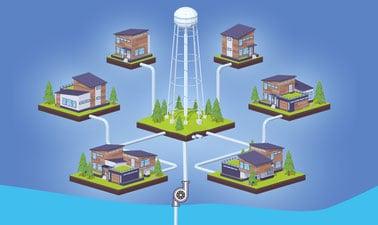
Analysis and Design of Water Distribution Systems (edX)

Offered by Purdue University, PurdueX,
Analysis and Design of Water Distribution Systems (edX)

Analyze and design water distribution networks and select pumps for applications. Water distribution networks are crucial for supplying water for residential areas, hospitals, educational institutions, industrial zones, commercial areas, and for firefighting purposes.

Class Deals by MOOC List - Click here and see EdX's Active Discounts, Deals, and Promo Codes.

In this course, we will:
Review fluid properties, and fundamental hydraulics principles leading to continuity equation, energy and momentum equations. Review energy grade lines, and hydraulic grade lines.
Quantify flows through pipes and learn to design simple water distribution networks. Topics such as major and minor energy loss computations in pipe networks, and role of reservoirs, tanks, pumps, etc. in network design will be covered. MS Excel and pipe-network analysis software such as EPANET will be used to analyze pipe networks of varying complexities. Learning assessments will enable students to perform steady-state as well as extended period analyses of water distribution networks.
Select combinations of pumps to meet design needs of flow demands and pressures in water distribution networks during regular, peak, and fire demands. Develop system curves, obtain operating points for pumps, account for cavitation in pumps, analyze single pumps, multiple pumps in series and parallel, and design and select pumps. A project will provide hands-on experience in the design and selection of pumps for water distribution network.

What you'll learn

  • Analyze and design water distribution networks
  • Select and size pumps for simple water distribution system
  • Identify, formulate, and solve complex engineering problems

Syllabus

Week 1: Introduction, review of continuity, momentum and energy equations
Week 2: Friction and minor loss expressions, flow through single pipes, pipes in series and parallel
Week 3: Pipes networks
Week 4: Pump definitions, system and pump curves, operating points, and affinity laws
Week 5: Pump design and selection, pump systems
Go to Class
MOOC List is learner-supported. When you buy through links on our site, we may earn an affiliate commission.

Related Courses

Human-Computer Interaction I: Fundamentals & Design Principles (edX) EdX
Georgia Institute of Technology,GTx

Human-Computer Interaction I: Fundamentals & Design Principles (edX)

Learn the principles of Human-Computer Interaction to create intuitive, usable interfaces, with established design principles like feedback cycles, direct manipulation, affordances, signifiers, and more. This course takes you through the first eight lessons of CS6750: Human-Computer Interaction as taught in the Georgia Tech Online Master of Science in Computer Science program.

Self Paced
Self-Paced
Human-Computer Interaction IV: Evaluation, Agile Methods & Beyond (edX) EdX
Georgia Institute of Technology,GTx

Human-Computer Interaction IV: Evaluation, Agile Methods & Beyond (edX)

Complete your understand of the design life cycle by learning to take interface ideas, prototype them quickly, and evaluate them with real users. Finally, tie principles and methods together and learn the next steps you could take in HCI. This course takes you through the last nine lessons of CS6750: Human-Computer Interaction as taught in the Georgia Tech Online Master of Science in Computer Science program.

Self Paced
Self-Paced
Introduction to Statistics (Coursera) Coursera
Stanford University

Introduction to Statistics (Coursera)

Stanford's "Introduction to Statistics" teaches you statistical thinking concepts that are essential for learning from data and communicating insights. By the end of the course, you will be able to perform exploratory data analysis, understand key principles of sampling, and select appropriate tests of significance for multiple contexts. You will gain the foundational skills that prepare you to pursue more advanced topics in statistical thinking and machine learning.

Oct 5th 2026
5-12 Weeks
Introduction to 3D Modeling (Coursera) Coursera
University of Michigan

Introduction to 3D Modeling (Coursera)

On this four-week practical course from the University of Michigan, you’ll not only learn how to use the Rhino software to create your 3D models, but you’ll also gain basic design skills to help bring your imagination to life. This course will guide you through 3D modeling within Rhino, so you’ll cover the fundamentals of the software as well as 3D modeling in general. You’ll first look at how to navigate the user interface and the different tools that you’ll be using to create models throughout this course. You’ll familiarize yourself with the 3D space and 3D objects before jumping straight in to create your own objects and building blocks.

Oct 5th 2026
4 Weeks
Groundscape Architecture Lab. Carpark Futures (edX) EdX
École Polytechnique Fédérale de Lausanne,EPFLx

Groundscape Architecture Lab. Carpark Futures (edX)

Developing architectural and design knowledge for the urban underground. ‘Groundscape’ is a new word coined by architect Dominique Perrault to integrate underground spaces into architecture knowledge. The general focus of this course is to provide students with underground design strategies that respond to contemporary urban challenges. Indeed, The underground of cities has become one of the most innovative and radical terrains of experimentation for future urban development by providing much needed spaces capable of optimizing existing city centers, by making them more resilient, responsible, durable and beautiful.

Self Paced
Self-Paced
Introducción al diseño de hardware con Verilog (edX) EdX
Galileo University,GalileoX

Introducción al diseño de hardware con Verilog (edX)

Aprende el lenguaje de descripción de hardware Verilog, utilizado en la industria en el diseño de hardware digital y microprocesadores a la medida. En la actualidad, el hardware de soporte en sistemas digitales se suele diseñar en un solo circuito integrado FPGA (Field Programmable Gate Array), en parte debido al abundante espacio físico que ocuparía una implementación con varios circuitos integrados dedicados para este fin.

Self Paced
Self-Paced
Virtual Building Design for Engineers Using Autodesk Revit (edX) EdX
University of Maryland, College Park,University System of Maryland - USM,USMx,UMD

Virtual Building Design for Engineers Using Autodesk Revit (edX)

This course is a beginners guide to Autodesk Revit software. Students will learn the fundamentals of Autodesk Revit’s functionality and how Design Professionals and Project Teams use Autodesk Revit-centric and BIM-centric workflows for design and construction optimization, coordination, visualization, and automation.

Self Paced
Self-Paced
Stability and Design of Structural Members (edX) EdX
Purdue University,PurdueX

Stability and Design of Structural Members (edX)

Learn fundamental concepts of buckling analysis and design of structural members for stability concerns for beam and column elements. Buckling can be a controlling limit state for many structural elements. This course will cover the intersection of buckling and member design – specifically the behavior of columns and beam elements.

No sessions available
5-12 Weeks
Ergonomics in Design (edX) EdX
The Hong Kong University of Science and Technology - HKUST,HKUSTx

Ergonomics in Design (edX)

The course is designed to provide a basic understanding of ergonomics in design through the introduction of human anatomy, anthropometry, and modeling techniques with the aim of improving safety, productivity, comfort and health of people. Ergonomics is the application of scientific information about people in order to design products and systems so that they are safe, productive, comfortable and healthy for people to use.

Self Paced
Self-Paced
Designing for Textiles (edX) EdX
Smithsonian,SmithsonianX

Designing for Textiles (edX)

The Designing for Textiles workshop provides those who work in traditional crafts-based media with an introduction, or refresher, to design education through the lens of Armenian textiles. Based on an in-person training program that took place in 2018 through the My Armenia program, this workshop is a series of lessons and extension activities that build upon one another and encourage you to innovate in your own textiles-based design work.

Self Paced
Self-Paced
Data – What It Is, What We Can Do With It (Coursera) Coursera
Johns Hopkins University

Data – What It Is, What We Can Do With It (Coursera)

This course introduces students to data and statistics. By the end of the course, students should be able to interpret descriptive statistics, causal analyses and visualizations to draw meaningful insights. The course first introduces a framework for thinking about the various purposes of statistical analysis. We’ll talk about how analysts use data for descriptive, causal and predictive inference. We’ll then cover how to develop a research study for causal analysis, compute and interpret descriptive statistics and design effective visualizations. The course will help you to become a thoughtful and critical consumer of analytics.

Sep 21st 2026
4 Weeks