AI and Climate Change (Coursera)

Offered by DeepLearning.AI,
AI and Climate Change (Coursera)

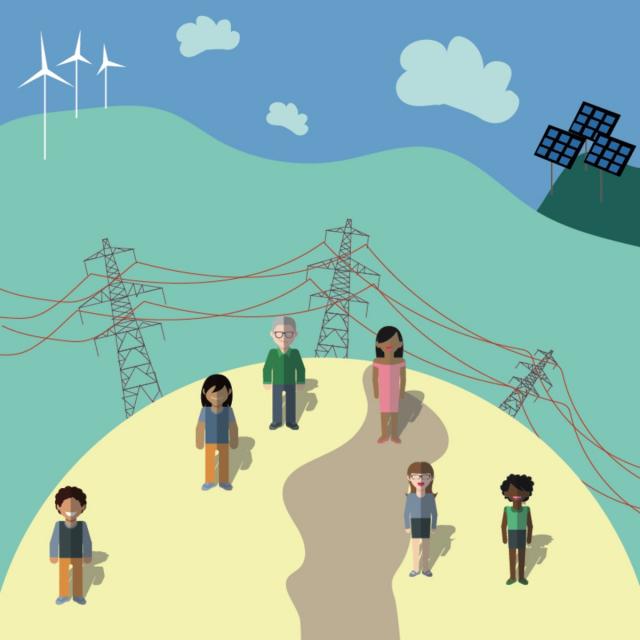
In Course 2: AI and Climate Change, you will begin by learning the basics of anthropogenic climate change — why it is happening, its projected impacts, and how it is already driving extreme weather around the globe. You will then learn how machine learning techniques can lessen climate change’s impacts and help communities prepare for those that do occur.

Class Deals by MOOC List - Click here and see Coursera's Active Discounts, Deals, and Promo Codes.

Learners will take part in two hands-on labs. In the first, you will use data modeling techniques to visualize how climate change is modeled to cause average temperatures to change in different locations around the world. In the second, you will build a model that forecasts how much power wind turbines in different locations will generate.
This course is part of the AI for Good Specialization, which demonstrates how AI is being harnessed to tackle some of the world’s biggest challenges — and provides a framework for you to be part of the solution.
This is a beginner-friendly course. Learners should be familiar with high school-level mathematics and basic spreadsheet operations. It is recommended that learners first complete Course 1: AI and Public Health.
Course 2 of 3 in the AI for Good Specialization.

Syllabus

WEEK 1: Introduction to AI and Climate Change
WEEK 2: Wind Power Forecasting
WEEK 3: Monitoring Biodiversity
WEEK 4: Monitoring Biodiversity Loss

Go to Class
MOOC List is learner-supported. When you buy through links on our site, we may earn an affiliate commission.

Related Courses

Gen AI for Code Generation for Python (Coursera) Coursera
Edureka

Gen AI for Code Generation for Python (Coursera)

Welcome to the 'Gen AI for Code Generation for Python' course, where you'll embark on a journey to explore and develop your skills in the art of code generation with Generative AI. Throughout this short course, you will delve into various techniques for generating Python code effortlessly, ranging from simple scripts to complete end-to-end projects.

Oct 12th 2026
1 Week
Technologies and platforms for Artificial Intelligence (Coursera) Coursera
Politecnico di Milano

Technologies and platforms for Artificial Intelligence (Coursera)

This course will address the hardware technologies for machine and deep learning (from the units of an Internet-of-Things system to a large-scale data centers) and will explore the families of machine and deep learning platforms (libraries and frameworks) for the design and development of smart applications and systems.

Oct 12th 2026
4 Weeks
Practical Machine Learning on H2O (Coursera) Coursera
H2O.ai

Practical Machine Learning on H2O (Coursera)

In this course, we will learn all the core techniques needed to make effective use of H2O. Even if you have no prior experience of machine learning, even if your math is weak, by the end of this course you will be able to make machine learning models using a variety of algorithms. We will be using linear models, random forest, GBMs and of course deep learning, as well as some unsupervised learning algorithms.

Oct 12th 2026
5-12 Weeks
Probabilistic Graphical Models 2: Inference (Coursera) Coursera
Stanford University

Probabilistic Graphical Models 2: Inference (Coursera)

Probabilistic graphical models (PGMs) are a rich framework for encoding probability distributions over complex domains: joint (multivariate) distributions over large numbers of random variables that interact with each other. These representations sit at the intersection of statistics and computer science, relying on concepts from probability theory, graph algorithms, machine learning, and more.

Oct 12th 2026
5-12 Weeks
Climate Change Mitigation in Developing Countries (Coursera) Coursera
University of Cape Town

Climate Change Mitigation in Developing Countries (Coursera)

This course challenges you to consider how one might lift societies out of poverty while also mitigating greenhouse gas emissions. We explore the inherent complexity of developing country governments wanting to grow their economies in a climate friendly way. You will be introduced to an approach with which to address this challenge. The approach consists of a facilitated process whereby academic researchers and high-level influential actors within society co-produce knowledge. You will track this process in four Latin American countries - Brazil, Chile, Colombia, Peru, and South Africa. You will hear from various professionals about their contexts and the different challenges and opportunities the process includes.

Oct 19th 2026
5-12 Weeks
Fundamentals of Machine Learning in Finance (Coursera) Coursera
New York University Tandon School of Engineering

Fundamentals of Machine Learning in Finance (Coursera)

The course aims at helping students to be able to solve practical ML-amenable problems that they may encounter in real life that include: (1) understanding where the problem one faces lands on a general landscape of available ML methods, (2) understanding which particular ML approach(es) would be most appropriate for resolving the problem, and (3) ability to successfully implement a solution, and assess its performance.

Oct 12th 2026
4 Weeks
ML Pipelines on Google Cloud (Coursera) Coursera
Google Cloud

ML Pipelines on Google Cloud (Coursera)

In this course, you will be learning from ML Engineers and Trainers who work with the state-of-the-art development of ML pipelines here at Google Cloud. The first few modules will cover about TensorFlow Extended (or TFX), which is Google’s production machine learning platform based on TensorFlow for management of ML pipelines and metadata. You will learn about pipeline components and pipeline orchestration with TFX. You will also learn how you can automate your pipeline through continuous integration and continuous deployment, and how to manage ML metadata.

Oct 12th 2026
4 Weeks
Data-Driven Decisions with Power BI (Coursera) Coursera
Knowledge Accelerators

Data-Driven Decisions with Power BI (Coursera)

New Power BI users will begin the course by gaining a conceptual understanding of the Power BI desktop application and the Power BI service. Learners will explore the Power BI interface while learning how to manage pages and understand the basics of visualizations. Learners will engage in numerous hands-on experiences to discover how to import, connect, clean, transform, and model their own data in the Power BI desktop application.

Oct 12th 2026
5-12 Weeks
Data Ingestion, Exploration & Visualization in Qlik Sense (Coursera) Coursera
Coursera Instructor Network

Data Ingestion, Exploration & Visualization in Qlik Sense (Coursera)

This course is an intermediate-level course designed for learners who want to continue their data visualization journey with Qlik Sense, a powerful sophisticated Business Intelligence tool. Data preparation and ingestion is a key prerequisite for data visualization, and this course not only dives deep into that concept, but other important intermediate topics such as filters, expressions, and personalization.

Oct 12th 2026
1 Week
Encoder-Decoder Architecture (Coursera) Coursera
Google Cloud

Encoder-Decoder Architecture (Coursera)

This course gives you a synopsis of the encoder-decoder architecture, which is a powerful and prevalent machine learning architecture for sequence-to-sequence tasks such as machine translation, text summarization, and question answering. You learn about the main components of the encoder-decoder architecture and how to train and serve these models. In the corresponding lab walkthrough, you’ll code in TensorFlow a simple implementation of the encoder-decoder architecture for poetry generation from the beginning.

Oct 12th 2026
1 Week