Structural Equation Model and its Applications | 结构方程模型及其应用 (普通话) (Coursera)

Structural Equation Model and its Applications | 结构方程模型及其应用 (普通话) (Coursera)

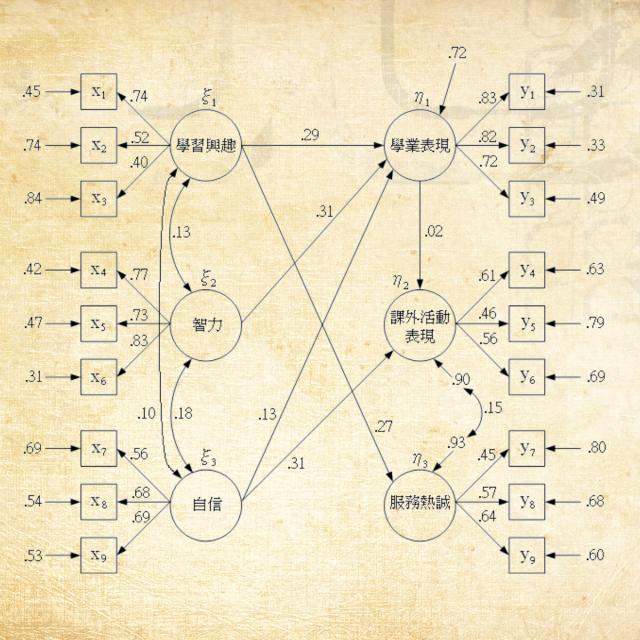
在社会学、心理学、教育学、经济学、管理学、市场学等研究领域的数据分析中,结构方程建模是当前最前沿的统计方法中应用最广、研究最多的一个。它包含了方差分析、回归分析、路径分析和因子分析,弥补了传统回归分析和因子分析的不足,可以分析多因多果的联系、潜变量的关系,

Class Deals by MOOC List - Click here and see Coursera's Active Discounts, Deals, and Promo Codes.

还可以处理多水平数据和纵向数据,是非常重要的多元数据分析工具。本课程系统地介绍结构方程模型和LISREL软件的应用,内容包括:结构方程分析(包括验证性因子分析)的基本概念、统计原理、在社会科学研究中的应用、常用模型及其LISREL程序、结果的解释和模型评价。学员应具备基本的统计知识(如:标准差、t-检验、相关系数),理解回归分析和因子分析的概念。 注:本课程配套教材为《结构方程模型及其应用》(以LISREL软件为例)。

Syllabus

WEEK 1: 课程资料
WEEK 2: 第一课:简介 (參考:第一章 引言)
WEEK 3: 第二课:探索性与验证性因子分析 (參考:第一章 引言)
WEEK 4: 第三课:SEM原理 (參考:第二章 结构方程模型简介)
WEEK 5: 第四课:验证性因子分析 (參考:第三章应用示范I 一、验证性因子分析)
WEEK 6: 第五课:多质多法模型 (參考:第三章应用示范I 二、多质多法模型)
WEEK 7: 第六课:全模型 (參考:第三章应用示范I 三、全模型)
WEEK 8: 第七课:高阶因子分析 (參考:第三章应用示范 四、高阶因子分析)
WEEK 9: 第八课:单纯形模型 (參考:第四章应用示范II:单纯形和多组模型 一、单纯形模型)
WEEK 10: 第九课:多组SEM分析 (參考:第四章应用示范II:单纯形和多组模型 二、多组验证性因子分析 三、多组分析:均值结构模型)
WEEK 11: 第十课:结构方程建模和分析步骤 (參考:第五章结构方程建模和分析步骤)
WEEK 12: 第十一课:涉及数据的问题 (參考:第六章专题讨论——涉及数据的问题 第七章专题讨论——涉及模型拟合的问题 第八章拟合指数)
WEEK 13: 第十二课:读取SPSS数据 (參考:附录III通过SPSS读取数据)
WEEK 14: 期末考
Go to Class
MOOC List is learner-supported. When you buy through links on our site, we may earn an affiliate commission.

Related Courses

Analyzing and Visualizing Data in Looker (Coursera) Coursera
Google Cloud

Analyzing and Visualizing Data in Looker (Coursera)

In this course, you learn how to do the kind of data exploration and analysis in Looker that would formerly be done primarily by SQL developers or analysts. Upon completion of this course, you will be able to leverage Looker's modern analytics platform to find and explore relevant content in your organization’s Looker instance, ask questions of your data, create new metrics as needed, and build and share visualizations and dashboards to facilitate data-driven decision making.

Sep 28th 2026
2 Weeks
Interprofessional Healthcare Informatics (Coursera) Coursera
University of Minnesota

Interprofessional Healthcare Informatics (Coursera)

Interprofessional Healthcare Informatics is a graduate-level, hands-on interactive exploration of real informatics tools and techniques offered by the University of Minnesota and the University of Minnesota's National Center for Interprofessional Practice and Education. We will be incorporating technology-enabled educational innovations to bring the subject matter to life. Over the 10 modules, we will create a vital online learning community and a working healthcare informatics network.

Sep 14th 2026
5-12 Weeks
Case studies in business analytics with ACCENTURE (Coursera) Coursera
ESSEC Business School

Case studies in business analytics with ACCENTURE (Coursera)

This course is RESTRICTED TO LEARNERS ENROLLED IN Strategic Business Analytics SPECIALIZATION as a preparation to the capstone project. During the first two MOOCs, we focused on specific techniques for specific applications. Instead, with this third MOOC, we provide you with different examples to open your mind to different applications from different industries and sectors. The objective is to give you an helicopter overview on what's happening in this field. You will see how the tools presented in the two previous courses of the Specialization are used in real life projects.

Sep 21st 2026
3 Weeks
Mathematical Biostatistics Boot Camp 1 (Coursera) Coursera
Johns Hopkins University

Mathematical Biostatistics Boot Camp 1 (Coursera)

This class presents the fundamental probability and statistical concepts used in elementary data analysis. It will be taught at an introductory level for students with junior or senior college-level mathematical training including a working knowledge of calculus. A small amount of linear algebra and programming are useful for the class, but not required.

Sep 14th 2026
4 Weeks
HI-FIVE: Health Informatics For Innovation, Value & Enrichment (Administrative/IT Perspective) (Coursera) Coursera
Columbia University

HI-FIVE: Health Informatics For Innovation, Value & Enrichment (Administrative/IT Perspective) (Coursera)

HI-FIVE (Health Informatics For Innovation, Value & Enrichment) Training is an approximately 10-hour online course designed by Columbia University in 2016, with sponsorship from the Office of the National Coordinator for Health Information Technology (ONC). The training is role-based and uses case scenarios. No additional hardware or software are required for this course. Our nation’s healthcare system is changing at a rapid pace.

Sep 28th 2026
4 Weeks
Pattern Discovery in Data Mining (Coursera) Coursera
University of Illinois at Urbana-Champaign

Pattern Discovery in Data Mining (Coursera)

Learn the general concepts of data mining along with basic methodologies and applications. Then dive into one subfield in data mining: pattern discovery. Learn in-depth concepts, methods, and applications of pattern discovery in data mining. We will also introduce methods for data-driven phrase mining and some interesting applications of pattern discovery. This course provides you the opportunity to learn skills and content to practice and engage in scalable pattern discovery methods on massive transactional data, discuss pattern evaluation measures, and study methods for mining diverse kinds of patterns, sequential patterns, and sub-graph patterns.

Sep 14th 2026
4 Weeks
Bioinformatic Methods I (Coursera) Coursera
University of Toronto

Bioinformatic Methods I (Coursera)

Large-scale biology projects such as the sequencing of the human genome and gene expression surveys using RNA-seq, microarrays and other technologies have created a wealth of data for biologists. However, the challenge facing scientists is analyzing and even accessing these data to extract useful information pertaining to the system being studied. This course focuses on employing existing bioinformatic resources – mainly web-based programs and databases – to access the wealth of data to answer questions relevant to the average biologist, and is highly hands-on.

Sep 21st 2026
5-12 Weeks
Gender Foundations in Health Data: A Data for Health Course (Coursera) Coursera
Johns Hopkins University

Gender Foundations in Health Data: A Data for Health Course (Coursera)

Welcome to Gender Foundations in Health Data: A Data for Health course. This course was developed from an online seminar series of the same name, that was hosted by Johns Hopkins University Bloomberg School of Health in 2021-22. The course instructors are Drs. Michelle Kaufman and Tahilin Sanchez Karver. This course will raise learners' awareness of the necessity of utilizing a gender lens in global public health data, policy, and practice, feature how-tos and key examples of integration of gender in data collection, analysis, and use from Data for Health partners.

Sep 28th 2026
1 Week
SQL: A Practical Introduction for Querying Databases (Coursera) Coursera
IBM

SQL: A Practical Introduction for Querying Databases (Coursera)

Much of the world's data lives in databases. SQL (or Structured Query Language) is a powerful programming language that is used for communicating with and manipulating data in databases. A working knowledge of databases and SQL is a must for anyone who wants to start a career in Data Engineering, Data Warehousing, Data Analytics, Data Science or Business Intelligence. The purpose of this course is to help you learn and apply foundational and intermediate knowledge of the SQL language, and become familiar with many relational database (RDBMS) concepts along the way.

Sep 21st 2026
5-12 Weeks
Assessing Health Program Delivery (Coursera) Coursera
Johns Hopkins University

Assessing Health Program Delivery (Coursera)

This course provides in-depth knowledge about implementation strength, quality of care, and service utilization, which are essential components of health program delivery. This course is primarily aimed at implementers, managers, funders, and evaluators of health programs in low- and middle-income settings (LMISs) targeting women and children, and undergraduate and graduate students in health-related fields.

Sep 21st 2026
5-12 Weeks