EdX

Stochastic Processes: Data Analysis and Computer Simulation (edX)

Offered by Kyoto University, KyotoUx,
Stochastic Processes: Data Analysis and Computer Simulation (edX)

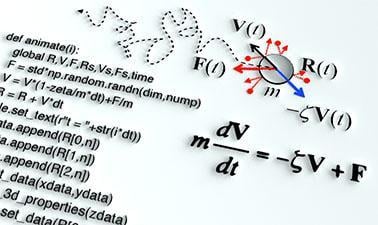
The course deals with how to simulate and analyze stochastic processes, in particular the dynamics of small particles diffusing in a fluid. The motion of falling leaves or small particles diffusing in a fluid is highly stochastic in nature. Therefore, such motions must be modeled as stochastic processes, for which exact predictions are no longer possible. This is in stark contrast to the deterministic motion of planets and stars, which can be perfectly predicted using celestial mechanics.

Class Deals by MOOC List - Click here and see EdX's Active Discounts, Deals, and Promo Codes.

This course is an introduction to stochastic processes through numerical simulations, with a focus on the proper data analysis needed to interpret the results. We will use the Jupyter (iPython) notebook as our programming environment. It is freely available for Windows, Mac, and Linux through the Anaconda Python Distribution.

The students will first learn the basic theories of stochastic processes. Then, they will use these theories to develop their own python codes to perform numerical simulations of small particles diffusing in a fluid. Finally, they will analyze the simulation data according to the theories presented at the beginning of course.
At the end of the course, we will analyze the dynamical data of more complicated systems, such as financial markets or meteorological data, using the basic theory of stochastic processes.

What you'll learn

  • Basic Python programming
  • Basic theories of stochastic processes
  • Simulation methods for a Brownian particle
  • Application: analysis of financial data

Syllabus

Week 1: Python programming for beginners

  • Using Python, iPython, and Jupyter notebook
  • Making graphs with matplotlib
  • The Euler method for numerical integration
  • Simulating a damped harmonic oscillator

Week 2: Distribution function and random number

  • Stochastic variable and distribution functions
  • Generating random numbers with Gaussian/binomial/Poisson distributions
  • The central limiting theorem
  • Random walk

Week 3: Brownian motion 1: basic theories

  • Basic knowledge of Stochastic process
  • Brownian motion and the Langevin equation
  • The linear response theory and the Green-Kubo formula

Week 4: Brownian motion 2: computer simulation

  • Random force in the Langevin equation
  • Simple Python code to simulate Brownian motion
  • Simulations with on-the-fly animation

Week 5: Brownian motion 3: data analyses

  • Distribution and time correlation
  • Mean square displacement and diffusion constant
  • Interacting Brownian particles

Week 6: Stochastic processes in the real world

  • Time variations and distributions of real world processes
  • A Stochastic Dealer Model I
  • A Stochastic Dealer Model II
  • A Stochastic Dealer Model III
Go to Class
MOOC List is learner-supported. When you buy through links on our site, we may earn an affiliate commission.

Related Courses

SQL for Data Science (edX) EdX
IBM

SQL for Data Science (edX)

Learn how to use and apply the powerful language of SQL to better communicate and extract data from databases - a must for anyone working in the data science field. Much of the world's data lives in databases. SQL (or Structured Query Language) is a powerful programming language that is used for communicating with and extracting various data types from databases.

Self Paced
Self-Paced
Case Studies in Functional Genomics (edX) EdX
HarvardX,Harvard University

Case Studies in Functional Genomics (edX)

Perform RNA-Seq, ChIP-Seq, and DNA methylation data analyses, using open source software, including R and Bioconductor. We will explain how to perform the standard processing and normalization steps, starting with raw data, to get to the point where one can investigate relevant biological questions.

Self Paced
Self-Paced
Observation Theory: Estimating the Unknown (edX) EdX
Delft University of Technology,DelftX

Observation Theory: Estimating the Unknown (edX)

Learn how to estimate parameters from observational data for real-world engineering applications and assess the quality of the results. Are you an engineer, scientist or technician? Are you dealing with measurements or big data, but are you unsure about how to proceed? This is the course that teaches you how to find the best estimates of the unknown parameters from noisy observations. You will also learn how to assess the quality of your results.

Self Paced
Self-Paced
Python Data Structures (edX) EdX
University of Michigan,MichiganX

Python Data Structures (edX)

The second course in Python for Everybody explores variables that contain collections of data like string, lists, dictionaries, and tuples. Learning how to store and represent and manipulate data collections while a program is running is an important part of learning how to program.

Self Paced
Self-Paced
Computing in Python II: Control Structures (edX) EdX
Georgia Institute of Technology,GTx

Computing in Python II: Control Structures (edX)

Learn about control structures, one of the most powerful parts of programming. This course covers conditionals, loops, functions, and error handling, specifically in Python but with broader applicability to other languages as well. Building on your prior knowledge of variables and operators, this course gets into the meat of programming. Organized into five chapters, this course starts by covering the fundamentals of what control structures are and what they do, then moves on to four common control structures in Python.

Self Paced
Self-Paced
Data Science: R Basics (edX) EdX
HarvardX,Harvard University

Data Science: R Basics (edX)

Build a foundation in R and learn how to wrangle, analyze, and visualize data. This course will introduce you to the basics of R programming. You can better retain R when you learn it to solve a specific problem, so you’ll use a real-world dataset about crime in the United States. You will learn the R skills needed to answer essential questions about differences in crime across the different states.

Self Paced
Self-Paced
Analytics for Decision Making (edX) EdX
Babson College

Analytics for Decision Making (edX)

Discover the foundational concepts that support modern data science and learn to analyze various data types and quality to make smart business decisions. Want to know how to avoid bad decisions with data? Making good decisions with data can give you a distinct competitive advantage in business. This statistics and data analysis course will help you understand the fundamental concepts of sound statistical thinking that can be applied in surprisingly wide contexts, sometimes even before there is any data! Key concepts like understanding variation, perceiving relative risk of alternative decisions, and pinpointing sources of variation will be highlighted.

Self Paced
Self-Paced
Full Stack Application Development Project (edX) EdX
IBM

Full Stack Application Development Project (edX)

For this project you will apply your knowledge of front end and back end development gained from previous courses and build and deploy a full stack real-world web application on the cloud. Your project will showcase your understanding of the user experience and user interface design process, and your skills and technologies with Django, Python, Node.JS and Containers.

Self Paced
Self-Paced
Excel avanzado: importación y análisis de datos (edX) EdX
Universitat Politècnica de València,UPValenciaX

Excel avanzado: importación y análisis de datos (edX)

Conoce técnicas y estrategias avanzadas para importar, consolidar y visualizar con Excel datos provenientes de cualquier fuente. En este curso de análisis e interpretación de datos te presentaremos técnicas avanzadas de importación de datos y estrategias diversas para consolidarlos y prepararlos una vez importados de forma que puedas extraer las conclusiones que necesitas (basadas en nuestra experiencia en el uso de Microsoft Excel y demostradas con casos reales).

Self Paced
Self-Paced
CS50's Introduction to Artificial Intelligence with Python (edX) EdX
HarvardX,Harvard University

CS50's Introduction to Artificial Intelligence with Python (edX)

Learn to use machine learning in Python in this introductory course on artificial intelligence. AI is transforming how we live, work, and play. By enabling new technologies like self-driving cars and recommendation systems or improving old ones like medical diagnostics and search engines, the demand for expertise in AI and machine learning is growing rapidly. This course will enable you to take the first step toward solving important real-world problems and future-proofing your career.

Self Paced
Self-Paced