Robotics: Aerial Robotics (Coursera)

Robotics: Aerial Robotics (Coursera)

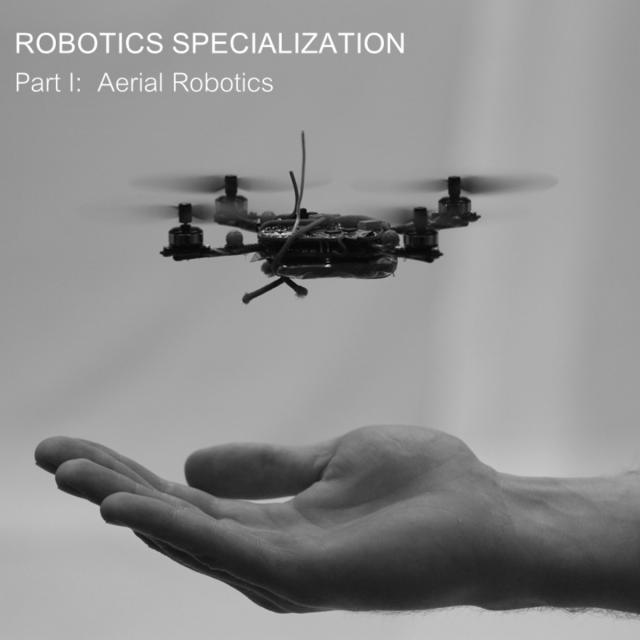
How can we create agile micro aerial vehicles that are able to operate autonomously in cluttered indoor and outdoor environments? You will gain an introduction to the mechanics of flight and the design of quadrotor flying robots and will be able to develop dynamic models, derive controllers, and synthesize planners for operating in three dimensional environments.

Class Deals by MOOC List - Click here and see Coursera's Active Discounts, Deals, and Promo Codes.

You will be exposed to the challenges of using noisy sensors for localization and maneuvering in complex, three-dimensional environments. Finally, you will gain insights through seeing real world examples of the possible applications and challenges for the rapidly-growing drone industry.
Mathematical prerequisites: Students taking this course are expected to have some familiarity with linear algebra, single variable calculus, and differential equations.
Programming prerequisites: Some experience programming with MATLAB or Octave is recommended (we will use MATLAB in this course.) MATLAB will require the use of a 64-bit computer.

Course 1 of 6 in the Robotics Specialization.

Syllabus

WEEK 1
Introduction to Aerial Robotics
Welcome to Week 1! In this week, you will be introduced to the exciting field of Unmanned Aerial Robotics (UAVs) and quadrotors in particular. You will learn about their basic mechanics and control strategies and realize how careful component selection and design affect the vehicles' performance. This week also provides you with instructions on how to download and install Matlab. This software will be used throughout this course in exercises and assignments, so it is strongly recommended to familiarize yourself with Matlab soon. Tutorials to help you get started are also provided in this week.

WEEK 2
Geometry and Mechanics
Welcome to Week 2 of the Robotics: Aerial Robotics course! We hope you are having a good time and learning a lot already! In this week, we will first focus on the kinematics of quadrotors. Then, you will learn how to derive the dynamic equations of motion for quadrotors. To build a better understanding on these notions, some essential mathematical tools are discussed in supplementary material lectures. In this week, you will also complete your first programming assignment on 1-D quadrotor control. If you have not done so already, please download, install, and learn about Matlab before starting the assignment.

WEEK 3
Planning and Control
Welcome to Week 3! We have developed planar and three-dimensional dynamic models of the quadrotor. This week, you will learn more about how to develop linear controllers for these models. With this knowledge, you will be required to complete the second programming assignment of this course, which focuses on controlling the quadrotor in two dimensions. We encourage you to start working on the assignment soon. This week ends with a discussion on motion planning for quadrotors.

WEEK 4
Advanced Topics
Welcome to Week 4! So far, we have gone over the basics of developing linear controllers for quadrotors and motion planning. In this last week of the course, we will discuss some more advanced material on how to enable quadrotors to perform more agile maneuvers and to operate autonomously in teams. Note that the last programming assignment on quadrotor control in three dimensions uses material from the previous weeks. It is strongly recommended to start the assignment as soon as possible.

Go to Class
MOOC List is learner-supported. When you buy through links on our site, we may earn an affiliate commission.

Related Courses

Mastering Programming with MATLAB (Coursera) Coursera
Vanderbilt University

Mastering Programming with MATLAB (Coursera)

The course builds on the foundation laid by the first course of the Specialization called “Introduction to Programming with MATLAB.” It covers more advanced programming concepts such as recursion, vectorization, function handles, algorithm efficiency and others. At the same time, it presents many features that make MATLAB a powerful programming environment for engineering and scientific computing, such as its support for object oriented programming, the new user interface design environment and Live Scripts.

Aug 3rd 2026
5-12 Weeks
Modern Robotics, Course 1: Foundations of Robot Motion (Coursera) Coursera
Northwestern University

Modern Robotics, Course 1: Foundations of Robot Motion (Coursera)

Do you want to know how robots work? Are you interested in robotics as a career? Are you willing to invest the effort to learn fundamental mathematical modeling techniques that are used in all subfields of robotics? If so, then the "Modern Robotics: Mechanics, Planning, and Control" specialization may be for you. This specialization, consisting of six short courses, is serious preparation for serious students who hope to work in the field of robotics or to undertake advanced study. It is not a sampler.

Jul 27th 2026
4 Weeks
Modern Robotics, Course 5: Robot Manipulation and Wheeled Mobile Robots (Coursera) Coursera
Northwestern University

Modern Robotics, Course 5: Robot Manipulation and Wheeled Mobile Robots (Coursera)

Do you want to know how robots work? Are you interested in robotics as a career? Are you willing to invest the effort to learn fundamental mathematical modeling techniques that are used in all subfields of robotics? If so, then the "Modern Robotics: Mechanics, Planning, and Control" specialization may be for you. This specialization, consisting of six short courses, is serious preparation for serious students who hope to work in the field of robotics or to undertake advanced study. It is not a sampler.

Aug 3rd 2026
4 Weeks
Dynamical Modeling Methods for Systems Biology (Coursera) Coursera
Icahn School of Medicine at Mount Sinai

Dynamical Modeling Methods for Systems Biology (Coursera)

An introduction to dynamical modeling techniques used in contemporary Systems Biology research. We take a case-based approach to teach contemporary mathematical modeling techniques. The course is appropriate for advanced undergraduates and beginning graduate students. Lectures provide biological background and describe the development of both classical mathematical models and more recent representations of biological processes. The course will be useful for students who plan to use experimental techniques as their approach in the laboratory and employ computational modeling as a tool to draw deeper understanding of experiments.

Aug 10th 2026
5-12 Weeks
Exploratory Data Analysis with MATLAB (Coursera) Coursera
MathWorks

Exploratory Data Analysis with MATLAB (Coursera)

In this course, you will learn to think like a data scientist and ask questions of your data. You will use interactive features in MATLAB to extract subsets of data and to compute statistics on groups of related data. You will learn to use MATLAB to automatically generate code so you can learn syntax as you explore. You will also use interactive documents, called live scripts, to capture the steps of your analysis, communicate the results, and provide interactive controls allowing others to experiment by selecting groups of data.

Jul 27th 2026
5-12 Weeks
Controle de Sistemas no Plano-s (Coursera) Coursera
Instituto Tecnológico de Aeronáutica

Controle de Sistemas no Plano-s (Coursera)

Após esse curso você será capaz de esboçar o Lugar Geométrico das Raízes (LGR - Root Locus) do denominador da Função de Transferência em Malha Fechada a partir dos polos e zeros da Função de Transferência em Malha aberta. Você também será capaz de projetar controladores de avanço de fase para atender simultaneamente requisitos de desempenho de amortecimento e de velocidade da resposta.

Aug 3rd 2026
5-12 Weeks
Motion Planning for Self-Driving Cars (Coursera) Coursera
University of Toronto

Motion Planning for Self-Driving Cars (Coursera)

Welcome to Motion Planning for Self-Driving Cars, the fourth course in University of Toronto’s Self-Driving Cars Specialization. This course will introduce you to the main planning tasks in autonomous driving, including mission planning, behavior planning and local planning. By the end of this course, you will be able to find the shortest path over a graph or road network using Dijkstra's and the A* algorithm, use finite state machines to select safe behaviors to execute, and design optimal, smooth paths and velocity profiles to navigate safely around obstacles while obeying traffic laws.

Jul 27th 2026
5-12 Weeks
Introduction to Image Processing (Coursera) Coursera
MathWorks

Introduction to Image Processing (Coursera)

In this introduction to image processing, you'll take your first steps in accessing and adjusting digital images for analysis and processing. You will load, save, and adjust image size and orientation while also understanding how digital images are recognized. You will then perform basic segmentation and quantitative analysis. Lastly, you will enhance the contrast of images to make objects of interest easier to identify.

Aug 3rd 2026
4 Weeks
Data Science Companion (Coursera) Coursera
MathWorks

Data Science Companion (Coursera)

The Data Science Companion provides an introduction to data science. You will gain a quick background in data science and core machine learning concepts, such as regression and classification. You’ll be introduced to the practical knowledge of data processing and visualization using low-code solutions, as well as an overview of the ways to integrate multiple tools effectively to solve data science problems.

Jul 31st 2026
4 Weeks
Computational Neuroscience (Coursera) Coursera
University of Washington

Computational Neuroscience (Coursera)

This course provides an introduction to basic computational methods for understanding what nervous systems do and for determining how they function. We will explore the computational principles governing various aspects of vision, sensory-motor control, learning, and memory. Specific topics that will be covered include representation of information by spiking neurons, processing of information in neural networks, and algorithms for adaptation and learning.

Aug 17th 2026
5-12 Weeks