Redes Ecológicas (Coursera)

Redes Ecológicas (Coursera)

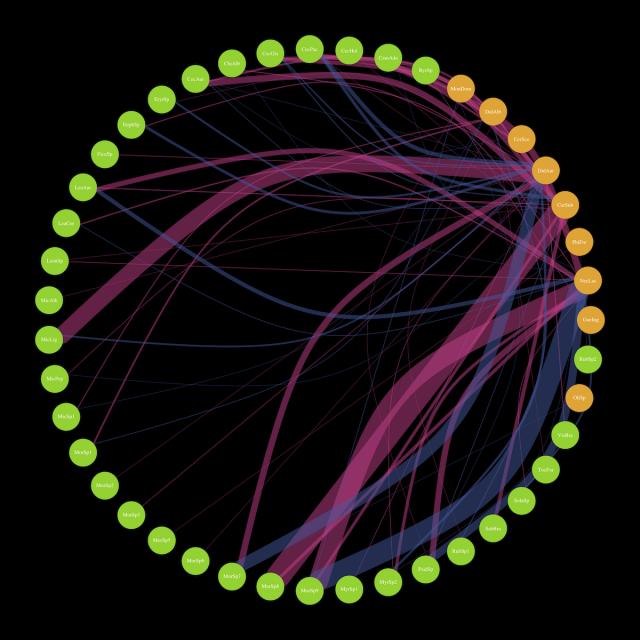
Todos os seres vivos estão conectados entre si por interações ecológicas, formando a “colina emaranhada” de Darwin, metáfora inspirada pela “teia da vida” de Humboldt. Desemaranhar essa complexidade é uma tarefa desafiadora, mas factível, desde que você use ferramentas adequadas. A ciência de redes nos ajuda com excelentes ferramentas conceituais e operacionais.

Class Deals by MOOC List - Click here and see Coursera's Active Discounts, Deals, and Promo Codes.

Você aceita este chamado para a aventura? Então venha comigo aprender os fundamentos sobre redes ecológicas!
Seguindo esse espírito, este curso visa ajudar pessoas interessadas em dar seus primeiros passos na análise de redes aplicada à Ecologia. Este é um curso introdutório, focado especialmente em redes de interações. Redes sociais e redes espaciais também são mencionadas, mas não de forma aprofundada, nas diversas atividades do curso.
Dedicando-se a essas atividades durante quatro semanas, ao final deste curso você terá adquirido uma visão geral sobre as teorias que orientam o estudo de redes ecológicas. Além disso, você será capaz de analisar gráfica- e numericamente, além de interpretar, dados de redes usando a linguagem de programação R.
Dessa forma, para aproveitar bem este curso você deve dominar habilidades básicas na linguagem R, além de ter familiaridade com conceitos básicos em Ecologia em nível de graduação. Mais concretamente, é importante que você já saiba como importar dados para o R, além de usar pacotes e rodar funções. Não é necessário saber construir funções personalizadas (UDFs).
Para ir além, aproveitando o conteúdo extra sugerido para aprofundamento posterior ao curso, é recomendável saber ler em inglês. Vale lembrar também que a ajuda dos pacotes e funções do R é toda escrita em inglês, então dominar a leitura nesse idioma também é importante para analisar dados com mais desenvoltura.
Também é importante mencionar que diversos conceitos estatísticos são mencionados no curso. Portanto, ter conhecimento básico sobre probabilidade, distribuições de dados, medidas de tendência central e medidas de dispersão ajuda muito.
Se você ainda não domina os fundamentos da linguagem R, recomendo que primeiro faça um dos excelentes cursos introdutórios disponíveis aqui na Coursera, como "R Programming" ou "The R Programming Environment". Há também aqui excelentes cursos introdutórios de estatística que podem lhe ensinar o básico sobre análise de dados.

What You Will Learn

  • Fundamentos da ciência de redes
  • Fundamentos de visualização e análise de redes
  • Interpretação biológica de redes

Syllabus

WEEK 1: Fundamentos
WEEK 2: Estrutura
WEEK 3: Centralidade
WEEK 4: Fechamento

Go to Class
MOOC List is learner-supported. When you buy through links on our site, we may earn an affiliate commission.

Related Courses

Introduction to Data Networks and the Internet - Master's (Coursera) Coursera
Illinois Tech

Introduction to Data Networks and the Internet - Master's (Coursera)

This course covers current and evolving data network technologies, protocols, network components, and the networks that use them, focusing on communication to and from the Internet and Local area networks. Course content includes Internet architecture, organization, and protocols including Ethernet, 802.11, routing, switching, OSI and TCP models, DNS, SNMP, DHCP, and more.

Aug 17th 2026
5-12 Weeks
Fundamentos de Excel para Negocios (Coursera) Coursera
Universidad Austral

Fundamentos de Excel para Negocios (Coursera)

Cuando finalices este curso habrás logrado un gran número de habilidades como introducir información, ordenarla, manipularla, realizar cálculos de diversa índole (matemáticos, trigonométricos, estadísticos, financieros, ingenieriles, probabilísticos), extraer conclusiones, trabajar con fechas y horas, construir gráficos, imprimir reportes y muchas más.

Aug 17th 2026
5-12 Weeks
Big Data Analysis with Scala and Spark (Coursera) Coursera
École Polytechnique Fédérale de Lausanne

Big Data Analysis with Scala and Spark (Coursera)

Manipulating big data distributed over a cluster using functional concepts is rampant in industry, and is arguably one of the first widespread industrial uses of functional ideas. This is evidenced by the popularity of MapReduce and Hadoop, and most recently Apache Spark, a fast, in-memory distributed collections framework written in Scala. In this course, we'll see how the data parallel paradigm can be extended to the distributed case, using Spark throughout.

Aug 17th 2026
4 Weeks
Research Design: Inquiry and Discovery (Coursera) Coursera
University of North Texas

Research Design: Inquiry and Discovery (Coursera)

The main purpose of this course is to focus on good questions and how to answer them. This is essential to making considered decisions as a leader in any organization or in your life overall. Topics will include the basis of human curiosity, development of questions, connections between questions and approaches to information gathering design, variable measurement, sampling, the differences between experimental and non-experimental designs, data analysis, reporting and the ethics of inquiry projects.

Aug 17th 2026
4 Weeks
Structural Equation Model and its Applications | 结构方程模型及其应用 (普通话) (Coursera) Coursera
The Chinese University of Hong Kong

Structural Equation Model and its Applications | 结构方程模型及其应用 (普通话) (Coursera)

在社会学、心理学、教育学、经济学、管理学、市场学等研究领域的数据分析中,结构方程建模是当前最前沿的统计方法中应用最广、研究最多的一个。它包含了方差分析、回归分析、路径分析和因子分析,弥补了传统回归分析和因子分析的不足,可以分析多因多果的联系、潜变量的关系,

Aug 17th 2026
5-12 Weeks
Principles of fMRI 1 (Coursera) Coursera
Johns Hopkins University

Principles of fMRI 1 (Coursera)

Functional Magnetic Resonance Imaging (fMRI) is the most widely used technique for investigating the living, functioning human brain as people perform tasks and experience mental states. It is a convergence point for multidisciplinary work from many disciplines. Psychologists, statisticians, physicists, computer scientists, neuroscientists, medical researchers, behavioral scientists, engineers, public health researchers, biologists, and others are coming together to advance our understanding of the human mind and brain. This course covers the design, acquisition, and analysis of Functional Magnetic Resonance Imaging (fMRI) data, including psychological inference, MR Physics, K Space, experimental design, pre-processing of fMRI data, as well as Generalized Linear Models (GLM’s).

Aug 17th 2026
4 Weeks
Analytics in Healthcare Management and Administration (Coursera) Coursera
Northeastern University

Analytics in Healthcare Management and Administration (Coursera)

This course is the continuation of Healthcare Analytics Essentials . If you have not yet taken the Healthcare Analytics Essentials course, it is recommended that you complete that course prior to this course. The foundational knowledge to support the project are carried through in this deeper dive into using healthcare analytics in management and administration.

Aug 17th 2026
4 Weeks
Mathematical Biostatistics Boot Camp 1 (Coursera) Coursera
Johns Hopkins University

Mathematical Biostatistics Boot Camp 1 (Coursera)

This class presents the fundamental probability and statistical concepts used in elementary data analysis. It will be taught at an introductory level for students with junior or senior college-level mathematical training including a working knowledge of calculus. A small amount of linear algebra and programming are useful for the class, but not required.

Aug 17th 2026
4 Weeks