EdX

MATLAB Essentials (edX)

Offered by MathWorks,
MATLAB Essentials (edX)

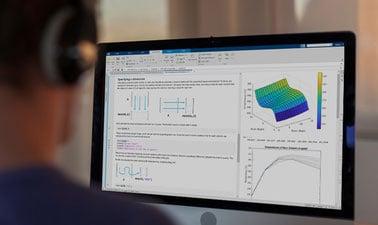
Master the essentials of data visualization, data analysis, programming, and app design interactively with MATLAB. Expand your data analysis and modeling skills in MATLAB, a programming and numeric computing platform used to analyze data, develop algorithms, and create models. Millions of engineers and scientists worldwide use MATLAB to study and build advanced applications in machine learning, deep learning, signal processing, communications, image processing, and control systems.

Class Deals by MOOC List - Click here and see EdX's Active Discounts, Deals, and Promo Codes.

They are shaping the future by modeling rockets that may someday take you into space, developing autonomous vehicles to travel safely and efficiently, and designing wave farms that harness the power of ocean waves to generate clean energy.
In this course, you'll use MATLAB to examine real-world problems and answer questions like:

  • How far does a blue whale swim each day?
  • What is the favorite topping in a pizza shop?
  • What is the ride quality of a car suspension?
  • How does the magnitude of an earthquake impact the strength of a tsunami?
  • What is the most expensive failure in a factory?

MATLAB makes it easy to see results quickly, so there are no pre-requisites for the course. You will learn how to process, analyze, and visualize data collected nearly everywhere in today's digital workplace. You'll use powerful templates and auto-generated code to start experimenting immediately and quickly process similar data sets. And you'll gain the essential programming skills needed to perform these exciting tasks.
Throughout the course, you'll have ample opportunities to practice your newly acquired skills – through auto-graded assignments, practice quizzes, interactive readings, and projects. By the end of the course, you'll be ready to analyze your own data sets and impress colleagues with word clouds, geographic plots, animations, and more.

What you'll learn

  • Accessing data within a wide range of formats from spreadsheets and text files
  • Producing professional-quality visualizations for 2-D, 3-D, geographic, text, and time-series data
  • Performing typical analysis tasks such as group statistics or processing data
  • Creating animations to visualize changes over time
  • Sharing work with colleagues for collaboration

Go to Class
MOOC List is learner-supported. When you buy through links on our site, we may earn an affiliate commission.

Related Courses

Data Visualization & Cloud Technologies (edX) EdX
University of Wisconsin–Madison,WisconsinX

Data Visualization & Cloud Technologies (edX)

Learn to use data visualization and cloud technologies for business analytics. In this course, gain experience in data visualization and cloud technologies to support business analytics. In the first half of the course, create and share compelling data visualizations to enhance decision-making. In the second half of the course, use cloud technologies to build scalable data warehouses, analyze big data, and develop and deploy machine learning models.

Mar 18th 2024
5-12 Weeks
Foundations of Data Analysis - Part 1: Statistics Using R (edX) EdX
University of Texas at Austin,UTAustinX

Foundations of Data Analysis - Part 1: Statistics Using R (edX)

This is a hands on course with a data lab to teach fundamental statistical topics such as descriptive statistics, inferential testing, and modeling. In this first part of a two part course, we’ll walk through the basics of statistical thinking – starting with an interesting question. Then, we’ll learn the correct statistical tool to help answer our question of interest – using R and hands-on Labs.

No sessions available
5-12 Weeks
Understanding the World Through Data (edX) EdX
MIT,MITx

Understanding the World Through Data (edX)

Become a data explorer – learn how to leverage data and basic machine learning algorithms to understand the world. Speech recognition, drones, and self-driving cars – things that once seemed like pure science fiction – are now widely available technologies, and just a few examples of how humans have taught machines to analyze data and make decisions. In this hands-on, introductory course, you will examine all the forms in which data exists, learn tools that uncover relationships between data, and leverage basic algorithms to understand the world from a new perspective.

Mar 13th 2024
5-12 Weeks
Applications of Linear Algebra Part 2 (edX) EdX
Davidson College,DavidsonX

Applications of Linear Algebra Part 2 (edX)

Explore applications of linear algebra in the field of data mining by learning fundamentals of search engines, clustering movies into genres and of computer graphics by posterizing an image. Our world is in a data deluge with ever increasing sizes of datasets. Linear algebra is a tool to manage and analyze such data. This course is part 2 of a 2-part course, with this part extending smoothly from the first. Note, however, that part 1, is not a prerequisite for part 2.

No sessions available
4 Weeks
Introduction to Computer Science and Programming Using Python (edX) EdX
MIT,MITx

Introduction to Computer Science and Programming Using Python (edX)

An introduction to computer science as a tool to solve real-world analytical problems using Python 3.5. This course is the first of a two-course sequence: Introduction to Computer Science and Programming Using Python, and Introduction to Computational Thinking and Data Science. Together, they are designed to help people with no prior exposure to computer science or programming learn to think computationally and write programs to tackle useful problems.

Jan 24th 2024
5-12 Weeks
Computing for Data Analysis (edX) EdX
Georgia Institute of Technology,GTx

Computing for Data Analysis (edX)

A hands-on introduction to basic programming principles and practice relevant to modern data analysis, data mining, and machine learning. The modern data analysis pipeline involves collection, preprocessing, storage, analysis, and interactive visualization of data. In the course, you’ll see how computing and mathematics come together.

Aug 19th 2024
13-24 Weeks
Computing: Art, Magic, Science (edX) EdX
ETH Zurich,ETHx

Computing: Art, Magic, Science (edX)

Learn the basics of Information Technology and how to write quality programs in this introductory computer science course. Information Technology (IT) is everywhere. Every aspect of human activity depends on it. All IT processes, whether they drive mobile phones, the Internet, transportation systems, enterprise systems, publishing, social networks or any other application, rely on software.

No sessions available
4 Weeks
Introduction to Linear Models and Matrix Algebra (edX) EdX
HarvardX,Harvard University

Introduction to Linear Models and Matrix Algebra (edX)

Learn to use R programming to apply linear models to analyze data in life sciences. Matrix Algebra underlies many of the current tools for experimental design and the analysis of high-dimensional data. In this introductory data analysis course, we will use matrix algebra to represent the linear models that commonly used to model differences between experimental units. We perform statistical inference on these differences. Throughout the course we will use the R programming language.

Self Paced
Self-Paced
Introduction to Java Programming - Part 1 (edX) EdX
The Hong Kong University of Science and Technology - HKUST,HKUSTx

Introduction to Java Programming - Part 1 (edX)

Learn the fundamental elements of Java programming and data abstraction. Do you want to become a better problem solver? This Java course will provide you with a strong understanding of basic Java programming elements and data abstraction using problem representation and the object-oriented framework.

Self Paced
Self-Paced
Data Analysis: Statistical Modeling and Computation in Applications (edX) EdX
MIT,MITx

Data Analysis: Statistical Modeling and Computation in Applications (edX)

A hands-on introduction to the interplay between statistics and computation for the analysis of real data. -- Part of the MITx MicroMasters program in Statistics and Data Science. Data science requires multi-disciplinary skills ranging from mathematics, statistics, machine learning, problem solving to programming, visualization, and communication skills. In this course, learners will combine these foundational and practical skills with domain knowledge to ask and answer questions using real data.

May 13th 2024
13-24 Weeks