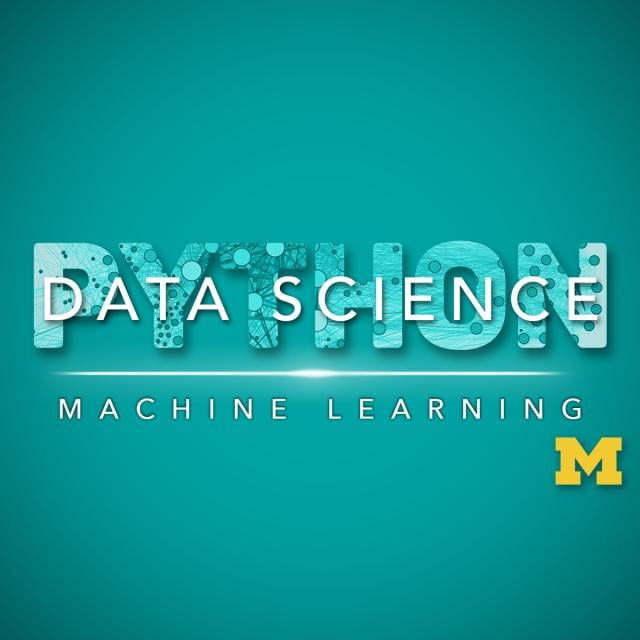
Introduction to Machine Learning with Python (Coursera)

Introduction to Machine Learning with Python (Coursera)

This course will give you an introduction to machine learning with the Python programming language. You will learn about supervised learning, unsupervised learning, deep learning, image processing, and generative adversarial networks. You will implement machine learning models using Python and will learn about the many applications of machine learning used in industry today. You will also learn about and use different machine learning algorithms to create your models.

Class Deals by MOOC List - Click here and see Coursera's Active Discounts, Deals, and Promo Codes.

You do not need a programming or computer science background to learn the material in this course. This course is open to anyone who is interested in learning how to code and write programs in Python. We are very excited that you will be learning with us and hope you enjoy the course!
This course is part of the Python: A Guided Journey from Introduction to Application Specialization.

What you'll learn
Students will be able to apply advanced python coding skills in the real world by creating machine learning models.

Syllabus

Course Introduction
Module 1
This course will give you an introduction to machine learning with the Python programming language. You will learn about supervised learning, unsupervised learning, deep learning, image processing, and generative adversarial networks. You will implement machine learning models using Python and will learn about the many applications of machine learning used in industry today. You will also learn about and use different machine learning algorithms to create your models. You do not need a programming or computer science background to learn the material in this course. This course is open to anyone who is interested in learning how to code and write programs in Python. We are very excited that you will be learning with us and hope you enjoy the course!

Module 1: Introduction to Machine Learning
Module 2
In this module you will learn about machine learning and how each branch of machine learning works in Python.

Module 2: More Supervised Learning Algorithms
Module 3
In this module, you will learn about two other supervised machine learning models: k-nearest neighbors (kNN) and support vector machines (SVM). You will learn under which conditions you’d use these two models. You will also learn about unsupervised machine learning models and how they work.

Module 3: Advanced Machine Learning Topics
Module 4
In this module, you will gain an overview of advanced machine learning topics, including deep learning, image processing, and generative adversarial networks (GANs).
Go to Class
MOOC List is learner-supported. When you buy through links on our site, we may earn an affiliate commission.

Related Courses

Preparing for the Google Cloud Professional Data Engineer Exam en Español (Coursera) Coursera
Google Cloud

Preparing for the Google Cloud Professional Data Engineer Exam en Español (Coursera)

En este curso, se emplea un enfoque descendente a fin de identificar las habilidades y los conocimientos adquiridos, así como poner en evidencia la información y las áreas de habilidades que requieren una preparación adicional. Puede aprovechar este curso para crear su propio plan de preparación personalizado. Lo ayudará a distinguir lo que sabe de lo que no. Además, le permitirá desarrollar y practicar las habilidades que se les exigen a los profesionales que realizan este trabajo.

Aug 10th 2026
1 Week
Big Data Analysis Deep Dive (Coursera) Coursera
Alibaba Cloud Academy

Big Data Analysis Deep Dive (Coursera)

The job market for architects, engineers, and analytics professionals with Big Data expertise continues to increase. The Academy’s Big Data Career path focuses on the fundamental tools and techniques needed to pursue a career in Big Data. This course includes: data processing with python, writing and reading SQL queries, transmitting data with MaxCompute, analyzing data with Quick BI, using Hive, Hadoop, and spark on E-MapReduce, and how to visualize data with data dashboards. Work through our course material, learn different aspects of the Big Data field, and get certified as a Big Data Professional!

Aug 3rd 2026
5-12 Weeks
Data Processing Using Python (Coursera) Coursera
Nanjing University

Data Processing Using Python (Coursera)

This course is mainly for non-computer majors. It starts with the basic syntax of Python, to how to acquire data in Python locally and from network, to how to present data, then to how to conduct basic and advanced statistic analysis and visualization of data, and finally to how to design a simple GUI to present and process data, advancing level by level.

Aug 10th 2026
5-12 Weeks
Visualization for Data Journalism (Coursera) Coursera
University of Illinois at Urbana-Champaign

Visualization for Data Journalism (Coursera)

While telling stories with data has been part of the news practice since its earliest days, it is in the midst of a renaissance. Graphics desks which used to be deemed as “the art department,” a subfield outside the work of newsrooms, are becoming a core part of newsrooms’ operation. Those people (they often have various titles: data journalists, news artists, graphic reporters, developers, etc.) who design news graphics are expected to be full-fledged journalists and work closely with reporters and editors.

Aug 10th 2026
5-12 Weeks
Estruturas de dados Python (Coursera) Coursera
University of Michigan

Estruturas de dados Python (Coursera)

Este curso apresentará as estruturas de dados centrais da linguagem de programação Python. Vamos superar os fundamentos da programação de procedimentos e explorar como podemos usar as estruturas de dados integradas do Python, como listas, dicionários e tuplas, para realizar análises de dados cada vez mais complexas. Este curso cobrirá os capítulos 6 a 10 do livro “Python para Todos”. Este curso aborda o Python 3.

Aug 10th 2026
5-12 Weeks
Remote Sensing Image Acquisition, Analysis and Applications (Coursera) Coursera
UNSW Sydney - University of New South Wales

Remote Sensing Image Acquisition, Analysis and Applications (Coursera)

Welcome to Remote Sensing Image Acquisition, Analysis and Applications, in which we explore the nature of imaging the earth's surface from space or from airborne vehicles. This course covers the fundamental nature of remote sensing and the platforms and sensor types used. It also provides an in-depth treatment of the computational algorithms employed in image understanding, ranging from the earliest historically important techniques to more recent approaches based on deep learning.

Aug 17th 2026
13-24 Weeks
An Introduction to Interactive Programming in Python (Part 2) (Coursera) Coursera
Rice University

An Introduction to Interactive Programming in Python (Part 2) (Coursera)

This two-part course is designed to help students with very little or no computing background learn the basics of building simple interactive applications. Our language of choice, Python, is an easy-to learn, high-level computer language that is used in many of the computational courses offered on Coursera. To make learning Python easy, we have developed a new browser-based programming environment that makes developing interactive applications in Python simple.

Aug 10th 2026
4 Weeks
Computers, Waves, Simulations: A Practical Introduction to Numerical Methods using Python (Coursera) Coursera
Ludwig-Maximilians-Universität München

Computers, Waves, Simulations: A Practical Introduction to Numerical Methods using Python (Coursera)

Interested in learning how to solve partial differential equations with numerical methods and how to turn them into python codes? This course provides you with a basic introduction how to apply methods like the finite-difference method, the pseudospectral method, the linear and spectral element method to the 1D (or 2D) scalar wave equation.

Aug 10th 2026
5-12 Weeks
Introduction to Neurohacking In R (Coursera) Coursera
Johns Hopkins University

Introduction to Neurohacking In R (Coursera)

Neurohacking describes how to use the R programming language and its associated package to perform manipulation, processing, and analysis of neuroimaging data. We focus on publicly-available structural magnetic resonance imaging (MRI). We discuss concepts such as inhomogeneity correction, image registration, and image visualization.

Aug 10th 2026
4 Weeks