Intro to Algorithms (Udacity)

Offered by Udacity,
Intro to Algorithms (Udacity)

This class will give you an introduction to the design and analysis of algorithms, enabling you to analyze networks and discover how individuals are connected.

Class Deals by MOOC List - Click here and see Udacity's Active Discounts, Deals, and Promo Codes.

Ever played the Kevin Bacon game? This class will show you how it works by giving you an introduction to the design and analysis of algorithms, enabling you to discover how individuals are connected. By the end of this class, you will understand key concepts needed to devise new algorithms for graphs and other important data structures and to evaluate the efficiency of these algorithms.

Syllabus

LESSON 1
A Social Network Magic Trick

  • Become familiar with algorithm analysis.
  • Eulerian Path and Correctness of Na.
  • Russian peasants algorithm and more.

LESSON 2
Growth Rates in Social Networks

  • Use mathematical tools to analyze how things are connected.
  • Chain, ring and grid networks.
  • Big Theta and more.

LESSON 3
Basic Graph Algorithms

  • Find the quickest route to Kevin Bacon.
  • Properties of social networks.
  • Clustering coefficient and more.

LESSON 4
It's Who You Know

  • Learn to keep track of your best friends using heaps.
  • Degree centrality.
  • Top K Via Partitioning and more.

LESSON 5
Strong and Weak Bonds

  • Work with social networks that have edge weights.
  • Make a tree and strength of connections.
  • Weighted social networks and more.

LESSON 6
Hardness of Network Problems

  • Explore what it means for a social network problem to be "harder" than other.
  • Tetristan and Exponential Running Time
  • Degrees of hardness and more.

LESSON 7
Review and Application

  • Interview with Peter Winker (Professor, Dartmouth College) on names and boxes problem and puzzles and algorithms.
  • Interview with Tina Eliassi-Rad (Professor, Rutgers University) on statistical measures in network and social networks in security and protests.
  • Additional interviews with Andrew Goldberg (Microsoft Research), Vukosi Marivate (Rutgers University) and Duncan Watts (Microsoft).

Go to Class
MOOC List is learner-supported. When you buy through links on our site, we may earn an affiliate commission.

Related Courses

Intro to jQuery (Udacity) Udacity
Udacity

Intro to jQuery (Udacity)

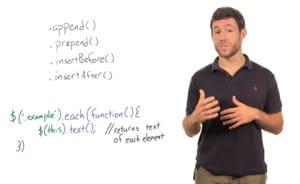
Manipulating Websites with Ease. jQuery is the most popular JavaScript library today, in use by over 60% of the top 100,000 most visited websites. This course will teach you how to use jQuery’s core features - DOM element selections, traversal and manipulation. You'll also learn how to read and make sense of jQuery's documentation, making it easy for you to go beyond the methods taught in this class and take advantage of jQuery's full array of features!

Self Paced
Self-Paced
Data Structures & Algorithms in Swift (Udacity) Udacity
Udacity

Data Structures & Algorithms in Swift (Udacity)

Confidently take on the tech interview. Technical interviews follow a pattern. If you know the pattern, you’ll be a step ahead of the competition. This course will introduce you to common data structures and algorithms in Swift. You'll review frequently-asked technical interview questions and learn how to structure your responses. You will answer practice problems and quizzes to test your abilities. Then you'll practice mock interviews to get specific recommendations for improvement. Be ready for anything the technical interviewer throws at you.

Self Paced
Self-Paced
Innovation Management (Coursera) Coursera
Erasmus University Rotterdam

Innovation Management (Coursera)

What is innovation management? How do firms bring in new business models and get new products and services to the market? Go on a nine-week journey through innovation management concepts, theories of idea generation, selection, strategy formulation and implementation in this MOOC in Innovation Management. In it, you will also learn the tools for implementing innovation projects yourself. Guided by world-class academics, you will develop an innovative mindset and expertise in how firms successfully create new ideas for marketing new products. The syllabus also includes sessions about innovation strategy, idea management and social networks.

Jun 4th 2026
5-12 Weeks
Regression Modeling in Practice (Coursera) Coursera
Wesleyan University

Regression Modeling in Practice (Coursera)

This course focuses on one of the most important tools in your data analysis arsenal: regression analysis. Using either SAS or Python, you will begin with linear regression and then learn how to adapt when two variables do not present a clear linear relationship. You will examine multiple predictors of your outcome and be able to identify confounding variables, which can tell a more compelling story about your results. You will learn the assumptions underlying regression analysis, how to interpret regression coefficients, and how to use regression diagnostic plots and other tools to evaluate the quality of your regression model. Throughout the course, you will share with others the regression models you have developed and the stories they tell you.

Jun 5th 2026
4 Weeks
What is Programming? (Udacity) Udacity
Udacity

What is Programming? (Udacity)

A Coding Dictionary. The world of development can be daunting with all of its lingo and jargon. This course will help demystify the cryptic terms that developers use on a daily basis. You'll learn about how the web functions, what a programmer does each day, why version control is so important, and how communication on the internet happens.

Self Paced
Self-Paced
Kotlin Bootcamp for Programmers (Udacity) Udacity
Udacity,Google

Kotlin Bootcamp for Programmers (Udacity)

Language fundamentals for developers. Learn the essentials of the Kotlin programming language from Kotlin experts at Google. Kotlin is a modern and concise JVM language that supports functional programming paradigms. Whether you’re a Java developer or a programmer in another object-oriented language, this course will teach you the essential language features that has made Kotlin so popular with developers.

Self Paced
Self-Paced
Computability, Complexity & Algorithms (Udacity) Udacity
Georgia Institute of Technology,Udacity

Computability, Complexity & Algorithms (Udacity)

The Power and Limitation of Algorithms. In this course, we will ask the big questions, "What is a computer? What are the limits of computation? Are there problems that no computer will ever solve? Are there problems that can’t be solved quickly? What kinds of problems can we solve efficiently and how do we go about developing these algorithms?" Understanding the power and limitations of algorithms helps us develop the tools to make real-world computers smarter, faster and safer.

Self Paced
Self-Paced
Spark (Udacity) Udacity
Udacity,Insight

Spark (Udacity)

Master how to work with big data and build machine learning models at scale using Spark! In this course, you’ll learn how to use Spark to work with big data and build machine learning models at scale, including how to wrangle and model massive datasets with PySpark, the Python library for interacting with Spark. In the first lesson, you will learn about big data and how Spark fits into the big data ecosystem. In lesson two, you will be practicing processing and cleaning datasets to get comfortable with Spark’s SQL and dataframe APIs. In the third lesson, you will debug and optimize your Spark code when running on a cluster. In lesson four, you will use Spark’s Machine Learning Library to train machine learning models at scale.

Self Paced
Self-Paced
High Performance Computing (Udacity) Udacity
Georgia Institute of Technology,Udacity

High Performance Computing (Udacity)

The goal of this course is to give you solid foundations for developing, analyzing, and implementing parallel and locality-efficient algorithms. This course focuses on theoretical underpinnings. To give a practical feeling for how algorithms map to and behave on real systems, we will supplement algorithmic theory with hands-on exercises on modern HPC systems, such as Cilk Plus or OpenMP on shared memory nodes, CUDA for graphics co-processors (GPUs), and MPI and PGAS models for distributed memory systems.

Self Paced
Self-Paced