IBM COBOL Software Development Practices (Coursera)

Offered by IBM, LearnQuest,
IBM COBOL Software Development Practices (Coursera)

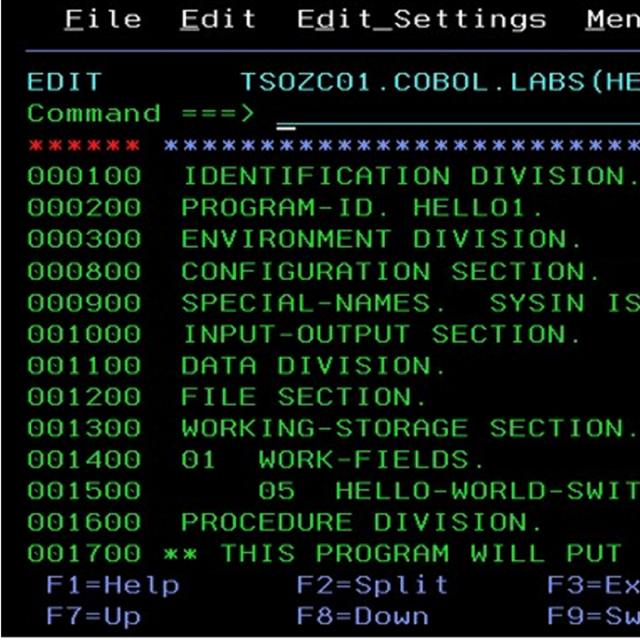
This course is aimed at anybody interested in COBOL or or software development. In this course, you will be introduced to core practices, systems, and methodologies associated with IBM COBOL software development. You will learn about COBOL as a self-documenting language. You will review working with existing coding. This course also covers quality assurance (QA), technical support and project management.

Class Deals by MOOC List - Click here and see Coursera's Active Discounts, Deals, and Promo Codes.

Course 4 of 7 in the IBM Mainframe Developer.

Syllabus

WEEK 1
Welcome to IBM COBOL Software Development Practices
In the first module of this course, we will welcome everyone to the course, present the course objectives, and define other pertinent course details.
Documenting Your Code
In the second module of the course, we will describe the critical task and function of documenting your COBOL code. By the end of this module, you will understand COBOL as a self-documenting language, define COBOL documentation usage and audience, and describe the need and process of documenting the undocumented in COBOL.

WEEK 2
Working with Existing Code
In the third module of the course, we will describe the process of working with existing COBOL code. By the end of this module, you will identify changes required in existing code, decide how much to change, and analyze existing code with modern tools.
Quality Assurance (QA) and Technical Support Concepts
In the fourth module of the course, we will describe COBOL quality assurance (QA) and technical support concepts. By the end of this module, you will be able to describe managing bugs, explain COBOL ticketing systems, and list core COBOL technical support concepts.

WEEK 3
Technical Project Management
In the fifth module of the course, we will describe COBOL technical project management. By the end of this module, you will be able to describe project management concepts related to the COBOL SDLC, identify agile and scrum project management concepts, and list COBOL project management core competencies.
Congratulations on Completing IBM COBOL Software Development Practices
In this module, will congratulate everyone for completing the course, present the completed course objectives, and define other pertinent course details and next steps.

Go to Class
MOOC List is learner-supported. When you buy through links on our site, we may earn an affiliate commission.

Related Courses

Introduction to CSS3 (Coursera) Coursera
University of Michigan

Introduction to CSS3 (Coursera)

The web today is almost unrecognizable from the early days of white pages with lists of blue links. Now, sites are designed with complex layouts, unique fonts, and customized color schemes. This course will show you the basics of Cascading Style Sheets (CSS3). The emphasis will be on learning how to write CSS rules, how to test code, and how to establish good programming habits.

Jun 15th 2026
4 Weeks
The R Programming Environment (Coursera) Coursera
Johns Hopkins University

The R Programming Environment (Coursera)

This course provides a rigorous introduction to the R programming language, with a particular focus on using R for software development in a data science setting. Whether you are part of a data science team or working individually within a community of developers, this course will give you the knowledge of R needed to make useful contributions in those settings.

Jun 15th 2026
4 Weeks
Audio Signal Processing for Music Applications (Coursera) Coursera
Stanford University,Universitat Pompeu Fabra

Audio Signal Processing for Music Applications (Coursera)

In this course you will learn about audio signal processing methodologies that are specific for music and of use in real applications. We focus on the spectral processing techniques of relevance for the description and transformation of sounds, developing the basic theoretical and practical knowledge with which to analyze, synthesize, transform and describe audio signals in the context of music applications.

Jun 15th 2026
5-12 Weeks
Introduction à la programmation orientée objet (en Java) (Coursera) Coursera
École Polytechnique Fédérale de Lausanne

Introduction à la programmation orientée objet (en Java) (Coursera)

Ce cours introduit la programmation orientée objet (encapsulation, abstration, héritage, polymorphisme) en l'illustrant en langage Java. Il présuppose connues les bases de la programmation (variables, types, boucles, fonctions, ...). Il est conçu comme la suite du cours « Initiation à la programmation (en Java) ».

Jun 21st 2026
5-12 Weeks
An Introduction to Interactive Programming in Python (Part 2) (Coursera) Coursera
Rice University

An Introduction to Interactive Programming in Python (Part 2) (Coursera)

This two-part course is designed to help students with very little or no computing background learn the basics of building simple interactive applications. Our language of choice, Python, is an easy-to learn, high-level computer language that is used in many of the computational courses offered on Coursera. To make learning Python easy, we have developed a new browser-based programming environment that makes developing interactive applications in Python simple.

Jun 15th 2026
4 Weeks
Data Structures and Performance (Coursera) Coursera
University of California, San Diego

Data Structures and Performance (Coursera)

How do Java programs deal with vast quantities of data? Many of the data structures and algorithms that work with introductory toy examples break when applications process real, large data sets. Efficiency is critical, but how do we achieve it, and how do we even measure it? This is an intermediate Java course. We recommend this course to learners who have previous experience in software development or a background in computer science, and in particular, we recommend that you have taken the first course in this specialization (which also requires some previous experience with Java).

Jun 15th 2026
5-12 Weeks
Programming for Everybody (Getting Started with Python) (Coursera) Coursera
University of Michigan

Programming for Everybody (Getting Started with Python) (Coursera)

This course aims to teach everyone the basics of programming computers using Python. We cover the basics of how one constructs a program from a series of simple instructions in Python. The course has no pre-requisites and avoids all but the simplest mathematics. Anyone with moderate computer experience should be able to master the materials in this course.

Jun 15th 2026
5-12 Weeks
Python Data Structures (Coursera) Coursera
University of Michigan

Python Data Structures (Coursera)

This course will introduce the core data structures of the Python programming language. We will move past the basics of procedural programming and explore how we can use the Python built-in data structures such as lists, dictionaries, and tuples to perform increasingly complex data analysis. This course will cover Chapters 6-10 of the textbook “Python for Everybody”. This course covers Python 3.

Jun 15th 2026
5-12 Weeks
Programming Languages, Part A (Coursera) Coursera
University of Washington

Programming Languages, Part A (Coursera)

This course is an introduction to the basic concepts of programming languages, with a strong emphasis on functional programming. The course uses the languages ML, Racket, and Ruby as vehicles for teaching the concepts, but the real intent is to teach enough about how any language “fits together” to make you more effective programming in any language -- and in learning new ones.

Jun 15th 2026
5-12 Weeks
Using Databases with Python (Coursera) Coursera
University of Michigan

Using Databases with Python (Coursera)

This course will introduce students to the basics of the Structured Query Language (SQL) as well as basic database design for storing data as part of a multi-step data gathering, analysis, and processing effort. The course will use SQLite3 as its database. We will also build web crawlers and multi-step data gathering and visualization processes. We will use the D3.js library to do basic data visualization.

Jun 15th 2026
5-12 Weeks