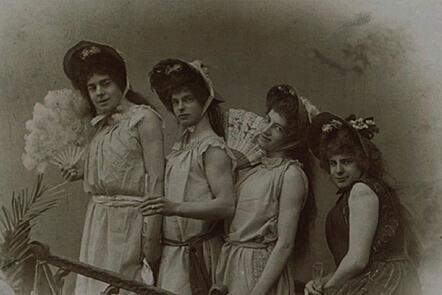
A Global History of Sex and Gender: Bodies and Power in the Modern World (FutureLearn)

Offered by University of Glasgow,
A Global History of Sex and Gender: Bodies and Power in the Modern World (FutureLearn)

Discover how a focus on gender and sexuality transforms our understanding of modern, global history. Study historical perspectives on contemporary issues of sex and gender. This course offers you the chance to explore vital historical perspectives on key contemporary issues surrounding sexuality and gender, including the #MeToo movement, campaigns for gay and trans rights, equal pay, and reproductive justice.

Class Deals by MOOC List - Click here and see FutureLearn's Active Discounts, Deals, and Promo Codes.

Track the history of the #MeToo movement
Whether you’re a curious citizen keen to learn more or you have a vocational commitment to implementing new perspectives on gender and sexuality at work, you’ll trace today’s social justice movements back to 1600, exploring the cultural and legal contexts of sexual abuse, gender-based violence, and bodily autonomy.
Through case studies of modern social justice movements, you’ll develop your understanding of the operation of, and resistance to, patriarchal and heteronormative power in diverse historical and geographical settings.
As you get to grips with sexuality and queer experiences in the modern era, you’ll explore reproductive rights issues like contraception, abortion, surrogacy, and fertility.

Explore key gender equality issues like LQBTQIA rights and the gender pay gap
You’ll study core concepts used in gender history and feminist, queer, and trans studies, including patriarchal equilibrium, hegemonic masculinity, and intersectionality.
Through creative forms of assessment, you’ll develop your skills in applying gendered and sexual approaches to a range of historical materials, such as oral testimony and material artefacts, as well as written texts.

Learn from social history experts at the Centre for Gender History
The course will be delivered by the interdisciplinary team at the Centre for Gender History at the University of Glasgow.
With world-leading expertise in this area, you’ll enhance your knowledge in gendered and sexual history with experts in the field of gender studies.

What topics will you cover?

Week 1: Gender and Power. How a gendered and sexual approach alters our understanding of the past; patriarchal and heteronormative power and its historical operation and resistance; men, masculinities and #MeToo; the sex and gender binary and beyond; new trans historical and philosophical approaches.
Week 2: Sex and Intimacy. How our bodies and their desires have been understood and regulated in the past; complicating narratives of nineteenth century sexual ‘repression’ and 1960s sexual ‘liberation’; sex, race and Empire; queer stories from history; movements for reproductive rights and justice.
Week 3: Work and Care. Feminist (re)definitions of work and care; gender inequality in pay and conditions; equal pay struggles in history and across the globe, including the 1975 ‘Women’s Day Off’ in Iceland; the historical provision of care, parenting and ‘blended families’; gender history and material culture.
Week 4: Dismantling Patriarchy and the Feminist Challenge. Diverse historical and global understandings of feminism; intersectionality, feminist activism and identities of race, class, sexual orientation and disability; women, political rights and transnational suffrage activism; cultural forms of feminist politics.
Go to Class
MOOC List is learner-supported. When you buy through links on our site, we may earn an affiliate commission.

Related Courses

Gender Foundations in Health Data: A Data for Health Course (Coursera) Coursera
Johns Hopkins University

Gender Foundations in Health Data: A Data for Health Course (Coursera)

Welcome to Gender Foundations in Health Data: A Data for Health course. This course was developed from an online seminar series of the same name, that was hosted by Johns Hopkins University Bloomberg School of Health in 2021-22. The course instructors are Drs. Michelle Kaufman and Tahilin Sanchez Karver. This course will raise learners' awareness of the necessity of utilizing a gender lens in global public health data, policy, and practice, feature how-tos and key examples of integration of gender in data collection, analysis, and use from Data for Health partners.

Aug 31st 2026
1 Week
Gender and Labour in the Global South (FutureLearn) FutureLearn
University of Basel,University of Bern, Interdisciplinary Centre for Gender Studies (ICFG)

Gender and Labour in the Global South (FutureLearn)

Delve into the Global South's labour market to understand gender issues and impacts on sustainable development. Examine gender discrimination in the Global South’s labour market. Although women’s participation in the paid labour market has increased in recent decades, gender discrimination in access to decent work persists. Women, particularly in the Global South, have the lowest participation in the labour market due to a number of factors. This three-week course from the University of Basel will guide you in assessing the Global South’s labour market to understand the impact of gender inequality in labour.

Mar 14th 2022
3 Weeks
A Guide to Diversifying and Transforming Football Leadership (Coursera) Coursera
Erasmus University Rotterdam,Fare Network

A Guide to Diversifying and Transforming Football Leadership (Coursera)

Football is a globally followed and revered sport. In recent years, concerns over diversity and discrimination in the beloved sport have made international headlines. This has put a spotlight on the lack of representation both on and off the football pitch. The disparity in football leadership representation is even more apparent when gender, race and ethnicity comes into play. This MOOC aims to understand, explore and ultimately address the exclusion of women and people of ethnic minority background (WEM) in football organizations.

Sep 7th 2026
4 Weeks
Religious Symbols of the World (edX) EdX
Seoul National University,SNUx

Religious Symbols of the World (edX)

This course is the third and final course in the series following “Understanding Religious Symbolism” and “Myths, Rituals, and Cosmos.” Through the theories and patterns that you learned in these three courses, I hope that you will be able to interpret the various religious phenomena in different cultures, and through this gain a better understanding of culture and human beings.

Self Paced
Self-Paced
Beyond the Ballot: Women’s Rights and Suffrage from 1866 to Today (FutureLearn) FutureLearn
Royal Holloway, University of London,Houses of Parliament

Beyond the Ballot: Women’s Rights and Suffrage from 1866 to Today (FutureLearn)

Explore the campaign for women’s right to vote and its impact on women’s rights and equality to the present day. Explore the remarkable history of women's rights. 6th February 2018 will mark the centenary of the Representation of the People Act, the change in the law that gave (some) women the right to vote in Westminster elections for the first time. On this course you will travel back to the nineteenth century to explore the legal, social and economic frameworks that limited women’s rights prior to the vote and discover the pioneering women campaigning for change.

Available now
3 Weeks
SDG: Moving Towards Sustainable Work (edX) EdX
Universidad Carlos III de Madrid - UC3M,UC3Mx

SDG: Moving Towards Sustainable Work (edX)

Decent work is thecritical engine of sustainable development. This course explores the United Nations' Sustainable Development Goals and mechanisms for developing decent and sustainable work. The United Nations' Sustainable Development 2030 Agenda gives us the opportunity to change and improve the lives of millions of people. These widespread efforts won't juststem from organizations in the formal public or private sectors (governments, corporations, trade unions, etc.) but will also require participation from ordinary people and civil society as a whole.

Self Paced
Self-Paced
The Modern World, Part One: Global History from 1760 to 1910 (Coursera) Coursera
University of Virginia

The Modern World, Part One: Global History from 1760 to 1910 (Coursera)

This is a survey of modern history from a global perspective. Part One begins with the political and economic revolutions of the late 1700s and tracks the transformation of the world during the 1800s. Part One concludes as these bewildering changes seem to be running beyond the capacity of older institutions to handle them. Throughout the course we try to grasp what is happening and ask: Why? And the answers often turn on very human choices.

Aug 31st 2026
5-12 Weeks
Sports and Society (Coursera) Coursera
Duke University

Sports and Society (Coursera)

Sports play a giant role in contemporary society worldwide. But few of us pause to think about the larger questions of money, politics, race, sex, culture, and commercialization that surround sports everywhere. This course draws on the tools of anthropology, sociology, history, and other disciplines to give you new perspectives on the games we watch and play.

Sep 7th 2026
5-12 Weeks
What does it mean to identify as Transgender or Gender Non-Conforming (TGNC)? (Coursera) Coursera
University of Minnesota

What does it mean to identify as Transgender or Gender Non-Conforming (TGNC)? (Coursera)

In the last decade transgender and gender nonconforming (TGNC) individuals have become increasingly visible in our families, culture, and public discourse. This course explores the concept of gender identity for people who are curious about the nature of gender, the process of gender affirmation, or changing social dynamics. Participants will learn the unique challenges faced by the TGNC population as well as develop the skills to build inclusive spaces in all spheres of their life. This course was developed under the Joycelyn Elders Chair for Sexual Health Education at the University of Minnesota.

Sep 14th 2026
5-12 Weeks
Representaciones Culturales de las Sexualidades (Coursera) Coursera
Universitat Autònoma de Barcelona

Representaciones Culturales de las Sexualidades (Coursera)

Desde los estudios de género, los estudios queer y los estudios culturales, este curso quiere familiarizaros con las representaciones culturales de las sexualidades no normativas en la cultura contemporánea. Planteamos diversos marcos teóricos y ejemplos prácticos a partir de los cuales reflexionar sobre las construcciones corporales e identitarias de las personas lesbianas, gays, transgénero, transexuales, queer, heterosexuales, etc. en diversos soportes culturales como el cine, la literatura, internet, la televisión o las artes plásticas.

Sep 14th 2026
5-12 Weeks