Foundations of Sports Analytics: Data, Representation, and Models in Sports (Coursera)

Foundations of Sports Analytics: Data, Representation, and Models in Sports (Coursera)

This course provides an introduction to using Python to analyze team performance in sports. Learners will discover a variety of techniques that can be used to represent sports data and how to extract narratives based on these analytical techniques. The main focus of the introduction will be on the use of regression analysis to analyze team and player performance data, using examples drawn from the National Football League (NFL), the National Basketball Association (NBA), the National Hockey League (NHL), the English Premier LEague (EPL, soccer) and the Indian Premier League (IPL, cricket).

Class Deals by MOOC List - Click here and see Coursera's Active Discounts, Deals, and Promo Codes.

This course does not simply explain methods and techniques, it enables the learner to apply them to sports datasets of interest so that they can generate their own results, rather than relying on the data processing performed by others. As a consequence the learning will be empowered to explore their own ideas about sports team performance, test them out using the data, and so become a producer of sports analytics rather than a consumer.
While the course materials have been developed using Python, code has also been produced to derive all of the results in R, for those who prefer that environment.
Course 1 of 5 in the Sports Performance Analytics Specialization

Syllabus

WEEK 1
Introduction to Sports Performance and Data
This week introduces a simple example of sports analytics in practice - the calculation of the Pythagorean expectation to model winning in team sports. This can also be used for the purposes of prediction. Examples are developed for five different sports leagues, Major League Baseball (MLB), the National Basketball Association (NBA), the National Hockey League (NHL), the English Premier League (EPL-soccer) and the Indian Premier League (IPL-cricket).

WEEK 2
Introduction to Data Sources
This week will use NBA data to introduce basic and important Python codes to conduct data cleaning and data preparation. This week also discusses summary and descriptive analyses with statistics and graphs to understand the distribution of data, the characteristics and pattern of variables as well as the relationship between two variables. At the end of this week, we will introduce correlation coefficients to summarize the linear relationship between two variables.

WEEK 3
Introduction to Sports Data and Plots in Python
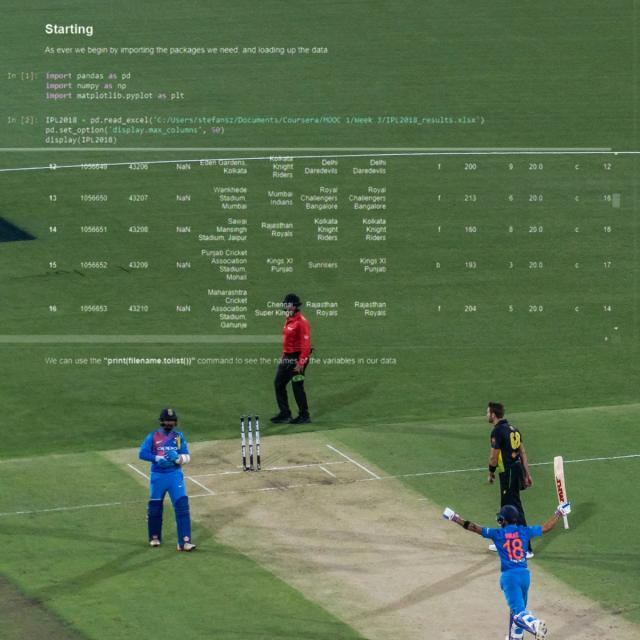
This module introduces some ways of representing data using examples from MLB, the NBA and Indian Premier League. MLB data is used to analyze the spatial distribution of different hits. NBA data is used to generate heatmaps to illustrate the different ways in which players contribute. IPL data is used to show how team performances can be compared graphically.

WEEK 4
Introduction to Sports Data and Regression Using Python
This week introduces the fundamentals of regression analysis. We will discuss how to perform regression analysis using Python and how to interpret regression output. We will use NHL data to estimate multiple regression models to identify the team level performance factors that affect the team's winning percentage. We will also use cricket data from the Indian Premier League to run regression analyses to examine whether player performance impacts player salary.

WEEK 5
More on Regressions
This module uses regression analysis to investigate the relationship between team salary spending and team performance in the NBA, NHL, EPL and IPL. The module explores different ways of defining the regression model, and how to interpret competing regression model results.

WEEK 6
Is There a Hot Hand in Basketball?
This week studies an interesting topic in sport, the hot hand. We will introduce the concept of hot hand and discuss the academic research that examines whether the hot hand is a phenomenon or a fallacy. We will demonstrate how to analytically test the hot hand using the NBA shot log data. We will test whether NBA players have hot hand by computing conditional probabilities and autocorrelation coefficients as well as performing regression analyses.
Go to Class
MOOC List is learner-supported. When you buy through links on our site, we may earn an affiliate commission.

Related Courses

Python Data Structures (Coursera) Coursera
University of Michigan

Python Data Structures (Coursera)

This course will introduce the core data structures of the Python programming language. We will move past the basics of procedural programming and explore how we can use the Python built-in data structures such as lists, dictionaries, and tuples to perform increasingly complex data analysis. This course will cover Chapters 6-10 of the textbook “Python for Everybody”. This course covers Python 3.

Sep 28th 2026
5-12 Weeks
Big Data Analysis Deep Dive (Coursera) Coursera
Alibaba Cloud Academy

Big Data Analysis Deep Dive (Coursera)

The job market for architects, engineers, and analytics professionals with Big Data expertise continues to increase. The Academy’s Big Data Career path focuses on the fundamental tools and techniques needed to pursue a career in Big Data. This course includes: data processing with python, writing and reading SQL queries, transmitting data with MaxCompute, analyzing data with Quick BI, using Hive, Hadoop, and spark on E-MapReduce, and how to visualize data with data dashboards. Work through our course material, learn different aspects of the Big Data field, and get certified as a Big Data Professional!

Sep 28th 2026
5-12 Weeks
Python Data Visualization (Coursera) Coursera
Rice University

Python Data Visualization (Coursera)

This if the final course in the specialization which builds upon the knowledge learned in Python Programming Essentials, Python Data Representations, and Python Data Analysis. We will learn how to install external packages for use within Python, acquire data from sources on the Web, and then we will clean, process, analyze, and visualize that data. This course will combine the skills learned throughout the specialization to enable you to write interesting, practical, and useful programs.

Oct 2nd 2026
4 Weeks
Applied Plotting, Charting & Data Representation in Python (Coursera) Coursera
University of Michigan

Applied Plotting, Charting & Data Representation in Python (Coursera)

This course will introduce the learner to information visualization basics, with a focus on reporting and charting using the matplotlib library. The course will start with a design and information literacy perspective, touching on what makes a good and bad visualization, and what statistical measures translate into in terms of visualizations. The second week will focus on the technology used to make visualizations in python, matplotlib, and introduce users to best practices when creating basic charts and how to realize design decisions in the framework.

Oct 5th 2026
4 Weeks
An Introduction to Interactive Programming in Python (Part 1) (Coursera) Coursera
Rice University

An Introduction to Interactive Programming in Python (Part 1) (Coursera)

This two-part course is designed to help students with very little or no computing background learn the basics of building simple interactive applications. Our language of choice, Python, is an easy-to learn, high-level computer language that is used in many of the computational courses offered on Coursera. To make learning Python easy, we have developed a new browser-based programming environment that makes developing interactive applications in Python simple.

Oct 5th 2026
5-12 Weeks
Programación en Python (Coursera) Coursera
Universidad de los Andes

Programación en Python (Coursera)

¡Te damos la bienvenida al curso de Programación en Python de la Universidad de los Andes! El propósito de este curso es ofrecerte un ambiente interactivo para que desarrolles tus habilidades de pensamiento computacional, aprendas a programar en el lenguaje Python y te entrenes en la resolución de problemas utilizando un computador. La estrategia pedagógica empleada es el aprendizaje activo basado en casos.

Sep 28th 2026
4 Weeks
Introdução à Ciência da Computação com Python Parte 2 (Coursera) Coursera
Universidade de São Paulo, Brasil

Introdução à Ciência da Computação com Python Parte 2 (Coursera)

Bem vindo ao curso de Introdução à Ciência da Computação destinado aos alunos regulares da Universidade de São Paulo! Esta é a segunda parte do Curso, onde você vai continuar a aprender os principais conceitos introdutórios de Ciência da Computação e também aprenderá a desenvolver pequenos programas na linguagem Python.

Oct 5th 2026
5-12 Weeks
Algorithmic Thinking (Part 1) (Coursera) Coursera
Rice University

Algorithmic Thinking (Part 1) (Coursera)

Experienced Computer Scientists analyze and solve computational problems at a level of abstraction that is beyond that of any particular programming language. This two-part class is designed to train students in the mathematical concepts and process of "Algorithmic Thinking", allowing them to build simpler, more efficient solutions to computational problems.

Oct 5th 2026
4 Weeks
Practical Python for AI Coding 2 (Coursera) Coursera
Korea Advanced Institute of Science and Technology - KAIST

Practical Python for AI Coding 2 (Coursera)

This course is for a complete novice of Python coding, so no prior knowledge or experience in software coding is required. This course selects, introduces and explains Python syntaxes, functions and libraries that were frequently used in AI coding. In addition, this course introduces vital syntaxes, and functions often used in AI coding and explains the complementary relationship among NumPy, Pandas and TensorFlow, so this course is helpful for even seasoned python users.

Sep 28th 2026
5-12 Weeks