EdX

Electromagnetic Compatibility Essentials (edX)

Electromagnetic Compatibility Essentials (edX)

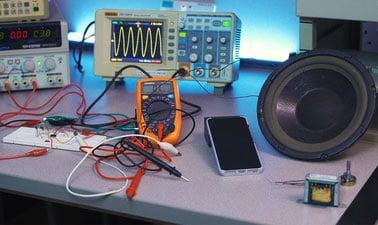
Advance your career by learning the basics of EMC. Explore all the different aspects and challenges every electronics engineer must be aware of. This course is designed to gain essential know-how in today’s world of very high frequencies. For instance, smartphone CPUs already work with clock frequencies above 3 GHz. But did you know that such fast switching disturbs other devices nearby? Such disturbances are either simply annoying or can become a real problem. As a consequence, international regulations exist which demand for emission and immunity tests before selling an electronic device.

Class Deals by MOOC List - Click here and see EdX's Active Discounts, Deals, and Promo Codes.

Why can’t I connect to WiFi? Why does my Bluetooth stop working when I use USB 3.0? Oh! I just sparked into my computer after sitting down; is it damaged now? All of these issues have to do with electromagnetic compatibility (EMC). International EMC experts David Pommerenke and Bernd Deutschmann break down situations that seem highly complex in order to highlight the causes of interference.

The topic of EMC must be considered in all aspects of circuit design in order to reduce the number of prototypes. We would like you to gain an intuition for EMC with the help of lab examples. We emphasize basic physical principles and avoid highly complex mathematical derivations instead. After completion, a certificate will be awarded. We are already working on three follow-up courses to obtain a professional EMC certificate, backed by Graz University of Technology.
TU Graz offers more than 10 on-campus lectures on the subject of EMC, most of them in small laboratory groups. More than 10 full-time employees investigate electromagnetism in a variety of applications just in our research group only. We would like to share this expertise with the community, since EMC must be considered by all electronics engineers and project managers.
The FREE version of this course includes all material except final exam questions and the certificate. This is a self-paced course, so there are no weekly deadlines. You can join this class completely free of charge and purchase the certificate later in case you liked it. Give it a try and dive into the fascinating world of EMC.

What you'll learn

  • Learn where these electromagnetic interferences (EMI) come from.
  • Fundamental knowledge on how to keep them under control.
  • Techniques such as the analysis in time and frequency domain.
  • Noise travels in two modes: differential and common. Knowing in which mode the noise occurs opens doors to suppression (EMI filtering).
  • Not only radiating fields matter, but electrostatic discharge (ESD) as well. How large are the voltages after walking on a carpet? How stressful are the discharges to my computer?
  • And much more! (e.g. EMI receiver, lumped-element models, most important EMC standards)

Syllabus

Week 1 (Introduction): Learn what EMC is and why we should bother with it. Understand the theory of galvanic, capacitive, inductive, and radiated coupling. Time and frequency domain awareness. Spectrum analysis.
Week 2 (EMC Design): Learn the most common EMI filtering methods. Understand that an EMC-aware PCB design makes a tremendous difference. Consider parasitic elements of components and create simple lumped element models.
Week 3 (EMC Testing): Learn the purpose of international regulations. Understand basic laboratory equipment. ESD testing. Emission measurements. Procedure with an accredited test house.

Go to Class
MOOC List is learner-supported. When you buy through links on our site, we may earn an affiliate commission.

Related Courses

Introduction to the Internet of Things (edX) EdX
Universitat Politècnica de València,UPValenciaX

Introduction to the Internet of Things (edX)

This is a preliminary course in which we deal with the basics of electronics and programming using Arduino and ESP boards. Internet of Things (IoT) is the present and the future of technology. Either, if you have none, few or some experience with electronics and you want to develop it projects this course will give you the necessary kick start to start creating amazing devices capable of sensing, controlling physical signals.

Self Paced
Self-Paced
Circuits and Electronics 2: Amplification, Speed, and Delay (edX) EdX
MIT,MITx

Circuits and Electronics 2: Amplification, Speed, and Delay (edX)

Learn how to speed up digital circuits and build amplifiers in the design of microchips used in smartphones, computers, and the Internet. Want to learn how to construct an amplifier for mobile phones? Wondering how energy storage elements like capacitors and inductors work, or how to make microchips run faster? This free circuit course taught by edX CEO and MIT Professor Anant Agarwal and colleagues is for you.

Self Paced
Self-Paced
Electrones en Acción: Electrónica y Arduinos para tus propios Inventos (Coursera) Coursera
Pontificia Universidad Católica de Chile

Electrones en Acción: Electrónica y Arduinos para tus propios Inventos (Coursera)

Este curso introduce al alumno a la electrónica y los Arduinos, comenzando desde lo más básico de un circuito eléctrico y finalizando con el diseño de circuitos de baja complejidad empleando dispositivos electrónicos programables. Durante el curso los alumnos aprenderán los fundamentos básicos de la electricidad y de la electrónica, conocerán los diferentes bloques empleados en el diseño de un circuito electrónico, aprenderán las bases del diseño de circuitos analógicos y digitales, y serán introducidos a la programación de estos últimos empleando la plataforma Arduino.

Jul 27th 2026
4 Weeks
Fundamentals of Audio and Music Engineering: Part 1 Musical Sound & Electronics (Coursera) Coursera
University of Rochester

Fundamentals of Audio and Music Engineering: Part 1 Musical Sound & Electronics (Coursera)

In this course students learn the basic concepts of acoustics and electronics and how they can applied to understand musical sound and make music with electronic instruments. Topics include: sound waves, musical sound, basic electronics, and applications of these basic principles in amplifiers and speaker design.

Aug 3rd 2026
5-12 Weeks
English as a Medium of Instruction for Academics (FutureLearn) FutureLearn
University of Southampton

English as a Medium of Instruction for Academics (FutureLearn)

Equip yourself to teach in international contexts by increasing your English language skills and intercultural knowledge. As universities work to become globally competitive courses taught in English are expanding. Those working in Higher Education are often thrown into producing academic work in English – either as teachers or researchers – without training in English language or intercultural skills.

Self Paced
4 Weeks
Introduction to Quantum Transport (edX) EdX
Purdue University,PurdueX

Introduction to Quantum Transport (edX)

This course introduces the non-equilibrium Green’s function (NEGF) method widely used to describe quantum effects in nanoscale devices, along with its applications to spintronic devices. This course introduces the Schrödinger equation, using the tight-binding method to discuss the concept of bandstructure and E(k) relations, followed by an introduction to the NEGF method with simple illustrative examples. Concept of spinors is introduced along with the application of the NEGF method to spintronic devices.

Feb 12th 2024
5-12 Weeks
Semiconductor Fundamentals (edX) EdX
Purdue University,PurdueX

Semiconductor Fundamentals (edX)

From smartphones to satellites, semiconductors are everywhere. Tying together physics, chemistry, and electrical engineering, this easy-to-follow introduction provides the background needed to understand devices such as transistors and solar cells. This course provides the essential foundations required to understand the operation of semiconductor devices such as transistors, diodes, solar cells, light-emitting devices, and more.

Jan 9th 2023
5-12 Weeks
Graphene Science and Technology (edX) EdX
Chalmers University of Technology,ChalmersX

Graphene Science and Technology (edX)

Graphene: its practical applications and how it offers new insights into quantum physics. Graphene is the world’s first 2-dimensional material and is the thinnest, strongest, and most flexible material known to exist. Graphene, a special form of carbon,,can conduct electricity and heat better than anything else.

No sessions available
5-12 Weeks
Semiconductors for Beginners (edX) EdX
National University of Singapore,NUS

Semiconductors for Beginners (edX)

The primary goal of the course is to enable the student to understand what semiconductors are, and why they are important to the electronics industry. Students will first learn and understand why some materials are insulators and others are conductors, and will learn how these properties can be modified. The course also explores other situations where the conductivity of an insulator can be drastically changed, such as the situation inside a bolt of lightning or inside a semiconductor.

Self Paced
Self-Paced
Electronique I (edX) EdX
École Polytechnique Fédérale de Lausanne,EPFLx

Electronique I (edX)

Introduction à l’électronique analogique- première partie. Fonctions de base réalisées à l’aide des amplificateurs opérationnels. Ce cours est un cours d’introduction à la réalisation des fonctions linéaires et non-linéaires de base à l’aide de l’amplificateur opérationnel.


Self Paced
Self-Paced
Building a RISC-V CPU Core (edX) EdX
Linux Foundation,LinuxFoundationX

Building a RISC-V CPU Core (edX)

Create a RISC-V CPU with modern open source circuit design tools, methodologies, and microarchitecture, all from your browser. Building a RISC-V CPU Core is designed for anyone with a technical inclination who is interested in learning more about hardware. Whether you are new to digital logic or are a seasoned veteran, students will take away new skills that can be applied immediately. No prior knowledge of digital logic design is required.

Self Paced
Self-Paced
Nanomaterials for Civil and Environmental Applications (edX) EdX
Purdue University,PurdueX

Nanomaterials for Civil and Environmental Applications (edX)

Learn about the field of nanotechnology with a special emphasis on nanomaterials synthesis, characterizations and their applications in civil and environmental engineering. This course will introduce students to the field of nanotechnology with a special emphasis on nanomaterials synthesis, characterizations and their applications in civil and environmental engineering.

Sep 27th 2021
5-12 Weeks