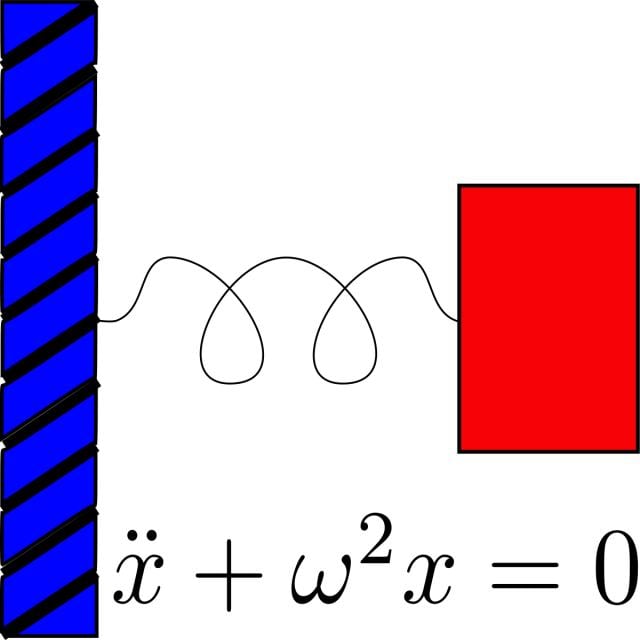
Differential Equations for Engineers (Coursera)

Differential Equations for Engineers (Coursera)

This course is about differential equations and covers material that all engineers should know. Both basic theory and applications are taught. In the first five weeks we will learn about ordinary differential equations, and in the final week, partial differential equations. The course is composed of 56 short lecture videos, with a few simple problems to solve following each lecture. And after each substantial topic, there is a short practice quiz. Solutions to the problems and practice quizzes can be found in instructor-provided lecture notes. There are a total of six weeks in the course, and at the end of each week there is an assessed quiz.

Class Deals by MOOC List - Click here and see Coursera's Active Discounts, Deals, and Promo Codes.

What You Will Learn

  • First-order differential equations
  • Second-order differential equations
  • The Laplace transform and series solution methods
  • Systems of differential equations and partial differential equations

Syllabus

WEEK 1
First-Order Differential Equations
A differential equation is an equation for a function with one or more of its derivatives. We introduce differential equations and classify them. We then learn about the Euler method for numerically solving a first-order ordinary differential equation (ode). Then we learn analytical methods for solving separable and linear first-order odes. An explanation of the theory is followed by illustrative solutions of some simple odes. Finally, we learn about three real-world examples of first-order odes: compound interest, terminal velocity of a falling mass, and the resistor-capacitor electrical circuit.

WEEK 2
Homogeneous Linear Differential Equations
We generalize the Euler numerical method to a second-order ode. We then develop two theoretical concepts used for linear equations: the principle of superposition, and the Wronskian. Armed with these concepts, we can find analytical solutions to a homogeneous second-order ode with constant coefficients. We make use of an exponential ansatz, and transform the constant-coefficient ode to a second-order polynomial equation called the characteristic equation of the ode. The characteristic equation may have real or complex roots and we learn solution methods for the different cases.

WEEK 3
Inhomogeneous Linear Differential Equations
We now add an inhomogeneous term to the constant-coefficient ode. The inhomogeneous term may be an exponential, a sine or cosine, or a polynomial. We also study the phenomena of resonance, when the forcing frequency is equal to the natural frequency of the oscillator. Finally, we learn about three important applications: the RLC electrical circuit, a mass on a spring, and the pendulum.

WEEK 4
The Laplace Transform and Series Solution Methods
We present two new analytical solution methods for solving linear odes. The first is the Laplace transform method, which is used to solve the constant-coefficient ode with a discontinuous or impulsive inhomogeneous term. The Laplace transform is a good vehicle in general for introducing sophisticated integral transform techniques within an easily understandable context. We also introduce the solution of a linear ode by a series solution. Although we do not go deeply here, an introduction to this technique may be useful to students that encounter it again in more advanced courses.

WEEK 5
Systems of Differential Equations
We learn how to solve a coupled system of homogeneous first-order differential equations with constant coefficients. This system of odes can be written in matrix form, and we learn how to convert these equations into a standard matrix algebra eigenvalue problem. The two-dimensional solutions are visualized using phase portraits. We then learn about the important application of coupled harmonic oscillators and the calculation of normal modes. The normal modes are those motions for which the individual masses that make up the system oscillate with the same frequency.

WEEK 6
Partial Differential Equations
To learn how to solve a partial differential equation (pde), we first define a Fourier series. We then derive the one-dimensional diffusion equation, which is a pde for the diffusion of a dye in a pipe. We proceed to solve this pde using the method of separation of variables.
Go to Class
MOOC List is learner-supported. When you buy through links on our site, we may earn an affiliate commission.

Related Courses

Discrete Mathematics (Coursera) Coursera
Shanghai Jiao Tong University

Discrete Mathematics (Coursera)

Discrete mathematics forms the mathematical foundation of computer and information science. It is also a fascinating subject in itself. Learners will become familiar with a broad range of mathematical objects like sets, functions, relations, graphs, that are omnipresent in computer science. Perhaps more importantly, they will reach a certain level of mathematical maturity - being able to understand formal statements and their proofs; coming up with rigorous proofs themselves; and coming up with interesting results.

Jul 6th 2026
5-12 Weeks
Pre-MBA Quantitative Skills: Data Analysis (Coursera) Coursera
Rice University

Pre-MBA Quantitative Skills: Data Analysis (Coursera)

This course will equip students with the quantitative skills needed to begin any Masters of Business Administration program. The goal is not to build foundational skills or expert mastery but rather, to provide some middle ground to “shake the rust off” skills that a typical MBA student probably knows, but may not have thought about for quite some time.

Jul 6th 2026
4 Weeks
Aprendizaje de las matemáticas de primaria (Coursera) Coursera
Universidad de los Andes

Aprendizaje de las matemáticas de primaria (Coursera)

En este segundo curso de acceso gratuito* del programa especializado Educación Matemática para profesores de primaria, conocerás las cuestiones particulares sobre el aprendizaje de las matemáticas y las dificultades y los errores más frecuentes que tienen que enfrentar los estudiantes al aprenderlas. El curso tiene una duración aproximada de seis semanas, con una dedicación promedio de 4 horas semanales. Todas las evaluaciones tienen retroalimentación y podrás descargar la mayoría de los recursos del curso.

Jul 6th 2026
5-12 Weeks
Calculus: Single Variable Part 2 - Differentiation (Coursera) Coursera
University of Pennsylvania

Calculus: Single Variable Part 2 - Differentiation (Coursera)

Calculus is one of the grandest achievements of human thought, explaining everything from planetary orbits to the optimal size of a city to the periodicity of a heartbeat. This brisk course covers the core ideas of single-variable Calculus with emphases on conceptual understanding and applications. The course is ideal for students beginning in the engineering, physical, and social sciences.

Jul 6th 2026
3 Weeks
Math for AI beginner part 1 Linear Algebra (Coursera) Coursera
Korea Advanced Institute of Science and Technology - KAIST

Math for AI beginner part 1 Linear Algebra (Coursera)

'Learn concept of AI such as machine learning, deep-learning, support vector machine which is related to linear algebra. Learn how to use linear algebra for AI algorithm. After completing this course, you are able to understand AI algorithm and basics of linear algebra for AI applications.

Jul 6th 2026
5-12 Weeks
Jugar y Aprender Matemática en aulas heterogéneas (Coursera) Coursera
Universidad Austral

Jugar y Aprender Matemática en aulas heterogéneas (Coursera)

Cuando se asume la enseñanza de la matemática con el compromiso de la participación de todos los alumnos en una comunidad de producción, en la que se resuelven problemas con distintos procedimientos, se comparan producciones, se analiza la validez de las afirmaciones que se hacen, la tarea resulta todo un desafío. En el caso del plurigrado, el desafío parece aún mayor. ¿Cómo presentar problemas que involucren en este trabajo reflexivo a niños y niñas de distintas edades y con distintos conocimientos?

Jul 6th 2026
4 Weeks
Cálculo Diferencial e Integral unidos por el Teorema Fundamental del Cálculo (Coursera) Coursera
Tecnológico de Monterrey

Cálculo Diferencial e Integral unidos por el Teorema Fundamental del Cálculo (Coursera)

Los cursos de Cálculo Diferencial y Cálculo Integral tradicionalmente se ofrecen separados y respetando ese orden. El primero estudia la derivada, y el segundo, la integral, siendo este momento en el que aparece el Teorema Fundamental del Cálculo (TFC) para establecer la relación entre ambos conceptos. En el presente curso vamos a hacer una diferencia: introduciremos la derivada y la integral como conceptos relacionados desde un principio.

Jun 29th 2026
5-12 Weeks
Calculus: Single Variable Part 1 - Functions (Coursera) Coursera
University of Pennsylvania

Calculus: Single Variable Part 1 - Functions (Coursera)

Calculus is one of the grandest achievements of human thought, explaining everything from planetary orbits to the optimal size of a city to the periodicity of a heartbeat. This brisk course covers the core ideas of single-variable Calculus with emphases on conceptual understanding and applications. The course is ideal for students beginning in the engineering, physical, and social sciences.

Jul 6th 2026
4 Weeks
Applied Calculus with Python (Coursera) Coursera
Johns Hopkins University

Applied Calculus with Python (Coursera)

This course is designed for the Python programmer who wants to develop the foundations of Calculus to help solve challenging problems as well as the student of mathematics looking to learn the theory and numerical techniques of applied calculus implemented in Python. By the end of this course, you will have learned how to apply essential calculus concepts to develop robust Python applications that solve a variety of real-world challenges.

Jul 6th 2026
5-12 Weeks
Matrix Algebra for Engineers (Coursera) Coursera
The Hong Kong University of Science and Technology - HKUST

Matrix Algebra for Engineers (Coursera)

This course is all about matrices, and concisely covers the linear algebra that an engineer should know. The mathematics in this course is presented at the level of an advanced high school student, but typically students should take this course after completing a university-level single variable calculus course. There are no derivatives or integrals in this course, but students are expected to have attained a sufficient level of mathematical maturity. Nevertheless, anyone who wants to learn the basics of matrix algebra is welcome to join.

Jul 6th 2026
4 Weeks