FUN

Des rivières et des hommes : hydrologie, hydraulique et géomorphologie (FUN)

Offered by Grenoble INP,
Des rivières et des hommes : hydrologie, hydraulique et géomorphologie  (FUN)

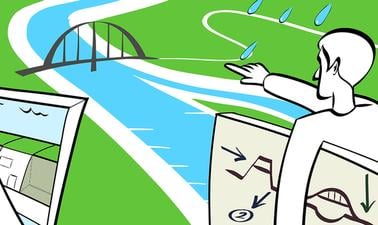
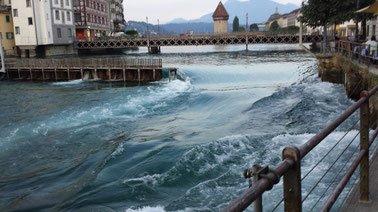
Comprendre et prévoir le comportement des rivières aménagées est un enjeu essentiel pour protéger les populations et préserver durablement les ressources en eau. Ce cours est illustré par de nombreux cas d'études.

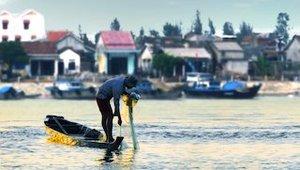
Ce cours aborde la dynamique des rivières aménagées à partir d’exemples de terrain présentant un intérêt avéré tant pour les pays du Sud que du Nord (Bénin, France, Mexique, Vietnam, etc.).
Il doit vous permettre de parfaire et d’enrichir vos connaissances dans les domaines de l’hydrologie et de la qualité de l'eau, de l’hydraulique et de la géomorphologie fluviale, appliquées à la gestion des rivières.
Il vous propose des savoir-faire méthodologiques et techniques pour évaluer l’état des cours d’eau et envisager des interventions transposables aux différents environnements au Nord comme au Sud.

A l’issue de ce cours, vous devriez pouvoir :

  • décrire les mécanismes fluviaux essentiels et calculer les conditions d’écoulement en rivière (prédiction des débits, calcul des profondeurs d’eau) au moins par des méthodes approchées,
  • poser correctement les problèmes : menaces qui pèsent sur la rivière, menaces que la rivière fait peser sur les riverains (en particulier risques d'inondation)
  • acquérir une autonomie et une créativité accrues grâce à une meilleure appréhension de votre contexte de travail.

Le suivi du cours et la délivrance des attestations sont gratuits.

Plan du cours

Semaine 0
Semaine de bienvenue.
Pendant cette semaine d'introduction vous seront présentés les outils du cours et la méthode de travail. Vous aurez également accès à des ressources permettant de compléter vos pré-requis.

Semaine 1
L’écoulement de l’eau dans un bassin versant.
Enjeu : gestion de l’eau des barrages.
Illustration : bassin de Cointzio au Mexique

Semaine 2
L’écoulement de l’eau dans la rivière.
Enjeu : risque inondation par débordement des rivières.
Illustrations : inondation d’Ho-Chi-Minh-Ville, hydraulique et dynamique sédimentaire dans la rivière Agbado.

Semaine 3
Lois physiques régissant le transport solide et la dynamique des formes fluviales.
Enjeu : charriage, exhaussement du lit et risques d’érosion.

Semaine 4
Réponses fluviales aux actions humaines.
Enjeu : diagnostic des ajustements fluviaux et solutions.
Illustrations : érosion des berges du Mekong, rivières alpines et périalpines (bassins du Rhône et du Rhin).

Semaine 5
Hydrologie et biodiversité dans les montagnes andines.
Enjeu : adaptation au changement climatique.
Illustrations : páramo du volcan antisana.
Go to Class
MOOC List is learner-supported. When you buy through links on our site, we may earn an affiliate commission.

Related Courses

Innate Immunity (FUN) FUN
Institut Pasteur

Innate Immunity (FUN)

More than a century ago, Elie Metchnikoff established the bases of cellular innate immunity when he discovered the mechanism of phagocytosis. However, during most of the XXth century, adaptive immunity (also known as specific immunity) focused most of the interest of the researchers, until Charles Janeway and Polly Matzinger revisited the definition of immunology. What was called “non-specific immunity” was renamed “innate immunity”, and the understanding of the sensing of the exogenous or endogenous dangers signals, and their identification revolutionized our understanding of the early mechanism aimed to defend the integrity of the host against any type of attacks including pathogens.

Jan 14th 2022
5-12 Weeks
Room for Rivers: River basin Management in Times of Climate Change (edX) EdX
Delft University of Technology,DelftX

Room for Rivers: River basin Management in Times of Climate Change (edX)

Learn from the experience of the Netherlands-based “Room for a River” program devising river and delta solutions in times of climate change. With a long history of disasters and years of dealing with the challenges posed by water, the Netherlands has accumulated essential knowledge about water management and specifically of rivers. This course will share with you this knowledge gleaned over more than a decade under the Dutch government’s “Room for the River” program, started in 2007.

Nov 22nd 2022
5-12 Weeks
Climate Change and Water in Mountains: A Global Concern (Coursera) Coursera
University of Geneva

Climate Change and Water in Mountains: A Global Concern (Coursera)

What is climate change? How are mountain regions affected by the evolution of water resources and their uses? What kind of risks need to be considered? Mountains are recognized as particularly sensitive physical environments where intense and rapid changes have in the past, and may increasingly in the future, place pressure on their resource base.

May 18th 2026
5-12 Weeks
The Challenge of Global Water Security (FutureLearn) FutureLearn
Cardiff University

The Challenge of Global Water Security (FutureLearn)

An introduction to the challenges of water security on a local and global scale. How do we achieve water security for everyone? Over the next 30 years it is estimated that 80% of the world’s population will live in areas with high levels of water scarcity. How do we manage this so that we can ensure global water security for both people and ecosystems?

Jun 6th 2022
4 Weeks
Water: an essential resource (POK) Polimi OPEN KNOWLEDGE
Politecnico di Milano

Water: an essential resource (POK)

The challenge of protection from chemical and microbiological hazards. This MOOC wants to communicate the challenge of protecting water and then human health from chemical and microbiological hazards, as well as the multidisciplinarity required by this challenge by providing some key elements about water quality, protection and remediation, sustainable drinking water production, online monitoring, and finally advanced computing for process control.

Available
3 Weeks
Tuberculosis (FUN) FUN
Institut Pasteur

Tuberculosis (FUN)

To provide an up-to-date overview of the disease, the Institut Pasteur has created a MOOC dedicated to Tuberculosis. This course will provide a knowledge base that goes from the basics of TB to the current state of knowledge on various aspects of tuberculosis: the clinical picture, epidemiology, pediatric TB, factors affecting susceptibility to the disease, including HIV, diabetes and human genetics, immunology, vaccines, diagnosis, current and future ways to detect drug resistance, and how to treat drug sensitive and multi-drug resistant strains.

Sep 7th 2021
5-12 Weeks
Drinking Water Treatment (edX) EdX
Delft University of Technology,DelftX

Drinking Water Treatment (edX)

Learn about urban water services, focusing on conventional technologies for drinking water treatment. This course focuses on conventional technologies for drinking water treatment. Unit processes, involved in the treatment chain, are discussed as well as the physical, chemical and biological processes involved.

Self Paced
Self-Paced
ImageInLife - Imaging the Vertebrate embryo: from biological material to modelling (FUN) FUN
Université de Montpellier

ImageInLife - Imaging the Vertebrate embryo: from biological material to modelling (FUN)

Microscopy technologies have progressed to such a point that it is now possible to image a developing vertebrate at the single cell resolution. Two main model species are being used for such studies, the zebrafish and the mouse. The present MOOC introduces the trainees to these two animal models, to the most modern microscopy technologies, to the use of high volume of data (images) and to the modelling of the studied processes. Trainees will also be introduced to the intravital study of viral infections.

Aug 24th 2021
5-12 Weeks