Computer Vision with Embedded Machine Learning (Coursera)

Offered by Edge Impulse,
Computer Vision with Embedded Machine Learning (Coursera)

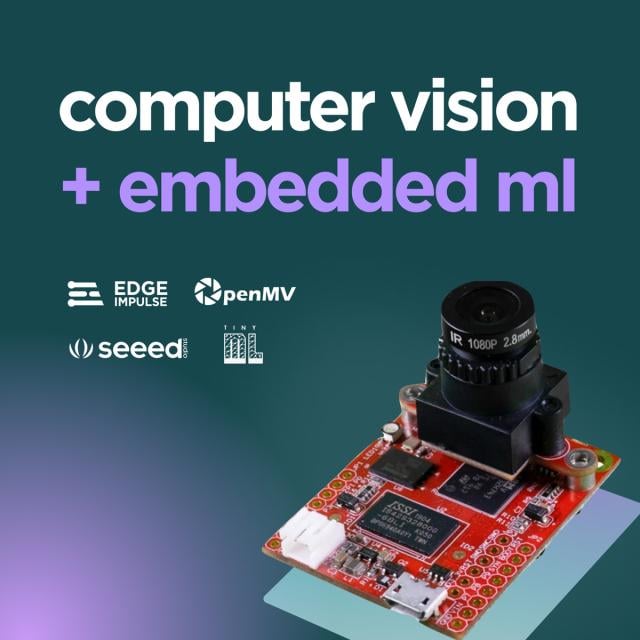
Computer vision (CV) is a fascinating field of study that attempts to automate the process of assigning meaning to digital images or videos. In other words, we are helping computers see and understand the world around us! A number of machine learning (ML) algorithms and techniques can be used to accomplish CV tasks, and as ML becomes faster and more efficient, we can deploy these techniques to embedded systems.

Class Deals by MOOC List - Click here and see Coursera's Active Discounts, Deals, and Promo Codes.

This course will give you an understanding of how deep learning with neural networks can be used to classify images and detect objects in images and videos. You will have the opportunity to deploy these machine learning models to embedded systems, which is known as embedded machine learning or TinyML.
Familiarity with the Python programming language and basic ML concepts (such as neural networks, training, inference, and evaluation) is advised to understand some topics as well as complete the projects. Some math (reading plots, arithmetic, algebra) is also required for quizzes and projects. If you have not done so already, taking the "Introduction to Embedded Machine Learning" course is recommended.
This course covers the concepts and vocabulary necessary to understand how convolutional neural networks (CNNs) operate, and it covers how to use them to classify images and detect objects. The hands-on projects will give you the opportunity to train your own CNNs and deploy them to a microcontroller and/or single board computer.

What You Will Learn

  • How to train and develop an image classification system using machine learning
  • How to train and develop an object detection system using machine learning
  • How to deploy a machine learning model to a microcontroller

Syllabus

WEEK 1
Image Classification
In this module, we introduce the concept of computer vision and how it can be used to solve problems. We cover how digital images are created and stored on a computer. Next, we review neural networks and demonstrate how they can be used to classify simple images. Finally, we walk you through a project to train an image classifier and deploy it to an embedded system.

WEEK 2
Convolutional Neural Networks
In this module, we go over the basics of convolutional neural networks (CNNs) and how they can be used to create a more robust image classification model. We look at the internal workings of CNNs (e.g. convolution and pooling) along with some visualization techniques used to see how CNNs make decisions. We introduce the concept of data augmentation to help provide more data to the training process. You will have the opportunity to train your own CNN and deploy it to an embedded system.

WEEK 3
Object Detection
In this module, we will cover the basics of object detection and how it differs from image classification. We will go over the math involved to measure objection detection performance. After, we will introduce several popular object detection models and demonstrate the process required to train such a model in Edge Impulse. Finally, you will be asked to deploy an object detection model to an embedded system.

Go to Class
MOOC List is learner-supported. When you buy through links on our site, we may earn an affiliate commission.

Related Courses

Encoder-Decoder Architecture (Coursera) Coursera
Google Cloud

Encoder-Decoder Architecture (Coursera)

This course gives you a synopsis of the encoder-decoder architecture, which is a powerful and prevalent machine learning architecture for sequence-to-sequence tasks such as machine translation, text summarization, and question answering. You learn about the main components of the encoder-decoder architecture and how to train and serve these models. In the corresponding lab walkthrough, you’ll code in TensorFlow a simple implementation of the encoder-decoder architecture for poetry generation from the beginning.

Oct 12th 2026
1 Week
Probabilistic Graphical Models 1: Representation (Coursera) Coursera
Stanford University

Probabilistic Graphical Models 1: Representation (Coursera)

Probabilistic graphical models (PGMs) are a rich framework for encoding probability distributions over complex domains: joint (multivariate) distributions over large numbers of random variables that interact with each other. These representations sit at the intersection of statistics and computer science, relying on concepts from probability theory, graph algorithms, machine learning, and more. They are the basis for the state-of-the-art methods in a wide variety of applications, such as medical diagnosis, image understanding, speech recognition, natural language processing, and many, many more. They are also a foundational tool in formulating many machine learning problems.

Sep 28th 2026
5-12 Weeks
Probabilistic Graphical Models 3: Learning (Coursera) Coursera
Stanford University

Probabilistic Graphical Models 3: Learning (Coursera)

Probabilistic graphical models (PGMs) are a rich framework for encoding probability distributions over complex domains: joint (multivariate) distributions over large numbers of random variables that interact with each other. These representations sit at the intersection of statistics and computer science, relying on concepts from probability theory, graph algorithms, machine learning, and more. They are the basis for the state-of-the-art methods in a wide variety of applications, such as medical diagnosis, image understanding, speech recognition, natural language processing, and many, many more. They are also a foundational tool in formulating many machine learning problems.

Sep 28th 2026
5-12 Weeks
Deep Learning Applications for Computer Vision (Coursera) Coursera
University of Colorado Boulder

Deep Learning Applications for Computer Vision (Coursera)

This course can be taken for academic credit as part of CU Boulder’s Master of Science in Data Science (MS-DS) degree offered on the Coursera platform. The MS-DS is an interdisciplinary degree that brings together faculty from CU Boulder’s departments of Applied Mathematics, Computer Science, Information Science, and others. With performance-based admissions and no application process, the MS-DS is ideal for individuals with a broad range of undergraduate education and/or professional experience in computer science, information science, mathematics, and statistics.

Oct 12th 2026
5-12 Weeks
Introduction to TensorFlow for Artificial Intelligence, Machine Learning, and Deep Learning (Coursera) Coursera
DeepLearning.AI

Introduction to TensorFlow for Artificial Intelligence, Machine Learning, and Deep Learning (Coursera)

If you are a software developer who wants to build scalable AI-powered algorithms, you need to understand how to use the tools to build them. This course is part of the upcoming Machine Learning in Tensorflow Specialization and will teach you best practices for using TensorFlow, a popular open-source framework for machine learning.

Oct 12th 2026
4 Weeks
Preparing for the Google Cloud Professional Data Engineer Exam en Español (Coursera) Coursera
Google Cloud

Preparing for the Google Cloud Professional Data Engineer Exam en Español (Coursera)

En este curso, se emplea un enfoque descendente a fin de identificar las habilidades y los conocimientos adquiridos, así como poner en evidencia la información y las áreas de habilidades que requieren una preparación adicional. Puede aprovechar este curso para crear su propio plan de preparación personalizado. Lo ayudará a distinguir lo que sabe de lo que no. Además, le permitirá desarrollar y practicar las habilidades que se les exigen a los profesionales que realizan este trabajo.

Oct 5th 2026
1 Week
Technologies and platforms for Artificial Intelligence (Coursera) Coursera
Politecnico di Milano

Technologies and platforms for Artificial Intelligence (Coursera)

This course will address the hardware technologies for machine and deep learning (from the units of an Internet-of-Things system to a large-scale data centers) and will explore the families of machine and deep learning platforms (libraries and frameworks) for the design and development of smart applications and systems.

Oct 12th 2026
4 Weeks
Introduction to Image Generation (Coursera) Coursera
Google Cloud

Introduction to Image Generation (Coursera)

This course introduces diffusion models, a family of machine learning models that recently showed promise in the image generation space. Diffusion models draw inspiration from physics, specifically thermodynamics. Within the last few years, diffusion models became popular in both research and industry. Diffusion models underpin many state-of-the-art image generation models and tools on Google Cloud. This course introduces you to the theory behind diffusion models and how to train and deploy them on Vertex AI.

Oct 12th 2026
3 Weeks
Foundations of Data Science: K-Means Clustering in Python (Coursera) Coursera
University of London,Goldsmiths, University of London

Foundations of Data Science: K-Means Clustering in Python (Coursera)

This MOOC, designed by an academic team from Goldsmiths, University of London, will quickly introduce you to the core concepts of Data Science to prepare you for intermediate and advanced Data Science courses. It focuses on the basic mathematics, statistics and programming skills that are necessary for typical data analysis tasks.

Oct 5th 2026
5-12 Weeks
Alibaba Cloud Native Solutions and Container Service (Coursera) Coursera
Alibaba Cloud Academy

Alibaba Cloud Native Solutions and Container Service (Coursera)

This course demonstrates how to use Alibaba Cloud Container Service and Container Registry Service to design and develop architectures related to cloud native applications, services, and security solutions. This course helps you understand the basic concepts of cloud native, the commercial implementation of container technology, and Kubernetes technology as well as extra benefits provided by Alibaba Cloud. This course is intended to prepare users to take the Alibaba Cloud Native ACA certification exam.

Oct 5th 2026
5-12 Weeks
Machine Teaching for Autonomous AI (Coursera) Coursera
University of Washington

Machine Teaching for Autonomous AI (Coursera)

Just as teachers help students gain new skills, the same is true of artificial intelligence (AI). Machine learning algorithms can adapt and change, much like the learning process itself. Using the machine teaching paradigm, a subject matter expert (SME) can teach AI to improve and optimize a variety of systems and processes. The result is an autonomous AI system.

Oct 5th 2026
4 Weeks
Data Science in Stratified Healthcare and Precision Medicine (Coursera) Coursera
University of Edinburgh

Data Science in Stratified Healthcare and Precision Medicine (Coursera)

An increasing volume of data is becoming available in biomedicine and healthcare, from genomic data, to electronic patient records and data collected by wearable devices. Recent advances in data science are transforming the life sciences, leading to precision medicine and stratified healthcare. In this course, you will learn about some of the different types of data and computational methods involved in stratified healthcare and precision medicine.

Oct 5th 2026
5-12 Weeks