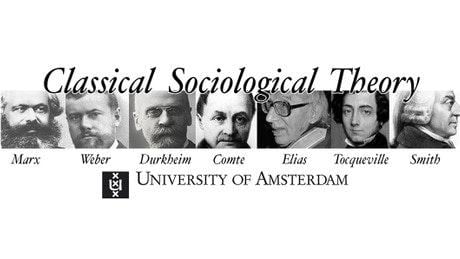
Classical Sociological Theory (Coursera)

Classical Sociological Theory (Coursera)

This Massive Open Online Course (MOOC) will offer the participants an introduction into the most important classical sociological readings between the 18th and 20th century. Highly influential social science scholars, such as Karl Marx, Max Weber and Emile Durkheim, will be discussed during 8 sessions. Combined with small tests, based on the video’s and recommended readings, the participants will be encouraged to dive deeply into the complex texts and get familiar with classical sociological concepts that are still very relevant today.

Class Deals by MOOC List - Click here and see Coursera's Active Discounts, Deals, and Promo Codes.

Syllabus

WEEK 1
Classical Sociological Theory - An Introduction
In this session the field of classical sociological theory will be introduced. It explains the historical roots of sociology. It shows you why classical sociological theories are still important in modern societies and it explains the Aims and Claims of this Course.

WEEK 2
Bernard Mandeville (1670-1733) and Adam Smith (1723-1790)
This session explains the work of Adam Smith. It shows you how a poem written by Bernard Mandeville inspired Adam Smith. Adam Smith's theory shines light on the consequences of industrialization. You will learn what the consequences are of the Division of Labour.

WEEK 3
Auguste Comte (1798-1857)
This session will cover the author of the word “sociology”, August Comte. He often engaged in theorizing the social world in order to attempt to discover invariant laws. Terms like “positivism”, “the law of the three stages” and “Functionalism” are prominent topics in this session. Comte believed that positivism could both advance science (theory) and change the ways people live their lives (practice).

WEEK 4
Alexis de Tocqueville (1805-1859)
Tocqueville’s works shaped 19th-century discussions of liberalism and equality, and were rediscovered in the 20th century as sociologists debated the causes and cures of tyranny and revolutions. His famous work “Democracy in America” remains widely read and even more widely quoted. This session will cover Tocqueville’s most important ideas.

WEEK 5
Karl Marx (1818-1883)
The German philosopher, radical economist, and revolutionary leader Karl Marx founded modern "scientific" socialism. His basic ideas, known as Marxism, form the foundation of socialist and communist movements throughout the world. Several topics like alienation, class struggle, and capitalism will be covered in this week's session.

WEEK 6
Émile Durkheim (1858-1917)
When thinking of Durkheim, one thinks of social facts. According to Durkheim these social facts are the social structures and cultural norms and values that are external to, and coercive over, individuals. Durkheim argues that two social facts, in particular, influence suicide rates: integration, and regulation. This session will cover the views of Durkheim on topics like solidarity, suicide, and religion.

WEEK 7
Max Weber (1864-1920)
This week shines a light on the work of Max Weber. From social action, verstehen, and ideal types to rationalisation and his famous work on the Protestant Ethic. Weber's theory of society tried to account for the manner in which various symbolic factors take part in establishing social status, stratification and inequality. His influence still runs throughout the realms of politics, religion and economics.

WEEK 8
Norbert Elias (1897-1990)
Elias is the last of the Classical Sociologists. Elias' theory focusses on long term trends, with his so called process or figurational sociology. He shows us how the civilisation proces can be explained in terms like Self-Constraint and Figurations.
Classical Sociological Theory Final Test
This is the final test. This test contains 87 question. To pass this test you need to answer at least 57 questions correct.


Go to Class
MOOC List is learner-supported. When you buy through links on our site, we may earn an affiliate commission.

Related Courses

Welcome to Game Theory (Coursera) Coursera
The University of Tokyo

Welcome to Game Theory (Coursera)

This course provides a brief introduction to game theory. Our main goal is to understand the basic ideas behind the key concepts in game theory, such as equilibrium, rationality, and cooperation. The course uses very little mathematics, and it is ideal for those who are looking for a conceptual introduction to game theory. Business competition, political campaigns, the struggle for existence by animals and plants, and so on, can all be regarded as a kind of “game,” in which individuals try to do their best against others.

Aug 10th 2026
4 Weeks
The Bilingual Brain (Coursera) Coursera
University of Houston System

The Bilingual Brain (Coursera)

This course explores the brain bases of bilingualism by discussing literature relevant to differences in age of initial learning, proficiency, and control in the nonverbal, single language and dual-language literature. Participants will learn about the latest research related to how humans learn one or two languages and other cognitive skills.

Aug 10th 2026
5-12 Weeks
Introduction to Global Sociology (edX) EdX
Wellesley College,WellesleyX

Introduction to Global Sociology (edX)

Connect your personal biography to global history as you develop your sociological imagination. Ever wondered why some countries are rich and others poor? Or why some people believe hard work results in upward mobility and others don’t? To answer these questions, you need to “see” the world sociologically. In this introductory sociology course, we will explore the concerns of an interconnected global world through classic sociological concepts.

No sessions available
4 Weeks
Global Sociology (edX) EdX
Wellesley College,WellesleyX

Global Sociology (edX)

Connect your personal biography to global history as you develop your sociological imagination. Ever wondered why some countries are rich and others poor? Or why some people believe hard work results in upward mobility and others don’t? To answer these questions, you need to “see” the world sociologically.

No sessions available
4 Weeks
What Is Sociology? An Introduction (FutureLearn) FutureLearn
The University of Newcastle, Australia

What Is Sociology? An Introduction (FutureLearn)

Examine perspectives on society, and the cultural issues facing society. Apply sociological theory to researching social groups. Discover the fascinating field of sociology. How can society be analysed? And what are some of the contemporary cultural issues in society? Get answers to these questions and more with this introduction to sociology course.

No sessions available
3 Weeks
EU policy and implementation: making Europe work! (Coursera) Coursera
Leiden University

EU policy and implementation: making Europe work! (Coursera)

People have become more critical of EU policy and often seem to prefer local policy solutions in response to globalisation problems. How do you experience EU policy? Does it help? And if not, how can we change this? In this course, we learn how the European Union prepares and decides on policy, and how policy is transferred to member states and implemented by various authorities, including regional and local governments. We discuss the challenges of the European multi-level governance structure. We also focus on the main causes of policy failure or success. On this journey, we focus on actual policy and present the views of various experts: how easy is it to establish yourself in another EU-country?

Aug 17th 2026
5-12 Weeks
Violence Against Healthcare (Coursera) Coursera
University of Geneva

Violence Against Healthcare (Coursera)

At the global level, there are many countries marked by violence affecting health care. The 'Health care in danger' project aims to establish practical measures and recommendations that can be implemented on the ground by policy-makers, humanitarian organizations and health professionals. In view of the multiplicity of actors and latitudes concerned, it is essential to be able to make available the tools needed to make informed decisions, guide behaviour in high-risk areas and provide everyone the means to create and optimize the dialogue between humanitarian professionals and health on the one hand and relevant authorities or other armed actors.

Aug 10th 2026
5-12 Weeks
International Humanitarian Law in Theory and Practice (Coursera) Coursera
Leiden University,Kalshoven-Gieskes Forum

International Humanitarian Law in Theory and Practice (Coursera)

“International Humanitarian Law in Theory and Practice” is the first MOOC of the Kalshoven-Gieskes Forum on International Humanitarian Law, which is the platform within the Grotius Centre for International Legal Studies of Leiden University for the research, teaching and dissemination of international humanitarian law (IHL).

Aug 10th 2026
5-12 Weeks
Sports and Society (Coursera) Coursera
Duke University

Sports and Society (Coursera)

Sports play a giant role in contemporary society worldwide. But few of us pause to think about the larger questions of money, politics, race, sex, culture, and commercialization that surround sports everywhere. This course draws on the tools of anthropology, sociology, history, and other disciplines to give you new perspectives on the games we watch and play.

Aug 10th 2026
5-12 Weeks
Economie du sol et de l'immobilier II (Coursera) Coursera
École Polytechnique Fédérale de Lausanne

Economie du sol et de l'immobilier II (Coursera)

Quels sont les liens entre les prix fonciers, les prix immobiliers et les prix pour l'usage des immeubles? Est-ce que les prix immobiliers permettent de comprendre les prix fonciers? Ou l'inverse? Quels sont les calculs faits par les opérateurs sur ces marchés? On a le sentiment que ces marchés sont liés les uns aux autres. Avec ce cours, vous comprendrez mieux comment. En passant, vous aurez acquis une meilleure compréhension des mécanismes économiques qui peut être utile dans d'autres domaines.

Aug 10th 2026
5-12 Weeks
Chemerinsky on Constitutional Law - Individual Rights and Liberties (Coursera) Coursera
University of California, Irvine

Chemerinsky on Constitutional Law - Individual Rights and Liberties (Coursera)

Chemerinsky on Constitutional Law: Individual Rights and Liberties will highlight the construction and interpretation of the U.S. Constitution through the centuries with an emphasis on protections of individual liberties and the evolution of equal protection. You'll learn the history behind the Constitution, cases that formed important precedent, and how changes in interpretation have been dependent on shifts in cultural and political climate as well as the composition of the Supreme Court.

Aug 10th 2026
5-12 Weeks
Systems Thinking In Public Health (Coursera) Coursera
Johns Hopkins University

Systems Thinking In Public Health (Coursera)

This course provides an introduction to systems thinking and systems models in public health. Problems in public health and health policy tend to be complex with many actors, institutions and risk factors involved. If an outcome depends on many interacting and adaptive parts and actors the outcome cannot be analyzed or predicted with traditional statistical methods. Systems thinking is a core skill in public health and helps health policymakers build programs and policies that are aware of and prepared for unintended consequences.

Aug 10th 2026
4 Weeks