Caring with Music: Can Music Do More In Adult Care Settings? (FutureLearn)

Offered by Nordoff Robbins,
Caring with Music: Can Music Do More In Adult Care Settings? (FutureLearn)

Learn how music can help you in your work as an adult caregiver and explore ideas from music therapists to use in care settings. Discover the benefits of using music interactively
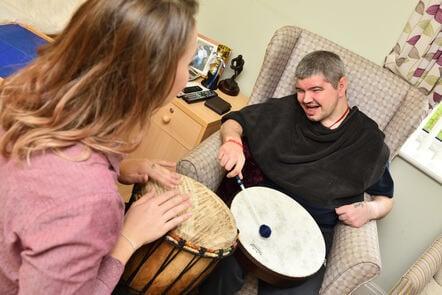
Regardless of our language, culture, or abilities, music speaks to all of us. It can enable us to connect with other people and to the world around us. It can help us express our feelings, increase our socialisation, and communicate in new ways. On this six-week course, you’ll explore the reasons why music ‘works’ and learn how to apply this knowledge in your adult care setting for positive change.

Class Deals by MOOC List - Click here and see FutureLearn's Active Discounts, Deals, and Promo Codes.

Using techniques from specially trained Nordoff Robbins music therapists – combined with your own expertise – you’ll explore how to effectively use music with the people you support.
Learn how to use music in care homes and other settings
You’ll explore your own relationship with music before learning how, and why, this can be used as an effective tool in care settings.
Tuning into the people you support, you’ll identify how you can bring music into the daily life of people you care for, such as creating songs and using musical instruments.
You’ll also learn how to plan and facilitate music activity sessions as well as tips to improve the soundscape of your setting.
Understand how to apply concepts such as active listening in your work
The course will help you apply your learning in a practical way and identify all opportunities to use music to benefit your care setting.
Examining concepts such as individual musicality and active listening, you’ll learn how to use music flexibly to enhance your work and caring environment.
Learn from the specialists at Nordoff Robbins
You’ll learn from the experts at Nordoff Robbins, the UK’s largest music therapy charity, whose practice is informed by research.
The course gives you the opportunity to explore the work of a music therapist and develop skills in this field to help provide better care for the people you support.

Syllabus

Week 1: Everyone has a personal relationship with music
Week 2: 'Tuning in' to the people you support
Week 3: The joy of familiar songs
Week 4: Music as part of your daily care setting
Week 5: Using musical instruments
Week 6: Embedding music into your care setting

What will you achieve?
By the end of the course, you‘ll be able to...

  • Apply active music-making in the everyday life of your adult care setting.
  • Identify your own existing relationship with music
  • Describe the musical identity of someone you support
  • Describe why music 'works' and is a valuable tool in adult care settings
  • Apply musical thinking to different forms of communication
  • Describe how the people you support present in musical terms
  • Explore how to use your voice and movement to engage with people you support
  • Demonstrate how familiar songs can be adapted to interact with people you support
  • Explore the purpose of a new song for someone you support
  • Explore how to create your own song based on a familiar tune and use it flexibly
  • Describe ways in which music can be used to enhance and ease daily routines and difficult moments in care settings
  • Describe the 'soundscape' within your setting and identify how musical changes could help
  • Apply specific musical changes to improve the everyday life of your care setting
  • Explain why specific instruments might be chosen for the people you support
  • Explain how instruments can be used in different ways as a form of expression, and how you can enable the people you support to play in their own way.
  • Identify different musical ideas for using instruments with the people you support, and how to facilitate some appropriate activities
  • Demonstrate how you would set-up and plan for a music activity session within your setting
  • Explore different sources for ideas and resources to further develop your music-making practice in your setting

Who is the course for?
This course is designed for anyone working in an adult care setting wanting to learn how music can support the people you care for.
The content is adaptable to suit a range of care settings, including care homes, day centres, hospices, secure wards, and more.

What software or tools do you need?
To take part in the course you’ll need access to a computer or mobile device. You will also need a ‘reflective journal’ - a means of keeping notes from week to week that you can store confidentially. There will be more information about this during Week 1 of the course.
Go to Class
MOOC List is learner-supported. When you buy through links on our site, we may earn an affiliate commission.

Related Courses

Pro Tools Basics (Coursera) Coursera
Berklee College of Music

Pro Tools Basics (Coursera)

Producing music is an incredibly creative process, and knowing the tools of the trade is essential in order to transmit the musical ideas in your head into the DAW in a creative and uninhibited way. Whether you have used a computer to create music before, or you have been curious about production for years, this 4-week course will give you an introductory look into the world of Avid Pro Tools and Pro Tools First.

Aug 17th 2026
4 Weeks
Making Music with Others (FutureLearn) FutureLearn
Trinity Laban Conservatoire of Music and Dance

Making Music with Others (FutureLearn)

Get an introduction to group music-making and the social contexts in which musicians participate. Understand how to make music effectively with others. This online course will help you reflect on your own music-making activities and the way you interact with other musicians.

No sessions available
4 Weeks
String Music Appreciation (FutureLearn) FutureLearn
Chung Yuan Christian University (CYCU)

String Music Appreciation (FutureLearn)

Explore the history, construction and techniques of different string instruments, and analyse the famous Butterfly Lovers Concerto. Discover the fascinating stories behind stringed instruments. From Haydn and Bach in the West to Chen Gang in China, string instruments have inspired some of the world’s most powerful music and gifted composers. On this course, you’ll examine the history of string instruments. You’ll go on to explore famous composers, and the most-celebrated Chinese classical string composition of all: the Butterfly Lovers Concerto.

Feb 27th 2023
4 Weeks
The Blues: Understanding and Performing an American Art Form (Coursera) Coursera
University of Rochester

The Blues: Understanding and Performing an American Art Form (Coursera)

The blues is an American art form and the most important musical form in jazz. Although there are other formal paradigms of the blues, such as 8-bar or 16-bar, this course focuses on different incarnations of the 12-bar blues. There are considerable differences between Early Jazz blues, Swing blues, Bebop blues, Modal blues, and Post Bop blues.

Aug 10th 2026
5-12 Weeks
Copyright for Multimedia (Coursera) Coursera
Duke University,Emory University,University of North Carolina

Copyright for Multimedia (Coursera)

Copyright questions about different formats (data, images, music and video) can be especially difficult. Sometimes the law specifically distinguishes between these different formats, and in most cases there are media-specific considerations that impact a copyright analysis. In this course we will look at four different media, paying special attention to the unique issues for each one and the kinds of information that is important when making copyright decisions for each type of material.

Aug 17th 2026
4 Weeks
Game Design and Development: A Bit-by-Bit History of Video Game Music (FutureLearn) FutureLearn
Abertay University

Game Design and Development: A Bit-by-Bit History of Video Game Music (FutureLearn)

Chart the evolution of the classic 8-bit sound and discover the role of musicians in game design and development. Chart the history of video game music, bit by bit. From early arcade games to modern open-world adventures, video game soundtracks have made an indelible mark on our culture. On this course, you’ll get an introduction to video game music and the platforms that define it (including Atari and NES), focusing on the evolution of the classic 8-bit sound.

Jul 26th 2021
2 Weeks
Learn to Code Electronic Music Tools with Javascript (FutureLearn) FutureLearn
Goldsmiths, University of London

Learn to Code Electronic Music Tools with Javascript (FutureLearn)

This course shows you how to build sound synthesizers and drum machines that run in your web browser using Javascript. In this course you will build a range of electronic music tools using the Javascript language and the Web Audio API. You will be shown line by line how to program interactive synthesizers, drum machines and even algorithmic music systems that can generate music automatically.

No sessions available
4 Weeks
Jazz Improvisation (Coursera) Coursera
Berklee College of Music

Jazz Improvisation (Coursera)

Learn the basic concepts of improvisation from Gary Burton, one of the most renowned improvisers in the jazz world, including the mental, melodic, and harmonic processes that contribute to the instinctive skills that an improviser puts to use when taking a solo. While many people are fans of jazz and understand that musicians are often “making up” the notes they are playing during a performance, most people—often including musicians, themselves, who are beginning to learn improvising—aren’t clear about what exact processes take place to enable this to happen. The purpose of this course is to introduce the basic concepts of modern improvisation and how to go about mastering the different musical and mental skills involved.

Aug 10th 2026
5-12 Weeks
Cantonese Opera: from Backstage to the Stage (FutureLearn) FutureLearn
The Hong Kong Academy for Performing Arts

Cantonese Opera: from Backstage to the Stage (FutureLearn)

Interested in Cantonese opera? Join us in an exploration of this artform from the Backstage to the Stage. Get an introduction to how a Cantonese opera show is prepared. Cantonese opera is a form of Chinese opera that can trace its roots back to the 12th century. Combining music, singing, martial arts, acrobatics and acting, Cantonese opera tells stories from Chinese history and myth, reflecting virtues like love, loyalty and patriotism.

No sessions available
4 Weeks