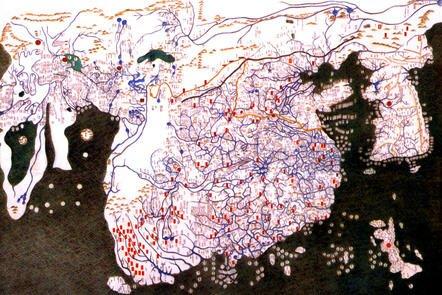
Lips and Teeth: Korea and China in Modern Times (FutureLearn)

Offered by Yonsei University,
Lips and Teeth: Korea and China in Modern Times (FutureLearn)

Explore the historical evolution of China and the Korean Peninsula and discover the implications for today.

Class Deals by MOOC List - Click here and see FutureLearn's Active Discounts, Deals, and Promo Codes.

As countries across Asia - and the globe - wrestle with the impact of China’s rise, nowhere are the opportunities and threats of a wealthy and powerful China felt more keenly than next door, on the Korean Peninsula.
Understanding the history and current reality behind Sino-Korean relations - countries long-described as being as close yet as different as “lips and teeth” - opens up a window onto perhaps the key geopolitical transformation of the present age.
This free online course from Yonsei University in Seoul will cover lot of ground chronologically, focussing on watershed moments that include: the Imjin War (1592-1598); the First Sino-Japanese War (1894-1895); the Korean War (1950-1953); and the end of the Cold War (1991).
We will then turn our historical gaze to the present, focusing on the current leaders of China, and North and South Korea. We will look at the ways in which the extraordinary family histories of Xi Jinping, Kim Jong-un and Park Geun-hye embody the complex relationship between lips and teeth.
Painting on a broad historical canvas, we will learn why Chinese and Koreans have insisted on remaining as close as “lips and teeth,” and yet how difficult that ideal is to achieve in reality.
The educator for this course is John Delury, Professor of Chinese history and Sino-Korean relations at Yonsei University, and co-author of the acclaimed book, “Wealth & Power: China’s Long March to the 21st Century.”
Go to Class
MOOC List is learner-supported. When you buy through links on our site, we may earn an affiliate commission.

Related Courses

China’s First Empires and the Rise of Buddhism (edX) EdX
HarvardX,Harvard University

China’s First Empires and the Rise of Buddhism (edX)

Learn about the Qin and Han dynasties, and how Buddhism and ideas of self-realization influenced the medieval period. This course, the second in a collection on Chinese history and culture, addresses how the Qin dynasty conquered China and established a new system of government and how the Han dynasty built a stable, centralized empire that lasted for hundreds of years. We cover the early history of Buddhism in China and how the rising feudal aristocracy responded to the loss of empire by looking inward.

Self Paced
Self-Paced
Social Science Approaches to the Study of Chinese Society Part 1 (Coursera) Coursera
The Hong Kong University of Science and Technology - HKUST

Social Science Approaches to the Study of Chinese Society Part 1 (Coursera)

This course seeks to turn learners into informed consumers of social science research. It introduces concepts, standards, and principles of social science research to the interested non-expert. Learners who complete the course will be able to assess evidence and critically evaluate claims about important social phenomena. It reviews the origins and development of social science, describes the process of discovery in contemporary social science research, and explains how contemporary social science differs from apparently related fields. It describes the goals, basic paradigms, and methodologies of the major social science disciplines.

Aug 3rd 2026
5-12 Weeks
Understanding China, 1700-2000: A Data Analytic Approach, Part 1 (Coursera) Coursera
The Hong Kong University of Science and Technology - HKUST

Understanding China, 1700-2000: A Data Analytic Approach, Part 1 (Coursera)

The purpose of this course is to summarize new directions in Chinese history and social science produced by the creation and analysis of big historical datasets based on newly opened Chinese archival holdings, and to organize this knowledge in a framework that encourages learning about China in comparative perspective. Our course demonstrates how a new scholarship of discovery is redefining what is singular about modern China and modern Chinese history.

Aug 3rd 2026
5-12 Weeks
Cosmopolitan Tang: Aristocratic Culture in China (edX) EdX
HarvardX,Harvard University

Cosmopolitan Tang: Aristocratic Culture in China (edX)

Explore the reunification of China under the Tang with a focus on aristocratic culture — from poetry to calligraphy to literature. By the Tang period, China was divided into northern and southern dynasties with different rulers and political systems. The north was conquered by relatively unsophisticated barbarians, but in the south, the aristocratic families established a refined appreciation of writing and literature.

Self Paced
Self-Paced
Social Science Approaches to the Study of Chinese Society Part 2 (Coursera) Coursera
The Hong Kong University of Science and Technology - HKUST

Social Science Approaches to the Study of Chinese Society Part 2 (Coursera)

This course is intended as a first step for learners who seek to become producers of social science research. It is organized as an introduction to the design and execution of a research study. It introduces the key elements of a proposal for a research study, and explains the role of each. It reviews the major types of qualitative and quantitative data used in social science research, and then introduces some of the most important sources of existing data available freely or by application, worldwide and for China.

Jul 27th 2026
5-12 Weeks
Chinese for HSK 1 (Coursera) Coursera
Peking University

Chinese for HSK 1 (Coursera)

Nǐ hǎo! 你好!Welcome to Chinese for HSK - a Chinese course for everybody. My name is YU Bin. I am very happy to meet you here! HSK stands for Hànyǔ (Chinese) Shuǐpíng (level) Kǎoshì (test), which is the most important Chinese proficiency test in use today. It assesses non-native Chinese speakers’ abilities in using Chinese in their daily, academic and professional lives. Chinese for HSK Level 1 is the first step of the 6 levels and assesses test takers’ abilities in the application of everyday Chinese. It is the counterpart of Level 1 of the Chinese Language Proficiency Scales for Speakers of Other Languages and the A1 Level of the Common European Framework of Reference for Languages.

Jul 27th 2026
5-12 Weeks
Korean Music, A Philosophical Exploration (Coursera) Coursera
Sungkyunkwan University - SKKU

Korean Music, A Philosophical Exploration (Coursera)

This course introduces Korean philosophy projected into the subject of Korean music, especially K-POP, which is drawing global attention today. We confirm that Korea's unique philosophy was the basis for maintaining originality while being universally accepted by many people, and seek the role of philosophy for the continuous development and spread of Korean music.

Aug 10th 2026
5-12 Weeks
Introduction to Korean Philosophy and Culture (Coursera) Coursera
Sungkyunkwan University - SKKU

Introduction to Korean Philosophy and Culture (Coursera)

This course will give you the cultural and historical background to begin your journey into Korean philosophy, and there is no prerequisite knowledge on philosophy required. Anybody who either has an interest in Korean culture, maybe through K-Dramas or K-pop, or an interest in philosophy from a cross-cultural perspective, are all welcome.

Aug 3rd 2026
4 Weeks