The History and Culture of Chinese Silk (FutureLearn)

The History and Culture of Chinese Silk (FutureLearn)

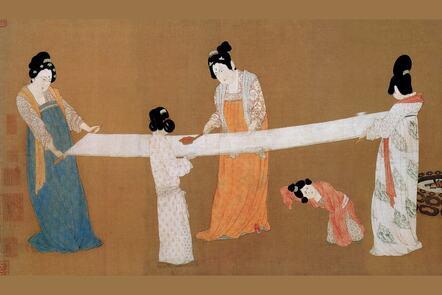
Delve into the origins and development of Chinese silk to understand its history, cultural heritage, and place in modern China. Unpack sericulture and silk craftsmanship in China. As one of the origins of textile culture, China is characterised by silk. The unique sericulture and silk craftsmanship from China is firmly embedded in its cultural heritage. In modern China, silk is not only a fibre material, but also permeates art, culture, economy, and even politics. On this three-week course, you’ll gain a solid understanding of the silk culture and art that characterises China from a material culture perspective.

Class Deals by MOOC List - Click here and see FutureLearn's Active Discounts, Deals, and Promo Codes.

You’ll unpack the origins and legends of Chinese silk as you discover exciting archaeological finds and explore Chinese history.

Gain an introduction to the silk road
From the second century BCE, the silk road was a network of routes active for more than 1,500 years.
You’ll explore the silk routes on the road to understand the full scale of this important trade route and how it impacted the Chinese economy.

Explore silk weaving and patterns
Next, you’ll delve into the evolution and development of silk weaving techniques.
You’ll also discover the characteristics of ancient Chinese silk patterns from different dynasties through the years to gain a deeper understanding of Chinese history.

Learn from the experts at the University for the Creative Arts
Throughout the course, you’ll be guided by the specialists at the University for the Creative Arts.
With their expertise, you’ll finish with in-depth knowledge of Chinese silk, its history, and its importance in Chinese culture.

Syllabus

Week 1: Getting started
Week 2: Chinese silk road
Week 3: The development of silk patterns and changes in weaving techniques

What will you achieve?
By the end of the course, you‘ll be able to...

  • Develop an in-depth understanding of Chinese silk culture.
  • Classify the artistic features of silk patterns from different dynasties.
  • Describe the Silk Road.
  • Summarise the development of silk weaving techniques.

Who is the course for?
This course is designed for anyone interested in Chinese silk, silk history and culture, and the evolution of textile techniques in different historical periods.
It will be particularly useful for textile students.
Go to Class
MOOC List is learner-supported. When you buy through links on our site, we may earn an affiliate commission.

Related Courses

Chinese for HSK 1 (Coursera) Coursera
Peking University

Chinese for HSK 1 (Coursera)

Nǐ hǎo! 你好!Welcome to Chinese for HSK - a Chinese course for everybody. My name is YU Bin. I am very happy to meet you here! HSK stands for Hànyǔ (Chinese) Shuǐpíng (level) Kǎoshì (test), which is the most important Chinese proficiency test in use today. It assesses non-native Chinese speakers’ abilities in using Chinese in their daily, academic and professional lives. Chinese for HSK Level 1 is the first step of the 6 levels and assesses test takers’ abilities in the application of everyday Chinese. It is the counterpart of Level 1 of the Chinese Language Proficiency Scales for Speakers of Other Languages and the A1 Level of the Common European Framework of Reference for Languages.

Aug 10th 2026
5-12 Weeks
International Communication and East Asian Affairs (2) (Coursera) Coursera
National Taiwan University

International Communication and East Asian Affairs (2) (Coursera)

Law

"International Communication and East Asian Affairs: Current Political and Economic Conditions" is an online course provided by the Graduate Institute of Journalism, National Taiwan University, and Radio Taiwan International. This course delves into East Asian affairs, particularly focusing on China and Taiwan. Topics covered include China's Third Revolution and its implications for the Sino-American strategic competition, the political economy of China, state-society relations within China, and an exploration of recent youth politics in Taiwan.

Aug 24th 2026
5-12 Weeks
Literati China: Examinations, Neo-Confucianism, and Later Imperial China (edX) EdX
HarvardX,Harvard University

Literati China: Examinations, Neo-Confucianism, and Later Imperial China (edX)

Explore China’s imperial period, with a focus on the Song dynasty and the role of the exam system in government. Fundamental changes in government, the economy, and broader society took place between the 8th and 11th centuries in China. The state aristocracy gave way to new literati elite: educated men who sought to enter government through competitive examinations. A new kind of Confucianism also took shape, which prized the moral autonomy of individuals. With this, the later imperial period of China’s history begins.

Self Paced
Self-Paced
Cosmopolitan Tang: Aristocratic Culture in China (edX) EdX
HarvardX,Harvard University

Cosmopolitan Tang: Aristocratic Culture in China (edX)

Explore the reunification of China under the Tang with a focus on aristocratic culture — from poetry to calligraphy to literature. By the Tang period, China was divided into northern and southern dynasties with different rulers and political systems. The north was conquered by relatively unsophisticated barbarians, but in the south, the aristocratic families established a refined appreciation of writing and literature.

Self Paced
Self-Paced
China’s First Empires and the Rise of Buddhism (edX) EdX
HarvardX,Harvard University

China’s First Empires and the Rise of Buddhism (edX)

Learn about the Qin and Han dynasties, and how Buddhism and ideas of self-realization influenced the medieval period. This course, the second in a collection on Chinese history and culture, addresses how the Qin dynasty conquered China and established a new system of government and how the Han dynasty built a stable, centralized empire that lasted for hundreds of years. We cover the early history of Buddhism in China and how the rising feudal aristocracy responded to the loss of empire by looking inward.

Self Paced
Self-Paced
The amazing world of the ethnic groups of Yunnan Province (Coursera) Coursera
Shanghai Jiao Tong University

The amazing world of the ethnic groups of Yunnan Province (Coursera)

Yunnan, abbreviated as Yun and called Dian for short, is a multi-ethnic province which has historically been situated in the southwest frontier of China. Over time, the ethnic minorities evolved into splendid cultures, each with their own unique social life, religious beliefs and customs. The course is taught in English and provides an introduction to 25 ethnic minorities in Yunnan Province, namely the Yi, Bai, Hani, Dai, Zhuang, Miao, Hui, Lisu, Lahu, Wa, Naxi, Yao, Jingpo, Tibetan, Bulang, Buyi, Achang, Pumi, Mongolian, Nu, Jinuo, De'ang, Shui, Man and Dulong nationalities.

Aug 10th 2026
5-12 Weeks
Structuring Values in Modern China (Coursera) Coursera
The Chinese University of Hong Kong

Structuring Values in Modern China (Coursera)

This sequence of four courses will propose a multi-disciplinary approach to the study of Chinese cultural history conceived of as a succession of modes of rationality (philosophical, bureaucratic, and economic). The focus will be on the moments of paradigm shift from one mode of rationality to another. For each of these moments, cultural facts and artifacts—thought, literature, ritual—will be examined in relationship to changing social, political, and economic systems.

Aug 17th 2026
5-12 Weeks
English for Doing Business in Asia - Speaking (edX) EdX
The Hong Kong University of Science and Technology - HKUST,HKUSTx

English for Doing Business in Asia - Speaking (edX)

Introducing strategies for developing your spoken English communication skills in the context of doing business in Asia. The use of English for doing business in multinational settings is a fact of life for many business people. As Asian economies expand and become more involved in the global economy, a lingua franca – a language used to communicate among groups of people who do not share a mother tongue – is needed to exchange information.

Self Paced
Self-Paced
Invasions, Rebellions, and the Fall of Imperial China (edX) EdX
HarvardX,Harvard University

Invasions, Rebellions, and the Fall of Imperial China (edX)

An overview of modern Chinese history, including the fall of the Qing and the end of imperial China. In the 18th century, the Qing Dynasty is at its height; it is the wealthiest, most powerful, most civilized state on earth. And yet the 19th century brought enormous challenges for the Qing and for the place we call China. By the 20th century, a 2,000-year imperial tradition is gone. What happened?

Self Paced
Self-Paced