Life Below Water: Conservation, Current Issues, Possible Solutions (FutureLearn)

Life Below Water: Conservation, Current Issues, Possible Solutions (FutureLearn)

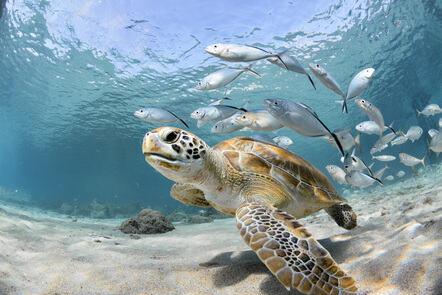
Explore the human impact on underwater biodiversity, ecosystems, and animals, and solutions for preserving life below water. Develop knowledge and research skills in marine conservation. It is widely accepted that the phenomenal biodiversity within underwater ecosystems and habitats has been very negatively affected by human interaction. The exact nature and course of the damage, and what can be done about it, are not as clearly understood. This four-week course by the University of the Sunshine Coast aims to change that.

Class Deals by MOOC List - Click here and see FutureLearn's Active Discounts, Deals, and Promo Codes.

You’ll develop research and analytic skills, gaining insights into how to measure and minimise human impact on marine life. Ultimately, you’ll learn how to preserve underwater biodiversity and better protect aquatic animals.

Explore marine biodiversity and aquatic ecology
On this course, you’ll take a deep dive into the ecosystems found below the water’s surface. You’ll also be introduced to the form, function, and evolution of aquatic animals.
As you learn what types of species exist, and how they have adapted to survive, you’ll gain greater insights into how to ensure animal conservation in these environments.

Gain a deeper understanding of the environmental impact of humans
In addition to natural aquatic ecology you’ll examine how human behaviour exacerbates climate change, and the effects that climate change has on underwater fauna and flora.
With an understanding of the threats to marine life, you’ll then take a look at new developments in marine science, and how this is leading to solutions to human impact.

Enjoy world-class education with the University of the Sunshine Coast
Throughout the course, you’ll be guided by the specialists at the University of the Sunshine Coast who are at the forefront of research into aquatic and terrestrial systems.
You’ll learn from ecology experts to help develop your skills, confidence, and knowledge in marine conservation.

What topics will you cover?
Over the duration of the course, you’ll look at the following subjects:

  • Biodiversity and ecology
  • Form, function, and evolution in marine animals
  • Human impacts and climate change
  • Cutting-edge research and possible conservation solutions

Learning on this course
You can take this self-guided course and learn at your own pace. On every step of the course you can meet other learners, share your ideas and join in with active discussions in the comments.
What will you achieve?
By the end of the course, you‘ll be able to...

  • Identify common groups of aquatic species, including marine mammals, reptiles, fish and seabirds
  • Discuss common problems facing species in aquatic environments, including climate change, urbanisation, and fisheries exploitation
  • Explain key aspects of the morphology, behaviour and ecology of species in aquatic environments, including crocodile movement, diving mammals, and shark reproduction
  • Investigate the advanced techniques and technology which are used to study and solve conservation issues by scientists.

Who is the course for?
This course is designed for anyone interested in the ecology and conservation of aquatic animals. The knowledge gained can be used to pursue opportunities outside environmentalism, in diverse fields such as business, education, finance, and eco-tourism.


Go to Class
MOOC List is learner-supported. When you buy through links on our site, we may earn an affiliate commission.

Related Courses

East Asian Religions & Ecology (Coursera) Coursera
Yale University

East Asian Religions & Ecology (Coursera)

At first glance the fields of religion and ecology may seem and unlikely pairing, but a deeper consideration reveals the two have a great deal to contribute to one another and are indeed inextricably linked. Religions recognize the unity and interdependence of humans with nature. Ecological sciences affirm this deep interconnection with the natural world. This partnership can inspire work for the wellbeing of the Earth community

Aug 17th 2026
5-12 Weeks
Ecologie Politique: défi de la durabilité pour les démocraties (Coursera) Coursera
University of Lausanne

Ecologie Politique: défi de la durabilité pour les démocraties (Coursera)

De quoi parle-t-on lorsque l’on parle d’environnement ? Existe-t-il une crise écologique ? L’environnement se résume-t-il à la pollution ? Est-on vraiment fondé à parler de risques environnementaux ? L’environnement a-t-il affaire à la politique et si oui pourquoi ? Pourquoi et à partir de quand a-t-on pu parler d’écologie politique ? Quelles en sont les différentes expressions ? Les démocraties et leurs expressions courantes ne suffisent-elles pas à répondre aux problèmes écologiques ? Et si ce n’est pas le cas, quels sont les apports éventuels et potentiels de l’écologie politique ? Ce cours se propose à répondre à ces questions, l’objectif global étant de comprendre les tenants et aboutissants de l’interface écologie et politique.

Aug 31st 2026
4 Weeks
Extinctions: Past and Present (FutureLearn) FutureLearn
University of Cape Town

Extinctions: Past and Present (FutureLearn)

Discover the diversity of life on earth, the impacts of five past mass extinctions and the prospect of a sixth extinction today. This free online course explores how life on earth has been shaped by five mass extinction events in the distant past. At present, biodiversity is facing a crisis, with the prospect of a sixth extinction event today.

Jul 25th 2022
5-12 Weeks
Fashion Values: Nature (FutureLearn) FutureLearn
London College of Fashion

Fashion Values: Nature (FutureLearn)

Understand biodiversity in the context of fashion and create a plan for fashion that protects our earth’s systems. Discover fashion practices that can protect, restore, and regenerate ecosystems. Nature is the life force that provides us with the air, water, soil, and minerals that sustain life on earth. These elements come together in the clothes we wear. This course will help you build the knowledge, skills, and connections to reimagine fashion’s practices and develop a plan to put nature first.

Available now
4 Weeks
China’s First Empires and the Rise of Buddhism (edX) EdX
HarvardX,Harvard University

China’s First Empires and the Rise of Buddhism (edX)

Learn about the Qin and Han dynasties, and how Buddhism and ideas of self-realization influenced the medieval period. This course, the second in a collection on Chinese history and culture, addresses how the Qin dynasty conquered China and established a new system of government and how the Han dynasty built a stable, centralized empire that lasted for hundreds of years. We cover the early history of Buddhism in China and how the rising feudal aristocracy responded to the loss of empire by looking inward.

Self Paced
Self-Paced
Dino 101: Dinosaur Paleobiology (Coursera) Coursera
University of Alberta

Dino 101: Dinosaur Paleobiology (Coursera)

Dino 101: Dinosaur Paleobiology is a 12-lesson course teaching a comprehensive overview of non-avian dinosaurs. Topics covered: anatomy, eating, locomotion, growth, environmental and behavioral adaptations, origins and extinction. Lessons are delivered from museums, fossil-preparation labs and dig sites. Estimated workload: 3-5 hrs/week.

Aug 22nd 2026
5-12 Weeks
Environmental Science (Coursera) Coursera
Dartmouth College

Environmental Science (Coursera)

The Introduction to Environmental Science course explores the field of environmental science and encourages participants to understand how environmental scientists think. It addresses some important questions such as: 1. What is the difference between environmental science and environmental studies? 2. How do both differ from environmentalism? 3. Why is energy so important in environmental science? 4. What do you mean by biodiversity?

Aug 17th 2026
4 Weeks
Christianity & Ecology (Coursera) Coursera
Yale University

Christianity & Ecology (Coursera)

There is a need for broader literacy and deeper knowledge of the world’s religions and their ecological contributions. This course is designed as a gateway to the rich ecological dimensions of the Christian religious tradition. We delve into unique contributions from Orthodox, Catholic, and Protestant Christianity, exploring views on and relationship with the natural world.

Aug 17th 2026
5-12 Weeks
Agroforestry IV: Climate, Carbon Storage and Agroforestry (Coursera) Coursera
University of Florida

Agroforestry IV: Climate, Carbon Storage and Agroforestry (Coursera)

Welcome to Agroforestry IV: Climate Change, Carbon Storage and Agroforestry Systems, a detailed review of fundamental principles and best practices for successful agroforestry projects. This interdisciplinary module, presented by leading experts in the field, is the fourth in the five-module course covering the various aspects of agroforestry including the global distribution of the practices, their underlying principles, and major scientific advances during the past nearly five decades.

Aug 17th 2026
1 Week
Introduction to Religions & Ecology (Coursera) Coursera
Yale University

Introduction to Religions & Ecology (Coursera)

At first glance the fields of religion and ecology may seem and unlikely pairing, but a deeper consideration reveals the two have a great deal to contribute to one another and are indeed inextricably linked. Religions recognize the unity and interdependence of humans with nature. Ecological sciences affirm this deep interconnection with the natural world. This partnership can inspire work for the wellbeing of the Earth community
.

Aug 17th 2026
5-12 Weeks
Western Religions & Ecology (Coursera) Coursera
Yale University

Western Religions & Ecology (Coursera)

At first glance the fields of religion and ecology may seem and unlikely pairing, but a deeper consideration reveals the two have a great deal to contribute to one another and are indeed inextricably linked. Religions recognize the unity and interdependence of humans with nature. Ecological sciences affirm this deep interconnection with the natural world. This partnership can inspire work for the wellbeing of the Earth community

Aug 17th 2026
5-12 Weeks
Invitation to Ex-Noguchi Room: Preservation and Utilization of Cultural Properties in Universities (FutureLearn) FutureLearn
Keio University

Invitation to Ex-Noguchi Room: Preservation and Utilization of Cultural Properties in Universities (FutureLearn)

Learn how to preserve, restore and utilize cultural properties in universities—a case study from Keio University, Tokyo. In this course, we will examine how to bring attention to cultural properties in a university, preserve and utilize them. The course focuses on the ‘Ex-Noguchi Room’ as a case study, which is a cultural property of Keio University in Tokyo. The space and what its contents are no longer in thier original state due to the partial reconstruction.

Self Paced
2 Weeks