Introduction to Quantum Information (Coursera)

Introduction to Quantum Information (Coursera)

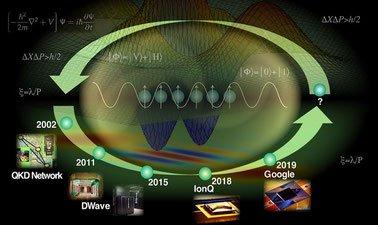
The course provides an introduction to quantum information at a beginning graduate level. It focuses on the fundamental understanding of how information is processed with quantum systems and how the quantum properties apply to computing and communication tasks. The course begins by presenting quantum theory as the framework of information processing. Quantum systems are introduced with single and two qubits. Axioms of quantum theory such as states, dynamics, and measurements are explained as preparation, evolution, and readout of qubits. Quantum computing and quantum communication are explained.

Class Deals by MOOC List - Click here and see Coursera's Active Discounts, Deals, and Promo Codes.

Entanglement is identified as a key resource of quantum information processing. Manipulation and quantification of entangled states are provided.
Quantum information processing opens an avenue to new information technologies beyond the current limitations but, more importantly, provides an approach to understanding information processing at the most fundamental level. What is desired is to find how Nature performs information processing with the quantum and classical systems. The ultimate power of Nature in computing and communication may be found and understood. The course provides a modest step to learn quantum information about how physical systems can be manipulated by the laws of quantum mechanics, how powerful they are in practical applications, and how the fundamental results make quantum advantages.

Syllabus

WEEK 1: Quantum Theory to Information Technologies
WEEK 2: Single qubit
WEEK 3: Bipartite quantum systems
WEEK 4: Quantum computing
WEEK 5: Quantum communication
WEEK 6: Entanglement
WEEK 7: Summary
Go to Class
MOOC List is learner-supported. When you buy through links on our site, we may earn an affiliate commission.

Related Courses

Cavity Quantum Optomechanics (edX) EdX
École Polytechnique Fédérale de Lausanne,EPFLx

Cavity Quantum Optomechanics (edX)

Fundamentals of optomechanics. Basic principles, recent developments and applications. Optomechanics is the study of the interaction between light and mechanical systems which can result in the manipulation of the state of both light and the mechanics. The nature of this interaction gives rise to a wide range of applications in both fundamental physics and technological advancements. In this course, you will learn the concepts and tools required for conducting research in the field of cavity optomechanics.

Self Paced
Self-Paced
Understanding Modern Physics II: Quantum Mechanics and Atoms (Coursera) Coursera
The Hong Kong University of Science and Technology - HKUST

Understanding Modern Physics II: Quantum Mechanics and Atoms (Coursera)

The 20th century was known as the century of physics. In the past 120 years, concepts such as space, time, energy, entropy and particles were understood to much deeper levels. New paradigms of thinking such as relativity and quantum mechanics emerged. This course is the second course in the Understanding Modern Physics series, which covers an introduction to quantum mechanics, atomic physics and quantum information.

Jun 8th 2026
4 Weeks
Understanding Quantum Computers (FutureLearn) FutureLearn
Keio University

Understanding Quantum Computers (FutureLearn)

Explore the key concepts of quantum computing and find out how it’s changing computer science with this introductory course. In this course, we will discuss the motivation for building quantum computers, cover the important principles in quantum computing, and take a look at some of the important quantum computing algorithms.

Available now
3 Weeks
Quantum Machine Learning (with IBM Quantum Research) (openHPI) OpenHPI
Hasso-Plattner-Institut

Quantum Machine Learning (with IBM Quantum Research) (openHPI)

Whether we stream our favorite series, develop new drugs or have us being chauffeured by a self-driving car -- machine learning is an essential part of our modern life, and of our future. But the growing amount of data and our increasing demands pose difficulties for today's classical computers. Can quantum computing overcome these challenges? What potentials does the emerging field of quantum machine learning have? In this course, we will not only learn about quantum machine learning and its prospects, but we will also solve concrete tasks with both classical and quantum models.

Jan 11th 2023
2 Weeks
Fundamentals of Quantum Information (edX) EdX
Delft University of Technology,DelftX

Fundamentals of Quantum Information (edX)

Learn how quantum information is represented mathematically via quantum circuits and how to manipulate quantum entanglement with these circuits. Take away the hardware, and all quantum computers work the same way, through the clever manipulation of quantum information and entanglement. This course provides a deeper understanding of some of the topics covered in our Quantum 101 program, namely, the representation and manipulation of quantum information at the level of abstract quantum circuits.

Self Paced
Self-Paced
Physical Basics of Quantum Computing (Coursera) Coursera
Saint Petersburg State University

Physical Basics of Quantum Computing (Coursera)

Quantum information and quantum computations is a new, rapidly developing branch of physics that has arisen from quantum mechanics, mathematical physics and classical information theory. Significant interest in this area is explained by the great prospects that will open upon the implementation of its ideas, capturing almost all areas of human activity related to the transfer, storage and processing of information.

Jul 25th 2022
5-12 Weeks
Emergent Phenomena in Science and Everyday Life (Coursera) Coursera
University of California, Irvine

Emergent Phenomena in Science and Everyday Life (Coursera)

Before the advent of quantum mechanics in the early 20th century, most scientists believed that it should be possible to predict the behavior of any object in the universe simply by understanding the behavior of its constituent parts. For instance, if one could write down the equations of motion for every atom in a system, it should be possible to solve those equations (with the aid of a sufficiently large computing device) and make accurate predictions about that system’s future.

Jun 22nd 2026
5-12 Weeks