Introduction to Machine Learning and AI (FutureLearn)

Introduction to Machine Learning and AI (FutureLearn)

Discover the fundamentals of machine learning, how it works, and learn to train your own AI using free online tools. Build your knowledge and skills in machine learning. From self-driving cars to determining someone’s age, artificial intelligence (AI) systems trained with machine learning (ML) are being used more and more. But what is AI, and what does machine learning actually involve?

Class Deals by MOOC List - Click here and see FutureLearn's Active Discounts, Deals, and Promo Codes.

On this four-week course from the Raspberry Pi Foundation, you’ll learn about different types of machine learning, and use online tools to train your own AI models.
You’ll delve into the problems that machine learning can help to solve, discuss how AI is changing the world, and think about the ethics of collecting data to train a machine learning model.
Explore the different types of machine learning
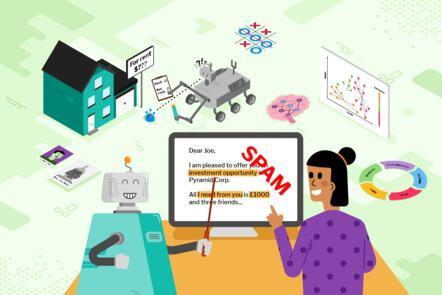
The first week of this course will guide you through how you can use machine learning to label data, whether to work out if a comment is positive or negative or to identify the contents of an image.
Then you’ll look at machine learning algorithms that create models to give a numerical output, such as predicting house prices based on information about the house and its surroundings.
You’ll also explore other types of machine learning that are designed to discover connections and groupings in data that humans would likely miss, giving you a deeper understanding of how machine learning can be used.
Use tools to develop and train your own AI
During this course, you’ll also investigate the different ways that the machine learning actually takes place.
You’ll compare supervised learning, which uses training data labelled with the desired outcome, to unsupervised learning, where the aim of the machine learning is to spot new connections.
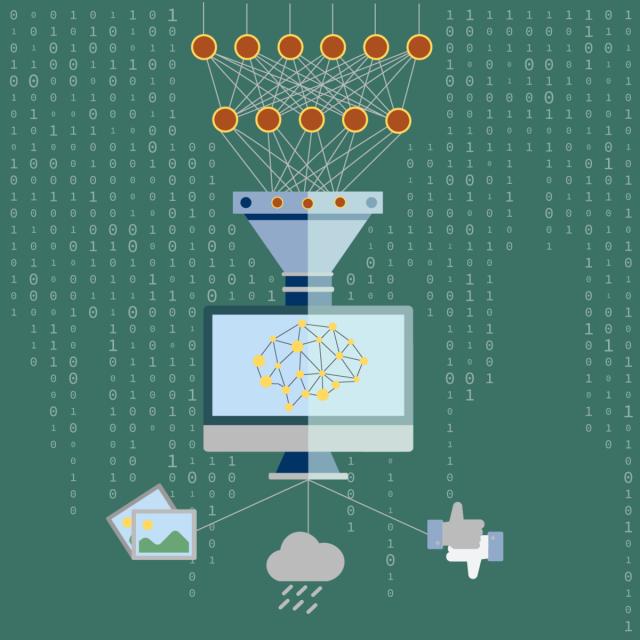
In the final week of the course, you’ll investigate neural networks; a type of machine learning inspired by the structure of the brain that is used by many state-of-the-art AI systems such as YOTI’s age determination algorithm.

Syllabus

Week 1: Introduction to machine learning
Week 2: Solving problems using AI
Week 3: How machines learn
Week 4: Neural networks and more activities

What will you achieve?
By the end of the course, you‘ll be able to...

  • Demonstrate several working machine learning models
  • Explain the different types of machine learning, and the problems that they are suitable for
  • Compare supervised, unsupervised, and reinforcement learning
  • Discuss the ethical issues surrounding machine learning and AI

Who is the course for?
This course is designed for anyone looking to learn more about machine learning without having to understand the maths involved.
To get the most out of this course, you should already have an understanding of what a computer algorithm is.
Some of the practical tasks also require familiarity with the Scratch programming language.

Go to Class
MOOC List is learner-supported. When you buy through links on our site, we may earn an affiliate commission.

Related Courses

How Artificial Intelligence Can Support Healthcare (FutureLearn) FutureLearn
University of Copenhagen,University of Groningen,University of Tartu,University Medical Center Groningen - UMCG,University Hospital Cologne

How Artificial Intelligence Can Support Healthcare (FutureLearn)

Explore how AI can be used to improve patient care and build your understanding of how to implement AI in the health professions. Understand real-life AI healthcare applications and their impact on healthcare. The use of artificial intelligence to improve efficiency is prevalent across almost every industry, none more so than the world of healthcare.

Self Paced
4 Weeks
Artificial Intelligence (AI) for Earth Monitoring (FutureLearn) FutureLearn
EUMETSAT,Copernicus Atmosphere Monitoring Service - CAMS,European Centre for Medium-Range Weather Forecasts - ECMWF,Mercator Ocean International - MOi,European Environment Agency - EEA

Artificial Intelligence (AI) for Earth Monitoring (FutureLearn)

Explore how artificial intelligence (AI) and machine learning (ML) technologies are helping to advance Earth monitoring. Learn to use AI and ML to improve the use of big data in Earth Monitoring. This is a fast-changing and critical time for Earth Observation (EO), especially for those involved in its use for climate and meteorology.

Oct 18th 2021
5-12 Weeks
Introduction to Machine Learning (Coursera) Coursera
Duke University

Introduction to Machine Learning (Coursera)

This course will provide you a foundational understanding of machine learning models (logistic regression, multilayer perceptrons, convolutional neural networks, natural language processing, etc.) as well as demonstrate how these models can solve complex problems in a variety of industries, from medical diagnostics to image recognition to text prediction.

Oct 19th 2026
5-12 Weeks
Machine Learning for All (Coursera) Coursera
University of London

Machine Learning for All (Coursera)

Machine Learning, often called Artificial Intelligence or AI, is one of the most exciting areas of technology at the moment. We see daily news stories that herald new breakthroughs in facial recognition technology, self driving cars or computers that can have a conversation just like a real person. Machine Learning technology is set to revolutionise almost any area of human life and work, and so will affect all our lives, and so you are likely to want to find out more about it.

Oct 19th 2026
4 Weeks
Applied Data Science (FutureLearn) FutureLearn
Birkbeck, University of London,Coventry University,Institute of Coding

Applied Data Science (FutureLearn)

Develop your data science and analytics skills and improve your understanding of using data in the workplace. Have the opportunity to build data science skills to advance your career. On this course, you’ll be introduced to the tools and techniques used in applied data science. You’ll explore the answers to important questions asked of business professionals today, such as why data science and machine learning have become so prevalent and what problems data science can address.

Jan 16th 2023
2 Weeks
Programming Languages, Part C (Coursera) Coursera
University of Washington

Programming Languages, Part C (Coursera)

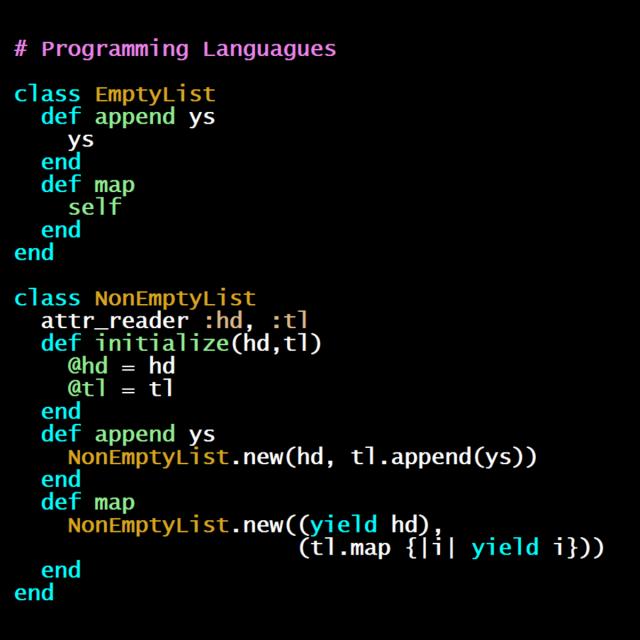
This course is an introduction to the basic concepts of programming languages, with a strong emphasis on functional programming. The course uses the languages ML, Racket, and Ruby as vehicles for teaching the concepts, but the real intent is to teach enough about how any language “fits together” to make you more effective programming in any language -- and in learning new ones.

Oct 19th 2026
3 Weeks
Artificial Intelligence: Ethics & Societal Challenges (Coursera) Coursera
Lund University

Artificial Intelligence: Ethics & Societal Challenges (Coursera)

Artificial Intelligence: Ethics & Societal Challenges is a four-week course that explores ethical and societal aspects of the increasing use of artificial intelligent technologies (AI). The aim of the course is to raise awareness of ethical and societal aspects of AI and to stimulate reflection and discussion upon implications of the use of AI in society.

Oct 19th 2026
4 Weeks
Artificial Intelligence (AI) Education for Teachers (Coursera) Coursera
Macquarie University

Artificial Intelligence (AI) Education for Teachers (Coursera)

Today’s learners need to know what artificial intelligence (AI) is, how it works, how to use it in their everyday lives, and how it could potentially be used in their future. Using AI requires skills and values which extend far beyond simply having knowledge about coding and technology. This course is designed by teachers, for teachers, and will bridge the gap between commonly held beliefs about AI, and what it really is. AI can be embedded into all areas of the school curriculum and this course will show you how. This course will appeal to teachers who want to increase their general understanding of AI, including why it is important for learners; and/or to those who want to embed AI into their teaching practice and their students’ learning.

Oct 19th 2026
5-12 Weeks
AI for Healthcare: Equipping the Workforce for Digital Transformation (FutureLearn) FutureLearn
University of Manchester,Health Education England

AI for Healthcare: Equipping the Workforce for Digital Transformation (FutureLearn)

Learn how artificial intelligence is transforming healthcare and how it can be used to support change in the healthcare workforce. Build your digital understanding and become a champion for AI in healthcare. AI is transforming healthcare in a variety of beneficial ways, from streamlining workflow processes to making more precise patient diagnoses. However, this is not without its challenges.

Self Paced
5-12 Weeks
Machine Learning for Accounting with Python (Coursera) Coursera
University of Illinois at Urbana-Champaign

Machine Learning for Accounting with Python (Coursera)

This course, Machine Learning for Accounting with Python, introduces machine learning algorithms (models) and their applications in accounting problems. It covers classification, regression, clustering, text analysis, time series analysis. It also discusses model evaluation and model optimization. This course provides an entry point for students to be able to apply proper machine learning models on business related datasets with Python to solve various problems.

Oct 19th 2026
5-12 Weeks
Sistemas difusos (Coursera) Coursera
Universidad Nacional de Colombia

Sistemas difusos (Coursera)

Los sistemas difusos permiten efectuar cálculos cuando hay información con incertidumbre, o cuando se debe combinar información tanto cuantitativa como cualitativa. Se trata de una aproximación matemática para modelar esas situaciones. Este curso está diseñado para ayudar a entender y explicar cómo funcionan dichos sistemas. El curso tiene una aproximación teórica y práctica. Los principios matemáticos son de un nivel bajo y están al alcance de un público muy amplio. El curso cuenta con varios laboratorios para aprender a utilizar las herramientas de software que usan esos principios. Este componente práctico requiere una comprensión mínima de programación.

Oct 19th 2026
4 Weeks