Fundamentals of Network Communication (Coursera)

Fundamentals of Network Communication (Coursera)

In this course, we trace the evolution of networks and identify the key concepts and functions that form the basis for layered architecture. We introduce examples of protocols and services that are familiar to the students, and we explain how these services are supported by networks.

Class Deals by MOOC List - Click here and see Coursera's Active Discounts, Deals, and Promo Codes.

Further, we explain fundamental concepts in digital communication, and focus on error control techniques that include parity check, polynomial code, and Internet checksum. Students will be required to have some previous programming experience in C-programming (C++/Java), some fundamental knowledge of computer organization and IT architecture and a background in computer science is a plus.
Course 1 of 4 in the Computer Communications Specialization

Syllabus

WEEK 1
Communication Networks and Services
This module discusses the evolution of three example networks and their associated services, how services are influencing the evolution of modern networks, and examples of protocols and services.

WEEK 2
Layered Architectures
This module discusses the OSI reference model and show how the overall communication process can be organized into functions that are carried out in seven layers, and introduces the TCP/IP architecture with a detailed routing example.

WEEK 3
Socket API & Digital Transmissions
This module introduces BSD sockets, which allow the student to write applications that use the service provided by the TCP/IP protocols. It also introduces some fundamentals of digital communications.

WEEK 4
Error Control
This module presents coding techniques that can be used to detect errors that may occur during digital transmission. These coding techniques form the basis for protocols that provide reliable transfer of information.

WEEK 5
course project - fundamentals of network communication
This is a comprehensive peer review assessment


Go to Class
MOOC List is learner-supported. When you buy through links on our site, we may earn an affiliate commission.

Related Courses

Securing Digital Democracy (Coursera) Coursera
University of Michigan

Securing Digital Democracy (Coursera)

In this course, you'll learn what every citizen should know about the security risks--and future potential — of electronic voting and Internet voting. We'll take a look at the past, present, and future of election technologies and explore the various spaces intersected by voting, including computer security, human factors, public policy, and more.

Jul 27th 2026
5-12 Weeks
Hardware Security (Coursera) Coursera
University of Maryland, College Park

Hardware Security (Coursera)

In this course, we will study security and trust from the hardware perspective. Upon completing the course, students will understand the vulnerabilities in current digital system design flow and the physical attacks to these systems. They will learn that security starts from hardware design and be familiar with the tools and skills to build secure and trusted hardware.

Jul 20th 2026
5-12 Weeks
Algorithms, Part II (Coursera) Coursera
Princeton University

Algorithms, Part II (Coursera)

This course covers the essential information that every serious programmer needs to know about algorithms and data structures, with emphasis on applications and scientific performance analysis of Java implementations. Part I covers elementary data structures, sorting, and searching algorithms. Part II focuses on graph- and string-processing algorithms.

Jul 20th 2026
5-12 Weeks
Programming with Scratch (Coursera) Coursera
The Hong Kong University of Science and Technology - HKUST

Programming with Scratch (Coursera)

Learning coding is not only about understanding the programming language being used, but also developing important computational thinking skills, which are useful for problem solving across many disciplinary areas. In this course, students will learn basic programming skills by creating interactive storybooks, animations, and games with Scratch, which is a block-based visual programming language for anyone new to coding.

Aug 3rd 2026
5-12 Weeks
Artificial Intelligence in Marketing (Coursera) Coursera
University of Virginia

Artificial Intelligence in Marketing (Coursera)

AI is everywhere! By harnessing the power of Artificial Intelligence, businesses and marketers have amazing growth potential, and the opportunities to enhance marketing with AI are always expanding. But how can businesses use AI tools to drive their success and gain sustainable competitive advantages? What are the challenges faced by businesses as they implement AI into their marketing strategies? In this course, developed at the Darden School of Business at the University of Virginia, and delivered by Professor of Business Administration Raj Venkatesan, you will explore an important frontier of digital transformation in marketing.

Aug 3rd 2026
4 Weeks
Computational Neuroscience (Coursera) Coursera
University of Washington

Computational Neuroscience (Coursera)

This course provides an introduction to basic computational methods for understanding what nervous systems do and for determining how they function. We will explore the computational principles governing various aspects of vision, sensory-motor control, learning, and memory. Specific topics that will be covered include representation of information by spiking neurons, processing of information in neural networks, and algorithms for adaptation and learning.

Jul 20th 2026
5-12 Weeks
Blockchain Scalability and its Foundations in Distributed Systems (Coursera) Coursera
The University of Sydney

Blockchain Scalability and its Foundations in Distributed Systems (Coursera)

Blockchain promises to disrupt industries once it will be efficient at large scale. In this course, you will learn how to make blockchain scale. You will learn about the foundational problem of distributed computing, consensus, that is key to create blocks securely. By illustrating limitations of mainstream blockchains, this course will indicate how to improve the technology in terms of security and efficiency. In particular, this course will help you: understand security vulnerabilities of mainstream blockchains; design consensus algorithms that tolerate attacks, and; design scalable blockchain systems.

Aug 3rd 2026
5-12 Weeks
Agile Planning for Software Products (Coursera) Coursera
University of Alberta

Agile Planning for Software Products (Coursera)

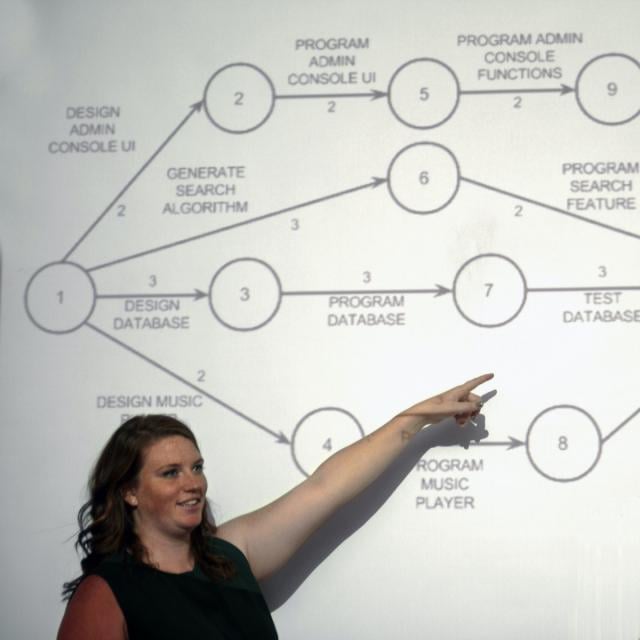
This course covers the techniques required to break down and map requirements into plans that will ultimately drive software production. Upon successful completion of this course, you will be able to: create effective plans for software development; map user requirements to developer tasks; assess and plan for project risks; apply velocity-driven planning techniques; generate work estimates for software products.

Aug 3rd 2026
4 Weeks
Networking and Security in iOS Applications (Coursera) Coursera
University of California, Irvine

Networking and Security in iOS Applications (Coursera)

You will learn to extend your knowledge of making iOS apps so that they can securely interact with web services and receive push notifications. You'll learn how to store data securely on a device using Core Data. You’ll also learn to securely deploy apps to the App Store and beta users over-the-air. The format of the course is through a series of code tutorials. We will walk you through the creation of several apps that you can keep as a personal app toolbox. When you make your own apps after this course, you can bring in these capabilities as needed. When necessary we pop out of the code tutorials to talk about concepts at a higher level so that what you are programming makes sense.

Jul 20th 2026
4 Weeks