Computational Geometry (Coursera)

Computational Geometry (Coursera)

This course represents an introduction to computational geometry – a branch of algorithm theory that aims at solving problems about geometric objects. Its application areas include computer graphics, computer-aided design and geographic information systems, robotics, and many others. You will learn to apply to this end various algorithmic approaches, and asses their strong and weak points in a particular context, thus gaining an ability to choose the most appropriate method for a concrete problem.

Class Deals by MOOC List - Click here and see Coursera's Active Discounts, Deals, and Promo Codes.

We will cover a number of core computational geometry tasks, such as testing point inclusion in a polygon, computing the convex hull of a point set, intersecting line segments, triangulating a polygon, and processing orthogonal range queries. Special attention will be paid to a proper representation of geometric primitives and evaluation of geometric predicates, which are crucial for an efficient implementation of an algorithm.
Each module includes a selection of programming tasks that will help you both to strengthen the newly acquired knowledge and improve your competitive coding skills.

Syllabus

WEEK 1
Point inclusion in a polygon
How can it be determined whether you have selected a particular region on an interactive map? This problem is an excellent starting point to get introduced to computational geometry and a variety of its applications!

WEEK 2
Convex hulls
Algorithmic processing of finely shaped objects may be computationally expensive. Can they be reasonably approximated, so as to decrease the handling costs? Convex hulls will come at hand!

WEEK 3
Intersections
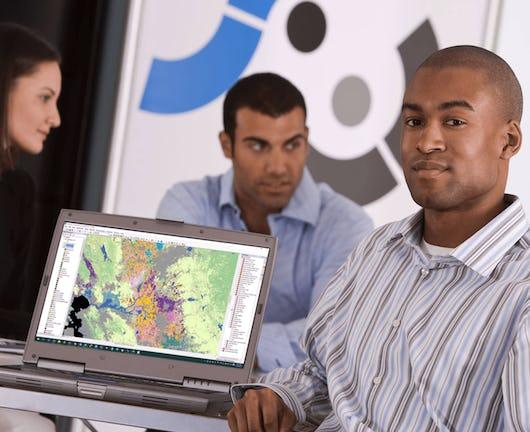
Geographic information systems typically store a vast amount of data in the form of various maps. How can be those efficiently combined to provide an adequate response to our requests? Get acquainted with the key algorithmic aspects underlying map overlay!

WEEK 4
Polygon triangulation
In computer graphics, 3D-scenes are commonly represented by complex polygonal models. Do you wonder how those can be processed efficiently? Triangulation stays behind!

WEEK 5
Orthogonal range search
How can computational geometry assist us in querying a database? You are about to learn the answer!

Go to Class
MOOC List is learner-supported. When you buy through links on our site, we may earn an affiliate commission.

Related Courses

Algorithmic Toolbox (Coursera) Coursera
University of California, San Diego,Higher School of Economics - HSE University

Algorithmic Toolbox (Coursera)

The course covers basic algorithmic techniques and ideas for computational problems arising frequently in practical applications: sorting and searching, divide and conquer, greedy algorithms, dynamic programming. We will learn a lot of theory: how to sort data and how it helps for searching; how to break a large problem into pieces and solve them recursively; when it makes sense to proceed greedily; how dynamic programming is used in genomic studies. You will practice solving computational problems, designing new algorithms, and implementing solutions efficiently (so that they run in less than a second).

Jun 1st 2026
5-12 Weeks
Introduction to Graph Theory (Coursera) Coursera
University of California, San Diego,Higher School of Economics - HSE University

Introduction to Graph Theory (Coursera)

We invite you to a fascinating journey into Graph Theory — an area which connects the elegance of painting and the rigor of mathematics; is simple, but not unsophisticated. Graph Theory gives us, both an easy way to pictorially represent many major mathematical results, and insights into the deep theories behind them. In this course, among other intriguing applications, we will see how GPS systems find shortest routes, how engineers design integrated circuits, how biologists assemble genomes, why a political map can always be colored using a few colors. We will study Ramsey Theory which proves that in a large system, complete disorder is impossible!

Jun 1st 2026
5-12 Weeks
Machine Learning for Accounting with Python (Coursera) Coursera
University of Illinois at Urbana-Champaign

Machine Learning for Accounting with Python (Coursera)

This course, Machine Learning for Accounting with Python, introduces machine learning algorithms (models) and their applications in accounting problems. It covers classification, regression, clustering, text analysis, time series analysis. It also discusses model evaluation and model optimization. This course provides an entry point for students to be able to apply proper machine learning models on business related datasets with Python to solve various problems.

Jun 1st 2026
5-12 Weeks
Development of Real-Time Systems (Coursera) Coursera
EIT Digital

Development of Real-Time Systems (Coursera)

This course is intended for the Master's student and computer engineer who likes practical programming and problem solving! After completing this course, you will have the knowledge to plan and set-up a real-time system both on paper and in practice. The course centers around the problem of achieving timing correctness in embedded systems, which means to guarantee that the system reacts within the real-time requirements.

Jun 1st 2026
5-12 Weeks
Modern Robotics, Course 1: Foundations of Robot Motion (Coursera) Coursera
Northwestern University

Modern Robotics, Course 1: Foundations of Robot Motion (Coursera)

Do you want to know how robots work? Are you interested in robotics as a career? Are you willing to invest the effort to learn fundamental mathematical modeling techniques that are used in all subfields of robotics? If so, then the "Modern Robotics: Mechanics, Planning, and Control" specialization may be for you. This specialization, consisting of six short courses, is serious preparation for serious students who hope to work in the field of robotics or to undertake advanced study. It is not a sampler.

Jun 1st 2026
4 Weeks
What is a Proof? (Coursera) Coursera
University of California, San Diego,Higher School of Economics - HSE University

What is a Proof? (Coursera)

Mathematical thinking is crucial in all areas of computer science: algorithms, bioinformatics, computer graphics, data science, machine learning, etc. In this course, we will learn the most important tools used in discrete mathematics: induction, recursion, logic, invariants, examples, optimality. We will use these tools to answer typical programming questions like: How can we be certain a solution exists? Am I sure my program computes the optimal answer? Do each of these objects meet the given requirements?

Jun 1st 2026
5-12 Weeks
Programming Foundations with JavaScript, HTML and CSS (Coursera) Coursera
Duke University

Programming Foundations with JavaScript, HTML and CSS (Coursera)

Learn foundational programming concepts (e.g., functions, for loops, conditional statements) and how to solve problems like a programmer. In addition, learn basic web development as you build web pages using HTML, CSS, JavaScript. By the end of the course, will create a web page where others can upload their images and apply image filters that you create.

Jun 1st 2026
4 Weeks
Combinatorics and Probability (Coursera) Coursera
University of California, San Diego,Higher School of Economics - HSE University

Combinatorics and Probability (Coursera)

Counting is one of the basic mathematically related tasks we encounter on a day to day basis. The main question here is the following. If we need to count something, can we do anything better than just counting all objects one by one? Do we need to create a list of all phone numbers to ensure that there are enough phone numbers for everyone? Is there a way to tell that our algorithm will run in a reasonable time before implementing and actually running it? All these questions are addressed by a mathematical field called Combinatorics.

Jun 1st 2026
5-12 Weeks
Cluster Analysis in Data Mining (Coursera) Coursera
University of Illinois at Urbana-Champaign

Cluster Analysis in Data Mining (Coursera)

Discover the basic concepts of cluster analysis, and then study a set of typical clustering methodologies, algorithms, and applications. This includes partitioning methods such as k-means, hierarchical methods such as BIRCH, and density-based methods such as DBSCAN/OPTICS. Moreover, learn methods for clustering validation and evaluation of clustering quality. Finally, see examples of cluster analysis in applications.

Jun 1st 2026
4 Weeks
Practical Machine Learning (Coursera) Coursera
Johns Hopkins University

Practical Machine Learning (Coursera)

One of the most common tasks performed by data scientists and data analysts are prediction and machine learning. This course will cover the basic components of building and applying prediction functions with an emphasis on practical applications. The course will provide basic grounding in concepts such as training and tests sets, overfitting, and error rates.

Jun 1st 2026
4 Weeks
Algorithms, Part I (Coursera) Coursera
Princeton University

Algorithms, Part I (Coursera)

This course covers the essential information that every serious programmer needs to know about algorithms and data structures, with emphasis on applications and scientific performance analysis of Java implementations. Part I covers elementary data structures, sorting, and searching algorithms. Part II focuses on graph- and string-processing algorithms.

Jun 1st 2026
5-12 Weeks
Problem Solving, Python Programming, and Video Games (Coursera) Coursera
University of Alberta

Problem Solving, Python Programming, and Video Games (Coursera)

This course is an introduction to computer science and programming in Python. Important computer science concepts such as problem solving (computational thinking), problem decomposition, algorithms, abstraction, and software quality are emphasized throughout. The Python programming language and video games are used to demonstrate computer science concepts in a concrete and fun manner. However, a learner can take the knowledge and skills from this course and apply them to non-game problems, other programming languages, and other computer science courses.

Jun 1st 2026
5-12 Weeks