Building Arduino robots and devices (Coursera)

Building Arduino robots and devices (Coursera)

For many years now, people have been improving their tools, studying the forces of nature and bringing them under control, using the energy of the nature to operate their machines. Last century is noted for the creation of machines which can operate other machines. Nowadays the creation of devices that interact with the physical world is available to anyone. Our course consists of a series of practical problems on making things that work independently: they make their own decisions, act, move, communicate with each other and people around, and control other devices. We will demonstrate how to assemble such devices and programme them using the Arduino platform as a basis.

Class Deals by MOOC List - Click here and see Coursera's Active Discounts, Deals, and Promo Codes.

After this course, you will be able to create devices that read the data about the external world with a variety of sensors, receive and forward this data to a PC, the Internet and mobile devices, and control indexing and the movement. The creation of such devices will involve design, the study of their components, the assemblage of circuit boards, coding and diagnostics. Along with the creation of the devices themselves, you will perform visualization on a PC, create a web page that will demonstrate one of your devices, and figure out how an FDM 3D-printer is configured and how it functions.
Besides those keen on robotics or looking to broaden their horizons and develop their skills, the course will also be useful to anyone facing the task of home and industrial automation, as well as to anyone engaged in industrial design, advertising and art.
The course does not require any special knowledge from the participants and is open even to students of upper secondary school. Programming skills and the level of English allowing to read technical documentation would be an advantage, but this is not obligatory.
The entire course is dedicated to practice, so the best way for you would be to get hold of some electronics, follow the illustrated examples and experiment on your own.

Syllabus

WEEK 1
Welcome to the course! During Week 1, we are going to introduce you to the course (go through the Introduction, that’s very important). Then we shall start our work: getting acquainted with Arduino, the development environment and our first components. You will learn how to assemble circuits on a breadboard and will write your first program and assemble your first device. Don’t forget about the DIY section, which is also very important.

WEEK 2
It’s time to learn how to receive data with the help of sensors. During Week 2, we will teach you how to read off digital and analog signals, exchange data with a computer, create more complex algorithms, and use new output devices.

WEEK 3
During Week 3, you will learn to explore the world around you with the help of a distance sensor, and visualize data on a computer. You are also going improve your programming skills by creating a device with moving components.

WEEK 4
After going through Week 4, you will be able to connect your device to a network, plan its creation beforehand , control heavy loads, and power your device correctly.

WEEK 5
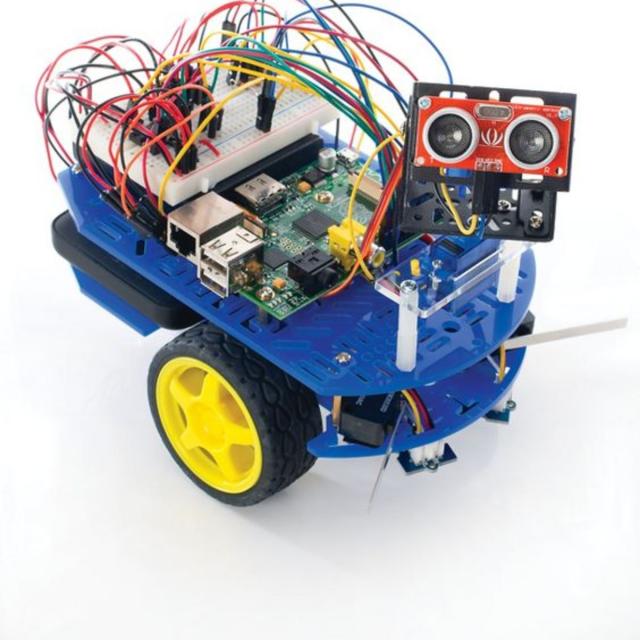
Let’s turn one wheel and then two wheels at once, and the robot car will start moving. It’ll be moving along the line or under your control. It could as well be just messing with your hand with which you are trying to control it.

WEEK 6
Having learnt to create a step motor, you can create devices which can perform very precise actions. For example, a 3D printer, which we will study in detail and then use to print some components.
Go to Class
MOOC List is learner-supported. When you buy through links on our site, we may earn an affiliate commission.

Related Courses

Fundamentals of Robotics & Industrial Automation (Coursera) Coursera
L&T EduTech

Fundamentals of Robotics & Industrial Automation (Coursera)

The "Fundamentals of Robotics & Industrial Automation" course is tailored to provide a comprehensive understanding of essential concepts and practical skills necessary for excelling in the field of collaborative robotics. Through three dynamic modules, participants will explore the intricacies of sensors & transducers in machine tools & robots, servo systems, and interfacing and simulation techniques.

Jun 8th 2026
3 Weeks
Introduction to Programming with MATLAB (Coursera) Coursera
Vanderbilt University

Introduction to Programming with MATLAB (Coursera)

This course teaches computer programming to those with little to no previous experience. It uses the programming system and language called MATLAB to do so because it is easy to learn, versatile and very useful for engineers and other professionals. MATLAB is a special-purpose language that is an excellent choice for writing moderate-size programs that solve problems involving the manipulation of numbers.

Jun 8th 2026
5-12 Weeks
Foundations of Objective-C App Development (Coursera) Coursera
University of California, Irvine

Foundations of Objective-C App Development (Coursera)

An introduction to the Objective-C programming language. This will prepare you for more extensive iOS app development and build a foundation for advanced iOS development topics. Objective-C programming requires a Mac laptop or desktop computer. An iOS device is optional if the learner is willing to working exclusively with the simulator. Some learners have been able to work with an OS X virtual machine on Windows, but explaining how to do that is beyond the scope of this course.

Jun 8th 2026
4 Weeks
Physics 102 - Electric Potential and DC Circuits (Coursera) Coursera
Rice University

Physics 102 - Electric Potential and DC Circuits (Coursera)

This course serves as an introduction to the physics of electricity and magnetism. Upon completion, learners will have an understanding of how the forces between electric charges are described by fields, and how these fields are related to electrical circuits. They will gain experience in solving physics problems with tools such as graphical analysis, algebra, vector analysis, and calculus.

Jun 8th 2026
3 Weeks
Aplicaciones musicales con Arduino (Coursera) Coursera
Universidad Nacional Autónoma de México

Aplicaciones musicales con Arduino (Coursera)

En este curso nos adentraremos en el terreno del hardware. Concretamente, aprenderemos a utilizar la placa de desarrollo de hardware de código abierto, llamada Arduino, enfocándonos en las aplicaciones que esta ofrece para la experimentación musical. De manera más específica, aprenderemos en este curso a construir nuestros propios generadores de sonido, y a partir de ello haremos instalaciones sonoras que nos permitirán expandir nuestra creatividad hacia el terreno de las cosas materiales, y ya no solo de los datos informáticos.

Jun 8th 2026
4 Weeks
Microwave engineering and antennas (Coursera) Coursera
Eindhoven University of Technology

Microwave engineering and antennas (Coursera)

This unique Master-level course provides you with in-depth know-how of microwave engineering and antennas. The course combines both passive and active microwave circuits as well as antenna systems. Future applications, like millimeter-wave 5G/beyond-5G wireless communications or automotive radar, require experts that can co-design highly integrated antenna systems that include both antennas and microwave electronics. We will provide you with the required theoretical foundation as well as hands-on experience using state-of-the-art design tools. The web lectures are supported by many on-line quizzes in which you can practice the background theory.

Jun 8th 2026
5-12 Weeks
Learn to Teach Java: Sequences, Primitive Types and Using Objects (Coursera) Coursera
University of California, San Diego

Learn to Teach Java: Sequences, Primitive Types and Using Objects (Coursera)

Get started with the basics of Java, and prepare to teach others using the free, online interactive CS Awesome textbook. In this course for teachers we'll guide you both in learning Java concepts and skills but also in how to effectively teach those to your students. This course will support you in teaching the Advanced Placement Computer Science A course or a similar introductory university-level programming course.

Jun 3rd 2026
4 Weeks
Robotics Engineering & Applications (Coursera) Coursera
L&T EduTech

Robotics Engineering & Applications (Coursera)

The "Robotics Engineering & Applications" course stands as a beacon of innovation and opportunity in the realm of collaborative robotics. Comprising three dynamic modules, participants embark on a transformative journey delving into the essentials of robotic engineering, advanced programming techniques, and the integration of vision systems in designing and building robots for real-world applications.

Jun 8th 2026
3 Weeks
Physics 102 - Magnetic Fields and Faraday's Law (Coursera) Coursera
Rice University

Physics 102 - Magnetic Fields and Faraday's Law (Coursera)

This course serves as an introduction to the physics of electricity and magnetism. Upon completion, learners will have an understanding of how the forces between electric charges are described by fields, and how these fields are related to electrical circuits. They will gain experience in solving physics problems with tools such as graphical analysis, algebra, vector analysis, and calculus. The course follows the typical progression of topics of a first-semester university physics course: charges, electric forces, electric fields potential, magnetic fields, currents, magnetic moments, electromagnetic induction, and circuits.

Jun 8th 2026
4 Weeks
Collaborative Robot Safety: Design & Deployment (Coursera) Coursera
University at Buffalo,The State University of New York

Collaborative Robot Safety: Design & Deployment (Coursera)

As robots evolve and increasingly interact with humans, enhancing the safety of personnel working with these “collaborative robots” (cobots) is vital. This course equips you to assess the safety of a collaborative robot workcell and prevent the chances of injury or harm. It imparts industry-endorsed safety standards, technical report recommendations and best practices from the International Organization for Standardization (ISO), Robotic Industries Association (RIA) and Occupational Safety and Health Administration (OSHA).

Jun 8th 2026
4 Weeks
Modern Robotics, Course 4: Robot Motion Planning and Control (Coursera) Coursera
Northwestern University

Modern Robotics, Course 4: Robot Motion Planning and Control (Coursera)

Do you want to know how robots work? Are you interested in robotics as a career? Are you willing to invest the effort to learn fundamental mathematical modeling techniques that are used in all subfields of robotics? If so, then the "Modern Robotics: Mechanics, Planning, and Control" specialization may be for you. This specialization, consisting of six short courses, is serious preparation for serious students who hope to work in the field of robotics or to undertake advanced study. It is not a sampler.

Jun 8th 2026
4 Weeks
Adding Electronics to Rapid Prototypes (Coursera) Coursera
Arizona State University

Adding Electronics to Rapid Prototypes (Coursera)

Hello, everyone! Welcome to this course on Adding Electronics to Rapid Prototypes. This is part of the Rapid Prototyping and Tooling specialization. In this course, I’ll cover the basics of electric circuits, breadboards, and multimeters. I’ll then discuss different options for connecting electrical components as well as discuss different types of motors and actuators. Finally, I’ll end this course by discussing microcontrollers and how to use them to make even more sophisticated prototypes.

Jun 8th 2026
5-12 Weeks