Advanced Data Visualization with R (Coursera)

Advanced Data Visualization with R (Coursera)

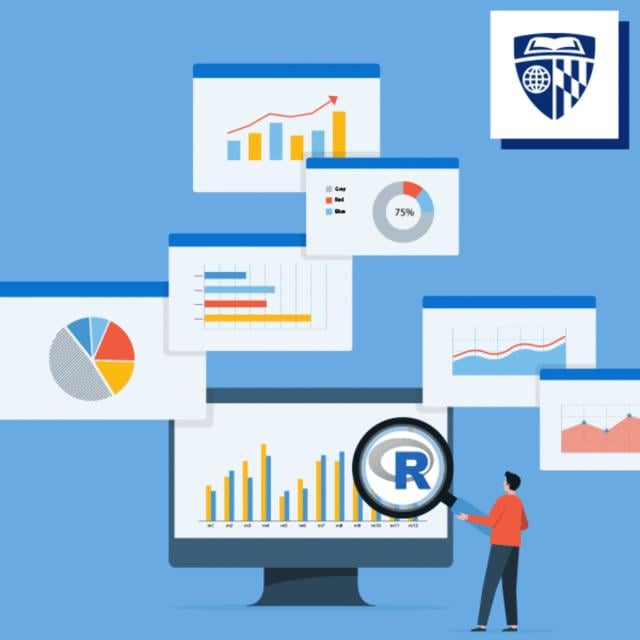
Data visualization is a critical skill for anyone that routinely using quantitative data in his or her work - which is to say that data visualization is a tool that almost every worker needs today. One of the critical tools for data visualization today is the R statistical programming language. Especially in conjunction with the tidyverse software packages, R has become an extremely powerful and flexible platform for making figures, tables, and reproducible reports. However, R can be intimidating for first time users, and there are so many resources online that it can be difficult to sort through without guidance.

Class Deals by MOOC List - Click here and see Coursera's Active Discounts, Deals, and Promo Codes.

This course is the third in the Specialization "Data Visualization and Dashboarding in R." Learners come into this course with a foundation using R to make many basic kinds of visualization, primarily with the ggplot2 package. Accordingly, this course focuses on expanding the learners' inventory of data visualization options. Drawing on additional packages to supplement ggplot2, learners will made more variants of traditional figures, as well as venture into spatial data. The course ends make interactive and animated figures.
To fill that need, this course is intended for learners who have little or no experience with R but who are looking for an introduction to this tool. By the end of this course, students will be able to import data into R, manipulate that data using tools from the popular tidyverse package, and make simple reports using R Markdown. The course is designed for students with good basic computing skills, but limited if any experience with programming.
Course 3 of 5 in the Data Visualization & Dashboarding with R Specialization

Syllabus

WEEK 1
Advanced Figures with ggplot2
In this module, we will work through making a number of different figures using ggplot2 and a few additional R packages. You should begin by watching the introductory videos in each lesson. Then, carefully review the readings and reference materials provided. Once you have done that, I recommend watching the videos again to check your understanding. You will take a few quizzes as you progress through the material to make sure you are keeping up.

WEEK 2
Spatial Data
In this module, we go through an introduction for making spatial figures (maps) in R. You should begin by watching the introductory videos in each lesson. Then, carefully review the readings and reference materials provided. Once you have done that, I recommend watching the videos again to check your understanding. You will take a few quizzes as you progress through the material to make sure you are keeping up.

WEEK 3
Plotly and gganimate
In this module, we will work on animating figures and making them interactive. You should begin by watching the introductory videos in each lesson. Then, carefully review the readings and reference materials provided. Once you have done that, I recommend watching the videos again to check your understanding. You will take a few quizzes as you progress through the material to make sure you are keeping up.

Go to Class
MOOC List is learner-supported. When you buy through links on our site, we may earn an affiliate commission.

Related Courses

Analyzing and Visualizing Data in Looker (Coursera) Coursera
Google Cloud

Analyzing and Visualizing Data in Looker (Coursera)

In this course, you learn how to do the kind of data exploration and analysis in Looker that would formerly be done primarily by SQL developers or analysts. Upon completion of this course, you will be able to leverage Looker's modern analytics platform to find and explore relevant content in your organization’s Looker instance, ask questions of your data, create new metrics as needed, and build and share visualizations and dashboards to facilitate data-driven decision making.

Sep 28th 2026
2 Weeks
Bayesian Statistics: Techniques and Models (Coursera) Coursera
University of California, Santa Cruz

Bayesian Statistics: Techniques and Models (Coursera)

This is the second of a two-course sequence introducing the fundamentals of Bayesian statistics. It builds on the course Bayesian Statistics: From Concept to Data Analysis, which introduces Bayesian methods through use of simple conjugate models. Real-world data often require more sophisticated models to reach realistic conclusions. This course aims to expand our “Bayesian toolbox” with more general models, and computational techniques to fit them.

Oct 5th 2026
5-12 Weeks
Making Data Science Work for Clinical Reporting (Coursera) Coursera
Genentech

Making Data Science Work for Clinical Reporting (Coursera)

This course is aimed to demonstrate how principles and methods from data science can be applied in clinical reporting. By the end of the course, learners will understand what requirements there are in reporting clinical trials, and how they impact on how data science is used. The learner will see how they can work efficiently and effectively while still ensuring that they meet the needed standards.

Oct 5th 2026
4 Weeks
Ferramentas para Ciência de Dados: Introdução ao R (Coursera) Coursera
FIA Business School

Ferramentas para Ciência de Dados: Introdução ao R (Coursera)

Nossas boas-vindas ao Curso Ferramentas para Ciência de Dados: Introdução ao R. Neste curso, você aprenderá que o mundo evoluiu muito quando o assunto é tomada de decisão baseada em dados e já não é possível comparar a quantidade de informações a que temos acesso atualmente com o que tínhamos disponíveis décadas atrás.

Oct 5th 2026
4 Weeks
The Fundamental of Data-Driven Investment (Coursera) Coursera
Sungkyunkwan University - SKKU

The Fundamental of Data-Driven Investment (Coursera)

In this course, the instructor will discuss the fundamental analysis of investment using R programming. The course will cover investment analysis topics, but at the same time, make you practice it using R programming. This course's focus is to train you to do the elemental analysis for investment management that you might need to do in your job every day. Additionally, the study note to do using Python programming will be provided.

Oct 5th 2026
4 Weeks
Multilevel Modeling (Coursera) Coursera
Erasmus University Rotterdam

Multilevel Modeling (Coursera)

In this course, PhD candidates will get an introduction into the theory of multilevel modelling, focusing on two level multilevel models with a 'continuous' response variable. In addition, participants will learn how to run basic two-level model in R. The objective of this course is to get participants acquainted with multilevel models. These models are often used for the analysis of ‘hierarchical’ data, in which observations are nested within higher level units (e.g. repeated measures nested within individuals, or pupils nested within schools).

Sep 28th 2026
4 Weeks
Math for MBA and GMAT Prep (Coursera) Coursera
Emory University

Math for MBA and GMAT Prep (Coursera)

This course gives participants a basic understanding of statistics as they apply in business situations. A fair share of students considering MBA programs come from backgrounds that do not include a large amount of training in mathematics and statistics. Often, students find themselves at a disadvantage when they apply for or enroll in MBA programs. This course will give you the tools to understand how these business statistics are calculated for navigating the built-in formulas that are included in Excel, but also how to apply these formulas in an range of business settings and situations.

Oct 5th 2026
5-12 Weeks
Basic Statistics (Coursera) Coursera
University of Amsterdam

Basic Statistics (Coursera)

Understanding statistics is essential to understand research in the social and behavioral sciences. In this course you will learn the basics of statistics; not just how to calculate them, but also how to evaluate them. This course will also prepare you for the next course in the specialization - the course Inferential Statistics. In the first part of the course we will discuss methods of descriptive statistics. You will learn what cases and variables are and how you can compute measures of central tendency (mean, median and mode) and dispersion (standard deviation and variance). Next, we discuss how to assess relationships between variables, and we introduce the concepts correlation and regression.

Sep 28th 2026
5-12 Weeks
Population Health: Responsible Data Analysis (Coursera) Coursera
Leiden University

Population Health: Responsible Data Analysis (Coursera)

In most areas of health, data is being used to make important decisions. As a health population manager, you will have the opportunity to use data to answer interesting questions. In this course, we will discuss data analysis from a responsible perspective, which will help you to extract useful information from data and enlarge your knowledge about specific aspects of interest of the population.

Oct 5th 2026
4 Weeks
Introduction to Neurohacking In R (Coursera) Coursera
Johns Hopkins University

Introduction to Neurohacking In R (Coursera)

Neurohacking describes how to use the R programming language and its associated package to perform manipulation, processing, and analysis of neuroimaging data. We focus on publicly-available structural magnetic resonance imaging (MRI). We discuss concepts such as inhomogeneity correction, image registration, and image visualization.

Oct 5th 2026
4 Weeks
From Excel to Power BI (Coursera) Coursera
Knowledge Accelerators

From Excel to Power BI (Coursera)

Are you using Excel to manage, analyze, and visualize your data? Would you like to do more? Perhaps you've considered Power BI as an alternative, but have been intimidated by the idea of working in an advanced environment. The fact is, many of the same tools and mechanisms exist across both these Microsoft products. This means Excel users are actually uniquely positioned to transition to data modeling and visualization in Power BI! Using methods that will feel familiar, you can learn to use Power BI to make data-driven business decisions using large volumes of data.

Oct 5th 2026
1 Week
Meaningful Marketing Insights (Coursera) Coursera
Emory University

Meaningful Marketing Insights (Coursera)

With marketers are poised to be the largest users of data within the organization, there is a need to make sense of the variety of consumer data that the organization collects. Surveys, transaction histories and billing records can all provide insight into consumers’ future behavior, provided that they are interpreted correctly. In Introduction to Marketing Analytics, we introduce the tools that learners will need to convert raw data into marketing insights. The included exercises are conducted using Microsoft Excel, ensuring that learners will have the tools they need to extract information from the data available to them.

Sep 21st 2026
5-12 Weeks