Working with Integrated Development Environments (Coursera)

Offered by University of Leeds,
Working with Integrated Development Environments (Coursera)

Integrated Development Environments (IDEs) are vital in increasing developer productivity and learning to work with them will help you create impressive software projects whether you're a beginner or have some programming experience. This course provides the essential skills and knowledge to excel in software development using Integrated Development Environments (IDEs). You'll cover IDE fundamentals, including environment setup, interface navigation, and valuable features like debugging.

Class Deals by MOOC List - Click here and see Coursera's Active Discounts, Deals, and Promo Codes.

You'll start by discovering IDEs' intriguing history and even experiment with some tools from the past. As you progress, you'll explore modern IDEs, learn how to select the right one for your needs and gain confidence using the most popular and powerful IDEs.
This course is one of many, offered by Click Start, a UK training programme designed to help young people develop digital skills. Click Start offers a limited number of scholarships giving free access to young people in the UK. Check the FAQs to see more detail and follow the link to check if you are eligible for free access today.
By completing this course, you'll be well-prepared to navigate software development with confidence, armed with the knowledge and skills required for Integrated Development Environments.

What you'll learn

  • Describe the purpose and benefits of using IDEs in software development and recognise how they improve productivity and streamline coding processes.
  • Summarise the capabilities of IDEs, including managing projects, and utilising features (the terminal, debugger) and extensions in tools like VSCode.
  • Compare and contrast different IDEs, distinguishing between language-ambiguous IDEs and language-specific IDEs.

Syllabus

Week 1: What is an integrated development environment?
Module 1
Welcome to Working with Integrated Development Environments! In this course, we'll take you on a journey through the history of IDEs, from the earliest text editors to the powerful modern tools used by developers today. You'll learn how IDEs can help you write, test, and debug your code more efficiently and explore the various features that make each IDE unique.

Week 2: Using IDEs
Module 2
Welcome to Week 2 of our course on Working with Integrated Development Environments (IDEs)! This week, we'll be getting hands-on with some of the practical features of IDEs, including the powerful debugger and breakpoints in Visual Studio Code. You'll learn how to use these tools to find and fix bugs in your code, and gain experience with other practical features like syntax highlighting and code completion. Get ready to take your coding skills to the next level and become a pro with IDEs!


Go to Class
MOOC List is learner-supported. When you buy through links on our site, we may earn an affiliate commission.

Related Courses

Computer Science: Programming with a Purpose (Coursera) Coursera
Princeton University

Computer Science: Programming with a Purpose (Coursera)

The basis for education in the last millennium was “reading, writing, and arithmetic;” now it is reading, writing, and computing. Learning to program is an essential part of the education of every student, not just in the sciences and engineering, but in the arts, social sciences, and humanities, as well. Beyond direct applications, it is the first step in understanding the nature of computer science’s undeniable impact on the modern world.

Oct 5th 2026
5-12 Weeks
Foundations of Data Science: K-Means Clustering in Python (Coursera) Coursera
University of London,Goldsmiths, University of London

Foundations of Data Science: K-Means Clustering in Python (Coursera)

This MOOC, designed by an academic team from Goldsmiths, University of London, will quickly introduce you to the core concepts of Data Science to prepare you for intermediate and advanced Data Science courses. It focuses on the basic mathematics, statistics and programming skills that are necessary for typical data analysis tasks.

Oct 5th 2026
5-12 Weeks
C# for .NET Developers (Coursera) Coursera
Board Infinity

C# for .NET Developers (Coursera)

In this course you will be introduced to everything from the basics of programming concepts like variables, data types, and control structures, to more advanced topics like object-oriented programming, etc. By the end of the course, you'll have a solid understanding of C# programming, the .NET framework, and how to use them to build a variety of applications. You'll have the skills and knowledge you need to start your career as a C# developer or take your current skills to the next level.

Oct 5th 2026
3 Weeks
Parallel programming (Scala 2 version) (Coursera) Coursera
École Polytechnique Fédérale de Lausanne

Parallel programming (Scala 2 version) (Coursera)

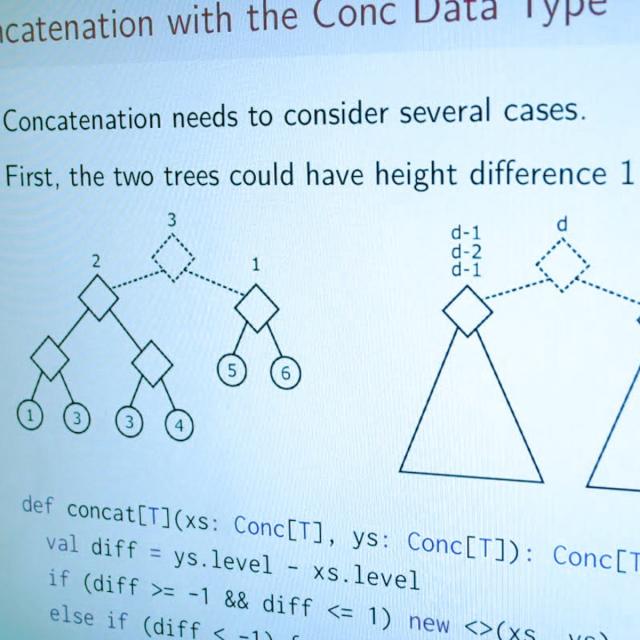
With every smartphone and computer now boasting multiple processors, the use of functional ideas to facilitate parallel programming is becoming increasingly widespread. In this course, you'll learn the fundamentals of parallel programming, from task parallelism to data parallelism. In particular, you'll see how many familiar ideas from functional programming map perfectly to to the data parallel paradigm. We'll start the nuts and bolts how to effectively parallelize familiar collections operations, and we'll build up to parallel collections, a production-ready data parallel collections library available in the Scala standard library.

Oct 5th 2026
4 Weeks
Introducción a Java (Coursera) Coursera
Universidad Nacional Autónoma de México

Introducción a Java (Coursera)

Me llamo Elisa Viso y una de mis pasiones es la de programar y enseñar a programar. El lenguaje Java es uno de los que más me ha gustado en mis 45 años que llevo programando. Si bien te podrá parecer un poco complicado empezar a programar en Java, una vez que cubras los conceptos básicos verás qué rápido se avanza. Java, como todos los lenguajes de programación bien hechos, te dejan hacer cualquier cosa (algunas de ellas con más trabajo que en otros lenguajes y otras casi directamente de cómo piensas la solución al problema).

Oct 5th 2026
5-12 Weeks
Programming for Everybody (Getting Started with Python) (Coursera) Coursera
University of Michigan

Programming for Everybody (Getting Started with Python) (Coursera)

This course aims to teach everyone the basics of programming computers using Python. We cover the basics of how one constructs a program from a series of simple instructions in Python. The course has no pre-requisites and avoids all but the simplest mathematics. Anyone with moderate computer experience should be able to master the materials in this course.

Sep 28th 2026
5-12 Weeks
Functional Program Design in Scala (Scala 2 version) (Coursera) Coursera
École Polytechnique Fédérale de Lausanne

Functional Program Design in Scala (Scala 2 version) (Coursera)

In this course you will learn how to apply the functional programming style in the design of larger Scala applications. You'll get to know important new functional programming concepts, from lazy evaluation to structuring your libraries using monads. We'll work on larger and more involved examples, from state space exploration to random testing to discrete circuit simulators. You’ll also learn some best practices on how to write good Scala code in the real world. Finally, you will learn how to leverage the ability of the compiler to infer values from types.

Oct 5th 2026
5-12 Weeks
IBM z/OS Rexx Programming (Coursera) Coursera
IBM

IBM z/OS Rexx Programming (Coursera)

This course is designed to teach you the basic skills required to write programs using the REXX language in z/OS. The course covers the TSO extensions to REXX and interaction with other environments such as the MVS console, running REXX in batch jobs, and compiling REXX. A total of 11 hands-on labs on an IBM Z server (via remote Skytap access) are part of this course.

Oct 5th 2026
5-12 Weeks
Quantitative Model Checking (Coursera) Coursera
EIT Digital

Quantitative Model Checking (Coursera)

The integration of ICT (information and communications technology) in different applications is rapidly increasing in e.g. Embedded and Cyber physical systems, Communication protocols and Transportation systems. Hence, their reliability and dependability increasingly depends on software. Defects can be fatal and extremely costly (with regards to mass-production of products and safety-critical systems).

Oct 5th 2026
5-12 Weeks