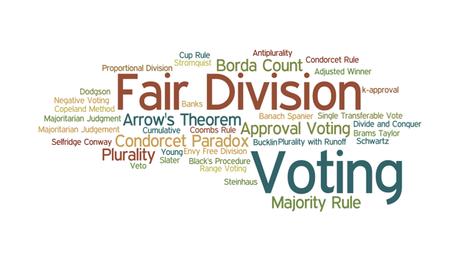
Making Better Group Decisions: Voting, Judgement Aggregation and Fair Division (Coursera)

Making Better Group Decisions: Voting, Judgement Aggregation and Fair Division (Coursera)

Learn about different voting methods and fair division algorithms, and explore the problems that arise when a group of people need to make a decision.

Class Deals by MOOC List - Click here and see Coursera's Active Discounts, Deals, and Promo Codes.

Much of our daily lives is spent taking part in various types of what we might call “political” procedures. Examples range from voting in a national election to deliberating with others in small committees. Many interesting philosophical and mathematical issues arise when we carefully examine our group decision-making processes.
There are two types of group decision making problems that we will discuss in this course. A voting problem: Suppose that a group of friends are deciding where to go for dinner. If everyone agrees on which restaurant is best, then it is obvious where to go. But, how should the friends decide where to go if they have different opinions about which restaurant is best? Can we always find a choice that is “fair” taking into account everyone’s opinions or must we choose one person from the group to act as a “dictator”? A fair division problem: Suppose that there is a cake and a group of hungry children. Naturally, you want to cut the cake and distribute the pieces to the children as fairly as possible. If the cake is homogeneous (e.g., a chocolate cake with vanilla icing evenly distributed), then it is easy to find a fair division: give each child a piece that is the same size. But, how do we find a “fair” division of the cake if it is heterogeneous (e.g., icing that is 1/3 chocolate, 1/3 vanilla and 1/3 strawberry) and the children each want different parts of the cake?

Note: This course is currently not available.

Related Courses

Aprendizaje de las matemáticas de primaria (Coursera) Coursera
Universidad de los Andes

Aprendizaje de las matemáticas de primaria (Coursera)

En este segundo curso de acceso gratuito* del programa especializado Educación Matemática para profesores de primaria, conocerás las cuestiones particulares sobre el aprendizaje de las matemáticas y las dificultades y los errores más frecuentes que tienen que enfrentar los estudiantes al aprenderlas. El curso tiene una duración aproximada de seis semanas, con una dedicación promedio de 4 horas semanales. Todas las evaluaciones tienen retroalimentación y podrás descargar la mayoría de los recursos del curso.

Jun 22nd 2026
5-12 Weeks
Vector Calculus for Engineers (Coursera) Coursera
The Hong Kong University of Science and Technology - HKUST

Vector Calculus for Engineers (Coursera)

Vector Calculus for Engineers covers both basic theory and applications. In the first week we learn about scalar and vector fields, in the second week about differentiating fields, in the third week about multidimensional integration and curvilinear coordinate systems. The fourth week covers line and surface integrals, and the fifth week covers the fundamental theorems of vector calculus, including the gradient theorem, the divergence theorem and Stokes’ theorem. These theorems are needed in core engineering subjects such as Electromagnetism and Fluid Mechanics.

Jun 29th 2026
5-12 Weeks
Analytic Combinatorics (Coursera) Coursera
Princeton University

Analytic Combinatorics (Coursera)

Analytic Combinatorics teaches a calculus that enables precise quantitative predictions of large combinatorial structures. This course introduces the symbolic method to derive functional relations among ordinary, exponential, and multivariate generating functions, and methods in complex analysis for deriving accurate asymptotics from the GF equations. All the features of this course are available for free. It does not offer a certificate upon completion.

Jun 15th 2026
5-12 Weeks
Image and video processing: From Mars to Hollywood with a stop at the hospital (Coursera) Coursera
Duke University

Image and video processing: From Mars to Hollywood with a stop at the hospital (Coursera)

In this course, you will learn the science behind how digital images and video are made, altered, stored, and used. We will look at the vast world of digital imaging, from how computers and digital cameras form images to how digital special effects are used in Hollywood movies to how the Mars Rover was able to send photographs across millions of miles of space.

Jun 15th 2026
5-12 Weeks
Cálculo Diferencial e Integral unidos por el Teorema Fundamental del Cálculo (Coursera) Coursera
Tecnológico de Monterrey

Cálculo Diferencial e Integral unidos por el Teorema Fundamental del Cálculo (Coursera)

Los cursos de Cálculo Diferencial y Cálculo Integral tradicionalmente se ofrecen separados y respetando ese orden. El primero estudia la derivada, y el segundo, la integral, siendo este momento en el que aparece el Teorema Fundamental del Cálculo (TFC) para establecer la relación entre ambos conceptos. En el presente curso vamos a hacer una diferencia: introduciremos la derivada y la integral como conceptos relacionados desde un principio.

Jun 29th 2026
5-12 Weeks
Introduction to Logic (Coursera) Coursera
Stanford University

Introduction to Logic (Coursera)

This course is an introduction to Logic from a computational perspective. It shows how to encode information in the form of logical sentences; it shows how to reason with information in this form; and it provides an overview of logic technology and its applications - in mathematics, science, engineering, business, law, and so forth.

Jun 22nd 2026
5-12 Weeks
Introduction to Mathematical Thinking (Coursera) Coursera
Stanford University

Introduction to Mathematical Thinking (Coursera)

Learn how to think the way mathematicians do - a powerful cognitive process developed over thousands of years. Mathematical thinking is not the same as doing mathematics – at least not as mathematics is typically presented in our school system. School math typically focuses on learning procedures to solve highly stereotyped problems. Professional mathematicians think a certain way to solve real problems, problems that can arise from the everyday world, or from science, or from within mathematics itself.

Jun 15th 2026
5-12 Weeks
Basic Mathematics (Coursera) Coursera
Birla Institute of Technology & Science

Basic Mathematics (Coursera)

Welcome to Basic Mathematics course! This course provides elementary introduction to basic mathematics concepts and their applications. In this course, you will be introduced to Complex Numbers, Quadratic Equations, Trigonometry, Matrices, Differential Calculus, Integral Calculus and Ordinary Differential Equations along with the applications of each concept. After completing this course, you will be able to use basic mathematics concepts effectively and also will be able to apply the concepts in real-world problems.

Jun 29th 2026
5-12 Weeks
Mathematics for Engineers: The Capstone Course (Coursera) Coursera
The Hong Kong University of Science and Technology - HKUST

Mathematics for Engineers: The Capstone Course (Coursera)

Mathematics for Engineers: The Capstone Course provides a capstone project for students who are completing the Mathematics for Engineers specialization. Students will first learn some basic concepts in computational fluid dynamics, and then apply these concepts to compute the fluid flow around a cylinder. Access to MATLAB online and the MATLAB grader is given to all students who enroll.

Jun 29th 2026
3 Weeks
The Mathematics of Democracy, Politics and Manipulation (Coursera) Coursera
Johns Hopkins University

The Mathematics of Democracy, Politics and Manipulation (Coursera)

Welcome to The Mathematics of Politics, Democracy, and Manipulation, an inspiring course that explores the intricate landscape of democracy and decision-making. In today's world, understanding the mechanisms that shape our electoral systems and influence democratic outcomes is more crucial than ever. This comprehensive course delves deep into five key pillars of electoral theory and practice, empowering participants with the knowledge and tools to navigate the complexities of voting and representation.

Jun 22nd 2026
5-12 Weeks
Algebra: Elementary to Advanced - Equations & Inequalities (Coursera) Coursera
Johns Hopkins University

Algebra: Elementary to Advanced - Equations & Inequalities (Coursera)

This course is intended for students looking to create a solid algebraic foundation of fundamental mathematical concepts from which to take more advanced courses that use concepts from precalculus, calculus, probability, and statistics. This course will help solidify your computational methods, review algebraic formulas and properties, and apply these concepts model real world situations.

Jun 22nd 2026
4 Weeks