Introduction to Programming with Scratch (FutureLearn)

Introduction to Programming with Scratch (FutureLearn)

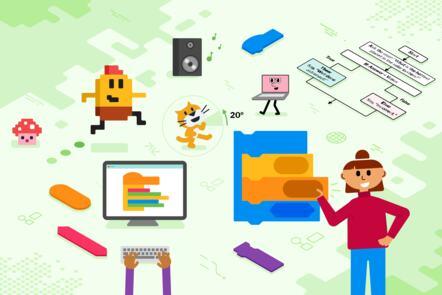
Discover the fundamentals of programming using the block-based programming language Scratch. Learn how to program your own animations and games. Scratch is a powerful, visual programming language that provides a great introduction to the world of programming. By snapping blocks together, you can create amazing animations and games. Over this four-week course, you’ll learn how to navigate the Scratch programming environment, create your own programs, and share your creations.

Class Deals by MOOC List - Click here and see FutureLearn's Active Discounts, Deals, and Promo Codes.

Explore the key programming concepts
You’ll start this course with an introduction to the Scratch programming language and the fundamentals of working with sprites, costumes, and backdrops.
As you progress, you’ll build your knowledge of core programming concepts and how best to use them, from sequencing and repetition to selection and variables. Throughout the course, you’ll create your own animations and games to test your new skills.
Become part of the Scratch community to share and remix Scratch projects
A key benefit of working in Scratch is the community, which can be used for support, collaboration, and inspiration.
You’ll become part of the Scratch community, exploring the website and its many features. At different points across this course, you’ll be encouraged to share your work with the wider community and you’ll learn how to view and remix other people’s work.
Create Scratch programs with user interactions built in
As you work towards your final Scratch project of this course, you’ll learn how to produce Scratch programs that allow the user to interact with them with keypresses, text answers, and motion. Using Scratch extensions, you’ll also learn how to create programs that draw shapes, play music, and even sense the user’s movements using a webcam.
Then, you’ll bring all of your new programming knowledge and skills together to build your own game or animation using the tools and concepts you’ve learnt throughout this course.

Syllabus

Week 1: Sequencing in Scratch
Week 2: Iteration, abstraction, and the Scratch community
Week 3: Using conditions, selection, and variables in your projects
Week 4: The power of lists and extensions

Learning on this course
You can take this self-guided course and learn at your own pace. On every step of the course you can meet other learners, share your ideas and join in with active discussions in the comments.
What will you achieve?
By the end of the course, you‘ll be able to...

  • Explain how to use the Scratch programming environment
  • Describe a range of Scratch commands and what they do
  • Produce Scratch programs that allow the user to interact with them with key presses, text answers, and motion
  • Demonstrate the key programming concepts of sequence, repetition, selection, and variables in Scratch programs

Who is the course for?
This course is designed for anyone with an interest in programming and who wants to learn to program using Scratch, a block-based programming language.

Go to Class
MOOC List is learner-supported. When you buy through links on our site, we may earn an affiliate commission.

Related Courses

Prepare for a Software Development Career (FutureLearn) FutureLearn
FutureLearn

Prepare for a Software Development Career (FutureLearn)

Review everything you need to know about Java and Python to start a career as a software developer. Cement your foundational knowledge of Python and Java and kickstart your career in software development. You’ll apply object-oriented programming principles to Java, and go deeper on methods, constructors, strings, inheritance, classes, and collection.

Self Paced
4 Weeks
Programming 103: Saving and Structuring Data (FutureLearn) FutureLearn
Raspberry Pi Foundation,National Centre for Computing Education

Programming 103: Saving and Structuring Data (FutureLearn)

Learn how to save and structure data in external files, and import files back into your Python programs. Supported by Google. Discover how to save data to use it across multiple runs of your program. On this course, you will learn how to save text and binary files, and how to structure data so that programs can interpret it correctly.

Jan 2nd 2023
3 Weeks
Software Development Basics (FutureLearn) FutureLearn
FutureLearn

Software Development Basics (FutureLearn)

Learn the basics of HTML code, gain expert insights into web development, and decide if the industry is right for you. Kick-start your career in web-based software development. The web design and development industry is growing exponentially and offers several exciting employment opportunities. Many people perceive this field as too complex, assume they won’t understand the material and therefore don’t consider it as a viable job prospect.

Self Paced
4 Weeks
Functional Programming in Erlang (FutureLearn) FutureLearn
University of Kent

Functional Programming in Erlang (FutureLearn)

Learn the theory and practice of functional programming in Erlang, through practical exercises and suggested projects. Functional programming is increasingly important in providing global-scale applications on the internet. For example, it’s the basis of the WhatsApp messaging system, which has over a billion users worldwide.

No sessions available
3 Weeks
Creative Coding (FutureLearn) FutureLearn
Monash University

Creative Coding (FutureLearn)

Use computer programming as a creative discipline to generate sounds, images, animations and more, with this free online course. Learning to program is no longer just for computer specialists and software developers. People from many different backgrounds now want to understand the basics of programming, because it’s both fun and an increasingly valuable skill.

No sessions available
5-12 Weeks
Begin Programming: Build Your First Mobile Game (FutureLearn) FutureLearn
University of Reading

Begin Programming: Build Your First Mobile Game (FutureLearn)

Learn basic Java programming by developing a mobile game that you can run on your computer, Android phone or tablet. Take your first steps into the world of computer programming and learn how to build your own mobile game in just five weeks. You’ll be introduced to the basic constructs and the principles behind computer programs, as well as the building blocks that are used to create them.

No sessions available
5-12 Weeks
Get ready for a Masters in Data Science and AI (FutureLearn) FutureLearn
Coventry University

Get ready for a Masters in Data Science and AI (FutureLearn)

Identify whether you’re ready for Master’s study, improve your data science skills, and get to grips with the basics of Python. Get a taste of life as a Data Science and AI Master's student. On this course, you’ll have the opportunity to explore the disciplines involved in a Master’s degree in Data Science and Artificial Intelligence (AI).

Apr 17th 2023
2 Weeks
Introduction to Quantitative Investing (FutureLearn) FutureLearn
Sungkyunkwan University - SKKU

Introduction to Quantitative Investing (FutureLearn)

Learn basics of financial economics and try its real life application using financial data and programming. Financial markets have become increasingly complex - it’s not easy to know where to start when it comes to investing. In today’s world the demand of accurate data-driven quantitative analysis across the world is steadily rising: it’s become crucial to understand and be able to use statistical and mathematical information accurately and promptly.

No sessions available
5-12 Weeks
Programming Applications with Python: Graphics User Interface (GUI) (FutureLearn) FutureLearn
FutureLearn

Programming Applications with Python: Graphics User Interface (GUI) (FutureLearn)

Discover how to create a GUI using Python and start to explore creating APIs. Make a GUI application in Python. On this course, you’ll explore a common use for Python – how to create a successful GUI. GUIs are a crucial aspect of any web service, and knowing how to create one is a vital skill for furthering your career in programming.

May 23rd 2022
4 Weeks
Programming Pedagogy in Secondary Schools: Inspiring Computing Teaching (FutureLearn) FutureLearn
Raspberry Pi Foundation,National Centre for Computing Education

Programming Pedagogy in Secondary Schools: Inspiring Computing Teaching (FutureLearn)

Examine a range of pedagogical approaches suitable for teaching computing in Key Stage 3 (Grade 6–8 in the USA). Transform your teaching by developing your pedagogical approach. In the first two weeks of this course, you’ll be introduced to a range of pedagogical approaches suitable for Key Stage 3. You’ll look at a range of pedagogies aimed at developing your students’ computational thinking skills, from unplugged approaches to PRIMM, and more. You’ll also investigate worked examples and targeted tasks such as Parson’s Problems.

Mar 6th 2023
3 Weeks
Teaching Programming in Primary Schools (FutureLearn) FutureLearn
Raspberry Pi Foundation,National Centre for Computing Education

Teaching Programming in Primary Schools (FutureLearn)

Understand key programming concepts and apply them using Scratch, with this introductory course for primary or K-5 teachers. This free online course will provide a comprehensive introduction to programming, designed for non-subject-specialist primary or K-5 teachers.

No sessions available
4 Weeks