Introduction to Machine Learning Course (Udacity)

Offered by Udacity,
Introduction to Machine Learning Course (Udacity)

This class will teach you the end-to-end process of investigating data through a machine learning lens. Learn online, with Udacity. Machine Learning is a first-class ticket to the most exciting careers in data analysis today. As data sources proliferate along with the computing power to process them, going straight to the data is one of the most straightforward ways to quickly gain insights and make predictions.

Class Deals by MOOC List - Click here and see Udacity's Active Discounts, Deals, and Promo Codes.

Machine learning brings together computer science and statistics to harness that predictive power. It’s a must-have skill for all aspiring data analysts and data scientists, or anyone else who wants to wrestle all that raw data into refined trends and predictions.
This is a class that will teach you the end-to-end process of investigating data through a machine learning lens. It will teach you how to extract and identify useful features that best represent your data, a few of the most important machine learning algorithms, and how to evaluate the performance of your machine learning algorithms.
This course is also a part of our Data Analyst Nanodegree.

Syllabus

LESSON 1
Welcome to Machine Learning

  • Learn what Machine Learning is and meet Sebastian Thrun!
  • Find out where Machine Learning is applied in Technology and Science.

LESSON 2
Naive Bayes

  • Use Naive Bayes with scikit learn in python.
  • Splitting data between training sets and testing sets with scikit learn.
  • Calculate the posterior probability and the prior probability of simple distributions.

LESSON 3
Support Vector Machines

  • Learn the simple intuition behind Support Vector Machines.
  • Implement an SVM classifier in SKLearn/scikit-learn.
  • Identify how to choose the right kernel for your SVM and learn about RBF and Linear Kernels.

LESSON 4
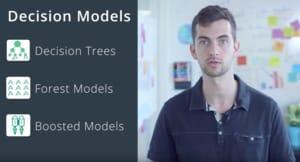
Decision Trees

  • Code your own decision tree in python.
  • Learn the formulas for entropy and information gain and how to calculate them.
  • Implement a mini project where you identify the authors in a body of emails using a decision tree in Python.

LESSON 5
Choose your own Algorithm

  • Decide how to pick the right Machine Learning Algorithm among K-Means, Adaboost, and Decision Trees.

LESSON 6
Datasets and Questions

  • Apply your Machine Learning knowledge by looking for patterns in the Enron Email Dataset.
  • You'll be investigating one of the biggest frauds in American history!

LESSON 7
Regressions

  • Understand how continuous supervised learning is different from discrete learning.
  • Code a Linear Regression in Python with scikit-learn.
  • Understand different error metrics such as SSE, and R Squared in the context of Linear Regressions.

LESSON 8
Outliers

  • Remove outliers to improve the quality of your linear regression predictions.
  • Apply your learning in a mini project where you remove the residuals on a real dataset and reimplement your regressor.
  • Apply your same understanding of outliers and residuals on the Enron Email Corpus.

LESSON 9
Clustering

  • Identify the difference between Unsupervised Learning and Supervised Learning.
  • Implement K-Means in Python and Scikit Learn to find the center of clusters.
  • Apply your knowledge on the Enron Finance Data to find clusters in a real dataset.

LESSON 10
Feature Scaling

  • Understand how to preprocess data with feature scaling to improve your algorithms.
  • Use a min mx scaler in sklearn.
Go to Class
MOOC List is learner-supported. When you buy through links on our site, we may earn an affiliate commission.

Related Courses

Materials Data Sciences and Informatics (Coursera) Coursera
Georgia Institute of Technology

Materials Data Sciences and Informatics (Coursera)

This course aims to provide a succinct overview of the emerging discipline of Materials Informatics at the intersection of materials science, computational science, and information science. Attention is drawn to specific opportunities afforded by this new field in accelerating materials development and deployment efforts.

Oct 5th 2026
5-12 Weeks
Big Data Analytics in Healthcare (Udacity) Udacity
Georgia Institute of Technology,Udacity

Big Data Analytics in Healthcare (Udacity)

Data science plays an important role in many industries. In facing massive amount of heterogeneous data, scalable machine learning and data mining algorithms and systems become extremely important for data scientists. The growth of volume, complexity and speed in data drives the need for scalable data analytic algorithms and systems. In this course, we study such algorithms and systems in the context of healthcare applications.

Self Paced
Self-Paced
Responsive Images (Udacity) Udacity
Udacity,Google

Responsive Images (Udacity)

Fewer Bytes, Faster Loads. Did you know that images account for more than 60% of the bytes on average needed to load a web page? In this course you will learn how to work with images on the modern web, so that your images look great and load quickly on any device. Along the way, you will pick up a range of skills and techniques to smoothly integrate responsive images into your development workflow. By the end of the course, you will be developing with images that adapt and respond to different viewport sizes and usage scenarios.

Self Paced
Self-Paced
Data Analysis with R (Udacity) Udacity
Udacity,Facebook

Data Analysis with R (Udacity)

Visually Analyze and Summarize Data Sets. Exploratory data analysis is an approach for summarizing and visualizing the important characteristics of a data set. Promoted by John Tukey, exploratory data analysis focuses on exploring data to understand the data’s underlying structure and variables, to develop intuition about the data set, to consider how that data set came into existence, and to decide how it can be investigated with more formal statistical methods.

Self Paced
Self-Paced
Statistics (Udacity) Udacity
Udacity,San Jose State University

Statistics (Udacity)

The Science of Decisions. We live in a time of unprecedented access to information...data. Whether researching the best school, job, or relationship, the Internet has thrown open the doors to vast pools of data. Statistics are simply objective and systematic methods for describing and interpreting information so that you may make the most informed decisions about life.

Self Paced
Self-Paced
AWS DeepRacer (Udacity) Udacity
Udacity,AWS

AWS DeepRacer (Udacity)

Learn the fundamentals of machine learning and reinforcement learning in a fun and engaging way through autonomous driving with AWS DeepRacer. This course will prepare you to create, train, and fine-tune reinforcement learning models in the AWS DeepRacer 3D racing simulator. You will be able to utilize the car's tech specs, assembly, and calibration to train and deploy your racing model using AWS in both simulated and real-world tracks.

Self Paced
Self-Paced
Data Wrangling with MongoDB (Udacity) Udacity
Udacity,MongoDB University

Data Wrangling with MongoDB (Udacity)

In this course, we will explore how to wrangle data from diverse sources and shape it to enable data-driven applications. Some data scientists spend the bulk of their time doing this! Students will learn how to gather and extract data from widely used data formats. They will learn how to assess the quality of data and explore best practices for data cleaning. We will also introduce students to MongoDB, covering the essentials of storing data and the MongoDB query language together with exploratory analysis using the MongoDB aggregation framework.

Self Paced
Self-Paced