Implement Polyglot Persistence Using SQL and NoSQL Databases (Coursera)

Offered by NIIT StackRoute,
Implement Polyglot Persistence Using SQL and NoSQL Databases (Coursera)

Have you ever wondered what happens to the registration details after you click on the submit button or to the order details once you press the confirm order button when you try to access any website? From where do you think, the details of the product catalogue are fetched to be displayed on the browser?

Class Deals by MOOC List - Click here and see Coursera's Active Discounts, Deals, and Promo Codes.

All dynamic or interactive applications should be able to store the details provided by the user and retrieve them when requested. Most websites require a database. This course will take you through the process of creating, retrieving, updating, and deleting data using SQL and NoSQL databases. It also challenges you with hands-on practices that enable you to perform database operations using shell commands and GUI tools.
Course 3 of 5 in the RESTful Microservices Using Node.js and Express Specialization.

Syllabus

WEEK 1
Eliminate Data Redundancy Using Relational Data Model
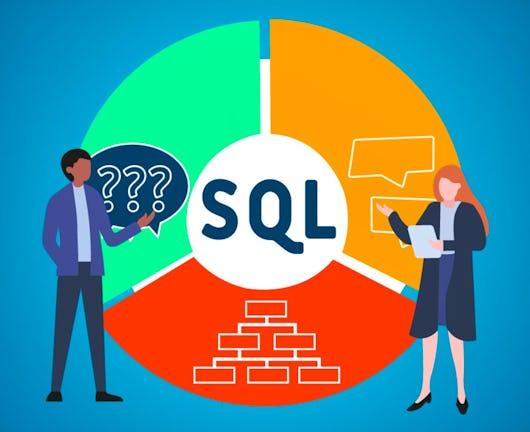
Over the last 3 decades, RDBMS has been a stable database for large global corporations and small business. Most employers mandate SQL skills as a necessary check in their recruitment process. As a software engineer, you will be required and be able to work with MySQL database to create, store, query and analyze data from RDBMS.
In this learning sprint, you will learn how to model data using the ER diagram. You will implement MySQL shell commands to perform CRUD operations. The hands-on exercises, in this learning sprint will also enable you to build RESTful APIs using Node.js and MySQL database.

WEEK 2
Minimizing Impedance Mismatch Using NoSQL Database
For a customer facing system of engagement, it is crucial to have a database that can handle unstructured and unpredictable data. NoSQL document database like MongoDB fulfills this criteria.
As a back-end programmer, you will be required to resolve the mismatch between the storage and application systems and accordingly model data to make processing efficient. In this learning sprint, you will identify steps to model data for MongoDB database. You will learn to setup MongoDB in local machines and perform CRUD operations using the shell commands. In addition, the hands-on exercises will help you gain experience with various techniques used to integrate MongoDB with Node.js RESTful APIs.
Go to Class
MOOC List is learner-supported. When you buy through links on our site, we may earn an affiliate commission.

Related Courses

Web Application Technologies and Django (Coursera) Coursera
University of Michigan

Web Application Technologies and Django (Coursera)

In this course, you'll explore the basic structure of a web application, and how a web browser interacts with a web server. You'll be introduced to the Hypertext Transfer Protocol (HTTP) request/response cycle, including GET/POST/Redirect. You'll also gain an introductory understanding of Hypertext Markup Language (HTML), as well as the overall structure of a Django application.

Jun 1st 2026
5-12 Weeks
Microsoft Azure Cosmos DB (Coursera) Coursera
Microsoft

Microsoft Azure Cosmos DB (Coursera)

In this course, you will learn the fundamentals of database concepts in a cloud environment, get basic skilling in cloud data services, and build your foundational knowledge of cloud data services within Microsoft Azure. You will explore non-relational data offerings, provisioning and deploying non-relational databases, and non-relational data stores with Microsoft Azure.

Jun 1st 2026
3 Weeks
Foundations: Data, Data, Everywhere (Coursera) Coursera
Google

Foundations: Data, Data, Everywhere (Coursera)

This is the first course in the Google Data Analytics Certificate. These courses will equip you with the skills you need to apply to introductory-level data analyst jobs. Organizations of all kinds need data analysts to help them improve their processes, identify opportunities and trends, launch new products, and make thoughtful decisions. In this course, you’ll be introduced to the world of data analytics through hands-on curriculum developed by Google. The material shared covers plenty of key data analytics topics, and it’s designed to give you an overview of what’s to come in the Google Data Analytics Certificate. Current Google data analysts will instruct and provide you with hands-on ways to accomplish common data analyst tasks with the best tools and resources.

Jun 2nd 2026
5-12 Weeks
Analyze Data to Answer Questions (Coursera) Coursera
Google

Analyze Data to Answer Questions (Coursera)

This is the fifth course in the Google Data Analytics Certificate. These courses will equip you with the skills needed to apply to introductory-level data analyst jobs. In this course, you’ll explore the “analyze” phase of the data analysis process. You’ll take what you’ve learned to this point and apply it to your analysis to make sense of the data you’ve collected. You’ll learn how to organize and format your data using spreadsheets and SQL to help you look at and think about your data in different ways. You’ll also find out how to perform complex calculations on your data to complete business objectives.

Jun 2nd 2026
4 Weeks
Building Web Applications in Django (Coursera) Coursera
University of Michigan

Building Web Applications in Django (Coursera)

In this course, you will learn how Django communicates with a database through model objects. You will explore Object-Relational Mapping (ORM) for database access and how Django models implement this pattern. We will review the Object-Oriented (OO) pattern in Python. You will learn basic Structured Query Language (SQL) and database modeling, including one-to-many and many-to-many relationships and how they work in both the SQL and Django models. You will learn how to use the Django console and scripts to work with your application objects interactively.

Jun 1st 2026
4 Weeks
Desarrollo del lado servidor: NodeJS, Express y MongoDB (Coursera) Coursera
Universidad Austral

Desarrollo del lado servidor: NodeJS, Express y MongoDB (Coursera)

En este curso trabajarás del lado servidor, en el backend, desarrollando el soporte que toda aplicación necesita para lidiar con la persistencia de la información, el setup de un servidor web, la creación de una API REST, autenticación y autorización, y la integración de librerías de terceros. Utilizarás Express para el servidor web, y una base de datos NoSQL orientada a documentos: MongoDB. Aprenderás de ODM con Mongoose y harás las típicas tareas CRUD sobre Mongo. Finalmente pondrás productivo tu sitio en Heroku.

Jun 1st 2026
4 Weeks
Big Data Integration and Processing (Coursera) Coursera
University of California, San Diego

Big Data Integration and Processing (Coursera)

At the end of the course, you will be able to: Retrieve data from example database and big data management systems; Describe the connections between data management operations and the big data processing patterns needed to utilize them in large-scale analytical applications; Identify when a big data problem needs data integration; Execute simple big data integration and processing on Hadoop and Spark platforms.

Jun 1st 2026
5-12 Weeks
Database Management Essentials (Coursera) Coursera
University of Colorado System

Database Management Essentials (Coursera)

Database Management Essentials provides the foundation you need for a career in database development, data warehousing, or business intelligence, as well as for the entire Data Warehousing for Business Intelligence specialization. In this course, you will create relational databases, write SQL statements to extract information to satisfy business reporting requests, create entity relationship diagrams (ERDs) to design databases, and analyze table designs for excessive redundancy.

Jun 1st 2026
5-12 Weeks