IBM COBOL Basics (Coursera)

Offered by IBM, LearnQuest,
IBM COBOL Basics (Coursera)

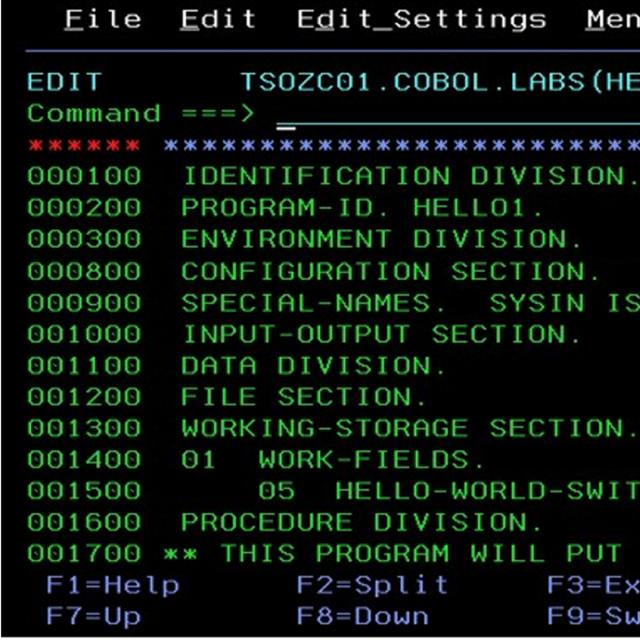
COBOL is a programming language that serves a wide range of businesses. Key aspects of COBOL are that it is scalable, mature, and self-documenting. In the Basics course you will learn about COBOL from its birth and through its evolution. You will have some basic lessons on handling numbers, symbols, editing, procedures, and the overall program structure. You'll even have the opportunity to create code of your own. Buckle up and join us on a ride through the world of COBOL, we can't wait to see you in class.

Class Deals by MOOC List - Click here and see Coursera's Active Discounts, Deals, and Promo Codes.

Course 2 of 7 in the IBM Mainframe Developer.

Syllabus

WEEK 1
Introduction to COBOL
Welcome to your first module in IBM COBOL Basics! This module will take the beginning steps in learning and using COBOL. As we navigate through, you will learn about the birth of COBOL, the purpose of COBOL, and who uses COBOL. We will then move to learning about the divisions of COBOL, its structure, and the purpose of the compiler.

WEEK 2
COBOL Components, Numbers, Data Types
Congratulations on making it through your first module! In this module, we’ll work on records of fixed and variable sizes, COBOL hierarchy, and clauses, wrapping up with some hands-on COBOL coding.

WEEK 3
Structure and Syntax
In this module we are going to get right to work and learn about scope terminators and how they’re used. Learn to code the Initialize statement and its purpose. Utilize I/O statements, move statements, use return-code, and compile and link simple programs.

WEEK 4
Arithmetic and Beautiful Numbers
Welcome to module four! Congratulations on making it to our final module of the course! In this module we learn the arithmetic behind COBOL, use of symbols and why they’re important for enhanced pictures, and perform data editing with numbers.

Go to Class
MOOC List is learner-supported. When you buy through links on our site, we may earn an affiliate commission.

Related Courses

An Introduction to Interactive Programming in Python (Part 1) (Coursera) Coursera
Rice University

An Introduction to Interactive Programming in Python (Part 1) (Coursera)

This two-part course is designed to help students with very little or no computing background learn the basics of building simple interactive applications. Our language of choice, Python, is an easy-to learn, high-level computer language that is used in many of the computational courses offered on Coursera. To make learning Python easy, we have developed a new browser-based programming environment that makes developing interactive applications in Python simple.

Oct 5th 2026
5-12 Weeks
Learn HTML and CSS (Coursera) Coursera
Scrimba

Learn HTML and CSS (Coursera)

This course is perfect if you want to learn how to code websites from scratch. You will learn the basics of HTML and CSS through interactive challenges. Along the way, you will build multiple projects, like a Google.com clone, a Space Exploration page, and a fun birthday site filled with GIFs. While most of the challenges are done in Scrimba's interactive editor, you will also learn how to use professional tools like VS Code for code editing, GitHub for hosting your code, and Netlify for deploying your projects to the world wide web.

Oct 12th 2026
5-12 Weeks
Computer Science: Algorithms, Theory, and Machines (Coursera) Coursera
Princeton University

Computer Science: Algorithms, Theory, and Machines (Coursera)

This course introduces the broader discipline of computer science to people having basic familiarity with Java programming. It covers the second half of our book Computer Science: An Interdisciplinary Approach (the first half is covered in our Coursera course Computer Science: Programming with a Purpose, to be released in the fall of 2018). Our intent is to demystify computation and to build awareness about the substantial intellectual underpinnings and rich history of the field of computer science.

Oct 5th 2026
5-12 Weeks
Introduction to Software, Programming, and Databases (Coursera) Coursera
IBM

Introduction to Software, Programming, and Databases (Coursera)

There are many types of software and understanding software can be overwhelming. This course aims to help you understand more about the types of software and how to manage software from an information technology (IT) perspective. This course will help you understand the basics of software, cloud computing, web browsers, development and concepts of software, programming languages, and database basics.

Oct 12th 2026
5-12 Weeks
Big Data Analysis with Scala and Spark (Coursera) Coursera
École Polytechnique Fédérale de Lausanne

Big Data Analysis with Scala and Spark (Coursera)

Manipulating big data distributed over a cluster using functional concepts is rampant in industry, and is arguably one of the first widespread industrial uses of functional ideas. This is evidenced by the popularity of MapReduce and Hadoop, and most recently Apache Spark, a fast, in-memory distributed collections framework written in Scala. In this course, we'll see how the data parallel paradigm can be extended to the distributed case, using Spark throughout.

Oct 12th 2026
4 Weeks
Estruturas de dados Python (Coursera) Coursera
University of Michigan

Estruturas de dados Python (Coursera)

Este curso apresentará as estruturas de dados centrais da linguagem de programação Python. Vamos superar os fundamentos da programação de procedimentos e explorar como podemos usar as estruturas de dados integradas do Python, como listas, dicionários e tuplas, para realizar análises de dados cada vez mais complexas. Este curso cobrirá os capítulos 6 a 10 do livro “Python para Todos”. Este curso aborda o Python 3.

Oct 5th 2026
5-12 Weeks
Parallel programming (Scala 2 version) (Coursera) Coursera
École Polytechnique Fédérale de Lausanne

Parallel programming (Scala 2 version) (Coursera)

With every smartphone and computer now boasting multiple processors, the use of functional ideas to facilitate parallel programming is becoming increasingly widespread. In this course, you'll learn the fundamentals of parallel programming, from task parallelism to data parallelism. In particular, you'll see how many familiar ideas from functional programming map perfectly to to the data parallel paradigm. We'll start the nuts and bolts how to effectively parallelize familiar collections operations, and we'll build up to parallel collections, a production-ready data parallel collections library available in the Scala standard library.

Oct 5th 2026
4 Weeks