EdX

Applications of TinyML (edX)

Applications of TinyML (edX)

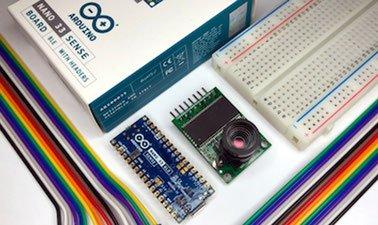
Get the opportunity to see TinyML in practice. You will see examples of TinyML applications, and learn first-hand how to train these models for tiny applications such as keyword spotting, visual wake words, and gesture recognition. Do you know what happens when you say “OK Google” to a Google device? Is your Google Home always listening? Following on the Foundations of Tiny ML course, Applications of TinyML will give you the opportunity to see tiny machine learning applications in practice. This course features real-world case studies, guided by industry leaders, that examine deployment challenges on tiny or deeply embedded devices.

Class Deals by MOOC List - Click here and see EdX's Active Discounts, Deals, and Promo Codes.

Dive into the code for using sensor data for tasks such as gesture detection and voice recognition. Focusing on the neural network of the applications, specifically on training and inference, you will review the code behind “OK Google,” “Alexa,” and smartphone features on Android and Apple . Learn about real-word industry applications of TinyML as well as Keyword Spotting, Visual Wake Words, Anomaly Detection, Dataset Engineering, and Responsible Artificial Intelligence.
Tiny Machine Learning (TinyML) is one of the fastest-growing areas of deep learning and is rapidly becoming more accessible. The second course in the TinyML Professional Certificate program, Applications of TinyML shows you the code behind some of the world’s most widely-used TinyML devices.
This course is part of the Tiny Machine Learning (TinyML) Professional Certificate.

What you'll learn

  • The code behind some of the most widely used applications of TinyML
  • Real-word industry applications of TinyML
  • Principles of Keyword Spotting
  • Principles of Visual Wake Words
  • Concept of Anomaly Detection
  • Principles of Dataset Engineering
  • Responsible AI Development

Syllabus

  • The TinyML Application Pipeline
  • Basics of Embedded Systems
  • Keyword Spotting, Visual Wake Words, and Anomaly Detection Applications
  • Dataset Engineering for effective TinyML
  • Responsible Machine Learning Development
Go to Class
MOOC List is learner-supported. When you buy through links on our site, we may earn an affiliate commission.

Related Courses

Machine Learning Use Cases in Finance (edX) EdX
Université de Montréal,UMontrealX

Machine Learning Use Cases in Finance (edX)

In the last six years, the financial sector has seen an increase in the use of machine learning models in financial, banking and insurance contexts. Data science and advanced analytics teams in the financial and insurance community are implementing these models regularly and have found a place for them in their toolbox.

Self Paced
Self-Paced
Data Science: R Basics (edX) EdX
HarvardX,Harvard University

Data Science: R Basics (edX)

Build a foundation in R and learn how to wrangle, analyze, and visualize data. This course will introduce you to the basics of R programming. You can better retain R when you learn it to solve a specific problem, so you’ll use a real-world dataset about crime in the United States. You will learn the R skills needed to answer essential questions about differences in crime across the different states.

Self Paced
Self-Paced
Deploying TinyML (edX) EdX
HarvardX,Harvard University

Deploying TinyML (edX)

Learn to program in TensorFlow Lite for microcontrollers so that you can write the code, and deploy your model to your very own tiny microcontroller. Before you know it, you’ll be implementing an entire TinyML application. Have you wanted to build a TinyML device? In Deploying TinyML, you will learn the software, write the code, and deploy the model to your own tiny microcontroller-based device. Before you know it, you’ll be implementing an entire TinyML application.

Self Paced
Self-Paced
Forecasting Techniques for Slow and Rapidly Changing Demand (edX) EdX
ISCEA

Forecasting Techniques for Slow and Rapidly Changing Demand (edX)

Master quantitative, judgmental and causal models used to forecast seasonal, intermittent, and new product future demand. Choose the right forecasting method for all kinds of demand patterns and sales data. Learn how to deal with randomness and low forecastability; missing data, outliers, and overfitting. Separate forecasting myths from reality and mitigate the risk of inaccurate forecasts.

Self Paced
Self-Paced
Data Science and Machine Learning Capstone Project (edX) EdX
IBM

Data Science and Machine Learning Capstone Project (edX)

Create a project that you can use to showcase your Data Science skills to prospective employers. Apply various data science and machine learning techniques to analyze and visualize a data set involving a real life business scenario and build a predictive model. Now that you've taken several courses on data science and machine learning, it’s time to put your learning to work on a data problem involving a real life scenario. Employers really care about how well you can apply your knowledge and skills to solve real world problems, and the work you do in this capstone project will make you stand out in the job market.

Self Paced
Self-Paced
Fundamentals of TinyML (edX) EdX
HarvardX,Harvard University

Fundamentals of TinyML (edX)

Focusing on the basics of machine learning and embedded systems, such as smartphones, this course will introduce you to the “language” of TinyML. What do you know about TinyML? Tiny Machine Learning (TinyML) is one of the fastest-growing areas of Deep Learning and is rapidly becoming more accessible. This course provides a foundation for you to understand this emerging field.

Self Paced
Self-Paced
AI skills for Engineers: Supervised Machine Learning (edX) EdX
Delft University of Technology,DelftX

AI skills for Engineers: Supervised Machine Learning (edX)

Learn the fundamentals of machine learning to help you correctly apply various classification and regression machine learning algorithms to real-life problems using the Python toolbox scikit-learn. Machine learning classification and regression techniques have potential uses in various engineering disciplines. These machine learning models allow you to make predictions for a category (classification) or for a number (regression) given sensor data, and can be used in, for example, predicting properties of objects (such as their weight or shape).

Self Paced
Self-Paced