FUN

La compta pour tous (FUN)

Offered by le cnam,
La compta pour tous (FUN)

Le Mooc « Comptabilité pour tous » a pour ambition de donner à des non spécialistes l’ensemble des outils permettant d'appréhender les états comptables, les rapports d'assemblée générale, les rapports des commissaires aux comptes lors d’une fusion, d’une augmentation de capital … de manière à être pro-actif dans le management de l'entreprise. En effet, comprendre la construction des états comptables permet d'assimiler le diagnostic, de bâtir ses propres outils de pilotage et de se fixer ses propres plans de progrès : la comptabilité est l'affaire de tous !

S’affranchissant de la technique comptable (le fameux journal) pour se centrer sur l’aspect décisionnel, ce Mooc se distingue de la plupart des enseignements existant en la matière et offre un panorama complet de l'impact des différents actes que peuvent prendre les entreprises sur les comptes de bilan et de résultat.

Ce cours a pour objectif d’apporter l’ensemble des outils permettant aux cadres en entreprises de :

  • Comprendre l’impact de l’ensemble de leurs décisions managériales dans les états comptables et financiers ;
  • Adopter le langage de l’ensemble des hommes et femmes du chiffre, et ainsi dialoguer avec les banquiers, les expert-comptables, les commissaires aux comptes, les avocats d’affaires, les actionnaires (fonds de pension) …
  • Défendre un projet d’entreprise (monter une nouvelle usine, justifier un investissement, monter un business plan, lever des fonds ….) ;
  • Suivre l’actualité de son entreprise et comprendre sa stratégie à long terme ;
  • Déchiffrer dans les comptes les faits et gestes de l’entreprise (augmentation de capital, fusion, scission, consolidation des comptes …) ;
  • Savoir déchiffrer les IFRS ;
  • Comprendre les rapports de gestion et poser les bonnes questions en assemblée générale.

Plan du cours

Semaine 1 : Impact de la création d’une société dans les états financiers

  • L’entité comptable
  • La comptabilité financière
  • Présentation du passif du bilan
  • Présentation de l’actif du bilan
  • Présentation du compte de résultat
  • Des statuts au bilan

Semaine 2 : La première année d’existence d’une société

  • La décomposition du chiffre d’affaires
  • La décomposition des charges dites courantes
  • Enregistrement comptable et impacts sur la création de richesse
  • Charges ou immobilisations ?
  • La taxe sur la valeur ajoutée

Semaine 3 : La clôture des comptes et notions de valeurs

  • L’inventaire et les notions de valeurs
  • Le concept de l’actualisation
  • Les stocks et leurs variations
  • Le concept d’amortissement
  • Le concept de dépréciation
  • Le concept de provision

Semaine 4 : La croissance interne des sociétés

  • Impact des acquisitions d’immobilisations corporelles dans les comptes
  • Impact des productions d’immobilisations corporelles dans les comptables
  • Impact des actifs incorporels dans les comptes
  • Les cas particuliers d’acquisitions d’immobilisations
  • Le délicat problème du démantèlement des entreprises polluantes

Semaine 5 : Les financements de la croissance interne

  • Les emprunts indivis
  • L’augmentation de capital : l’évaluation de la société
  • L’augmentation de capital proprement dite
  • Impact du subventionnement dans les comptes
  • Les cessions d’immobilisations

Semaine 6 : La croissance externe des sociétés et leurs financements

  • Les actifs financiers et la croissance externe
  • Montage d’un L. B. O. (première partie)
  • Montage d’un L. B O. (seconde partie)
  • Impact d’une fusion au bilan
  • Quels impacts comptables lors d’une introduction en bourse

Go to Class
MOOC List is learner-supported. When you buy through links on our site, we may earn an affiliate commission.

Related Courses

Introduction to Finance: The Basics (Coursera) Coursera
University of Illinois at Urbana-Champaign

Introduction to Finance: The Basics (Coursera)

In the Introduction to Finance I: The Basics course, you will be introduced to the basic concepts needed to understand the financial manager’s decision-making process. To achieve that, you will learn about the basic forms a business can take and the goal of the financial manager. You will also learn the fundamentals of financial statements and how to measure a company’s financial health using financial ratios.

Oct 5th 2026
4 Weeks
C'est quoi l'éco ? (FUN) FUN
ENS de Lyon

C'est quoi l'éco ? (FUN)

Chômage, mondialisation, dettes, crise, ubérisation : l’économie est partout dans les médias, mais les explications proposées ne sont pas toujours facilement compréhensibles. Pourtant, nous sommes tous des acteurs de l’économie : nous consommons, nous cherchons un emploi, nous épargnons (quand nous le pouvons). L’objectif de ce cours est de vous aider à dépasser le cadre d’analyse de simples expériences personnelles et acquérir des clés nécessaires à la compréhension du mode de raisonnement des économistes.

No sessions available
5-12 Weeks
Financement de l'innovation (FUN) FUN
Université de Montpellier

Financement de l'innovation (FUN)

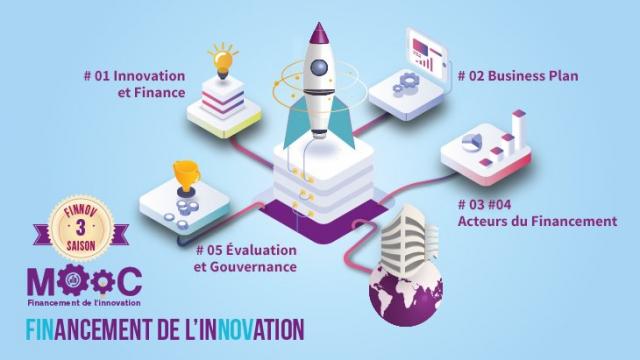
Ce MOOC est dédié au financement de l’innovation. L’enjeu est de taille, car sans capital, une idée, aussi innovante soit elle, ne peut se développer. Ce MOOC propose une approche pratique mais aussi une réflexion sur ces questions. Vous pourrez découvrir de nombreux témoignages de professionnels, permettant d’illustrer les vidéos de cours par des retours d’expériences.

Mar 10th 2022
5-12 Weeks
Introduction to Finance: The Role of Financial Markets (Coursera) Coursera
University of Illinois at Urbana-Champaign

Introduction to Finance: The Role of Financial Markets (Coursera)

In Introduction to Finance: The Role of Financial Markets, you will be introduced to the basic concepts and skills needed for financial managers to make informed decisions. With an overview of the structure and dynamics of financial markets and commonly used financial instruments, you will get crucial skills to make capital investment decisions.

Oct 12th 2026
4 Weeks
Behavioral Finance (Coursera) Coursera
Duke University

Behavioral Finance (Coursera)

We make thousands of decisions every day. Do I cross the road now, or wait for the oncoming truck to pass? Should I eat fries or a salad for lunch? How much should I tip the cab driver? We usually make these decisions with almost no thought, using what psychologists call “heuristics” – rules of thumb that enable us to navigate our lives. Without these mental shortcuts, we would be paralyzed by the multitude of daily choices.

Oct 12th 2026
3 Weeks
Financial Markets (Coursera) Coursera
Yale University

Financial Markets (Coursera)

An overview of the ideas, methods, and institutions that permit human society to manage risks and foster enterprise. Emphasis on financially-savvy leadership skills. Description of practices today and analysis of prospects for the future. Introduction to risk management and behavioral finance principles to understand the real-world functioning of securities, insurance, and banking industries. The ultimate goal of this course is using such industries effectively and towards a better society.

Sep 28th 2026
5-12 Weeks
Finance for Non-Financial Professionals (Coursera) Coursera
University of California, Irvine

Finance for Non-Financial Professionals (Coursera)

Impact your financial decisions and learn how to affect the performance of your unit's profitability and of your organization. In this course gain a basic understanding of finance and accounting concepts to drive your organization's growth. Upon completion of this course, you will have gained general financial knowledge and an in-depth understanding of the impact of your decisions outside your functional area. Content of the course includes selected aspects of finance from a non-financial specialist perspective. Specific topics include: financial analysis; planning, forecasting, and budgeting; cash flow, and strategic financing. This class will be interactive and will require the active involvement of the participants in finance related activities.

Sep 28th 2026
4 Weeks
Forecasting Financial Statements & Valuation for Accountants (Coursera) Coursera
University of Illinois at Urbana-Champaign

Forecasting Financial Statements & Valuation for Accountants (Coursera)

The objective of this course is to provide you with the knowledge and skills necessary to analyze, interpret, understand and use financial information to make informed decisions. We will discuss financial reporting from a user’s perspective, use a variety of tools to break apart financial reports into meaningful units for analysis, forecast financial statements, and value a firm. This course is intended to give you exposure to the issues facing users of financial statements. You will better understand your role in the financial reporting process if you know how the financial statements will ultimately be used.

Oct 12th 2026
5-12 Weeks
FinTech Law and Policy (Coursera) Coursera
Duke University

FinTech Law and Policy (Coursera)

Being a successful FinTech firm requires more than just great technology; it also requires an understanding of the laws and regulations applicable to your business. This course will provide you with that understanding. You will learn about the critical legal, regulatory, and policy issues associated with cryptocurrencies, initial coin offerings, online lending, new payments and wealth management technologies, and financial account aggregators.

Oct 5th 2026
5-12 Weeks
Finance of Mergers and Acquisitions: Designing an M&A Deal (Coursera) Coursera
University of Illinois at Urbana-Champaign

Finance of Mergers and Acquisitions: Designing an M&A Deal (Coursera)

This course focuses on the theory and practice of mergers and acquisitions (M&A), with a focus on the Finance. The Finance of M&A uses tools from different areas of Finance to help managers and investment bankers design successful M&A deals. In particular, we will learn to value and price M&A deals and how to choose the optimal financing mix for an M&A deal. The course focuses on all the major types of M&A deals including strategic M&A, private equity leveraged buyouts (LBOs), and restructuring deals such spinoffs and asset transfers.

Oct 5th 2026
4 Weeks